All students are held accountable to the policies and guides of the College. Please take some time to familiarize yourselves with the below information.
Guest Procedures
Guests are allowed in the halls as long as they comply with all Residence Life policies and procedures and do not disturb the normal operation of the building. Guests must carry the appropriate valid identification on them at ALL times and have access to their approved Guest Registration email if residing on campus after 10:00 PM. Guests must remain with their resident (host) at all times. Residents will be held accountable for the behavior and/or actions of the guest(s).
Each registered guest is allowed to stay on-campus no more than three (3) nights (consecutively or not) within a seven (7) day period. A night begins and ends at 10:00 PM. RCNJ residents are allowed to host up to two (2) guests at any given time. Guests may not move from host to host to stay on-campus more than three (3) nights.
Current RCNJ residential students do not need to be registered as a guest. All residents are responsible for their guests.
The College automatically assumes that all residents within a shared housing unit (room/suite/apartment) agree to permit their roommate, suitemate, or apartment-mates to register guests in their shared housing unit, without having to provide prior acknowledgment of those guests. However, residents have the right to opt-out of this automatic Guest Registration by contacting their Resident Assistant to facilitate a roommate/suitemate/apartment contract. As with any roommate/suitemate/apartment contract, if someone violates the terms of the contract, staff in the hall/area office must receive a formal complaint before they can act upon it. It is important to note that once a complaint is received for a particular room/suite/apartment, all residents of that space may lose guest privileges until they come together and a contract is developed.
It is essential that students adhere to the Occupancy Limit for Residence Units Policy for the assigned room/suite/apartment. It is the responsibility of roommates/suitemates to alert the host of the guest of any issues or concerns they may have concerning any guests or the amount of guests entering their room/suite/apartment. It is recommended that students have open conversations with roommates/suitemates about guest expectations.
Acceptable Identification
Any current government issued photo identification:
- Ramapo College ID for currently enrolled commuter students
- State Driver’s License
- State issued photo identification card
- Military Identification Card
- Permanent Resident Card
- Passport of any Country
Unacceptable Identification
Any forms of identification that are not government issued with a photo will not be accepted for guests:
- Any college identification, including Ramapo ID cards*
- General photo identification cards (i.e. – Work Identification cards, Volunteer Identification cards)
- Birth certificates
- Credit Cards of any kind (i.e. – Credit Card displaying the owner’s face)
- Expired government issued photo ID
Note: Expired identification cards are not acceptable forms of identification. Guest identification must not be expired.
*Currently Enrolled commuters with current RCNJ IDs may use their IDs. If a commuter is not found on the list, they will need to provide another form of acceptable identification.
Adult Guests (18+)
An Adult Guest is defined as anyone who is age 18 years or older and not assigned to an on-campus student residence room, suite, or apartment.
Examples of Guests:
- RCNJ Commuter Students
- RCNJ Former Students
- Non-RCNJ Students
- Non-RCNJ Family Members
These individuals need to complete the Guest Registration process if visiting on campus after 10 PM and can be registered any night of the week. All guests must remain with their hosts at all times. Guests must have access to the approved Guest Registration email and a valid form of identification.
Minor Guests (Under age 18)
A Minor is defined as a person under 18 years of age. Minor Guests are only permitted to visit on the weekends (Friday-Sunday).
Minors over the age of 14 must provide a current high school identification card. All other forms of acceptable Identification listed above will be sufficient as well.
Failure to adequately supervise guests who are minors may result in disciplinary action or termination of minor visitation privileges.
All guests, regardless of age, must abide by all Ramapo College rules and local, State, and Federal regulations and laws.
Guest Registration Availability and Submission
In order to have a guest(s) after 10 PM, the resident (host) must register their guest(s) by completing the Guest Registration Process at any Guest Registration kiosk in the Residence Halls. Guest Registration will be monitored daily by Public Safety and Residence Life Staff.
Guest Kiosk Locations are available to be filled out 24/7 here:
Bischoff Hall, Mackin Hall, Laurel Hall & The Overlook: First Floor Lobby of each Residence Hall
College Park Apartments: The Lodge
The Village: Thomases Commons
No one may use the guest procedure to evade paying proper residence hall charges. Guests may not move from host to host in order to stay on campus for more than the duration the policy states. Students and guests who are found to be in violation of these procedures will be documented by the Residence Life Staff or Public Safety Officers. Students who violate the Guest Policy may be referred to the Office of Student Conduct and may be subject to campus restriction ban. Individuals, such as runaways or others fleeing lawful parental authority, are not permitted as guests.
NOTE: Depending on the situation, the College reserves the right to change or limit guest procedures. Guest privileges will be revoked if actions impede the teaching and learning processes that are at the heart of the College’s mission. Guests’ personal behaviors should conform to the wishes of all the residents in the room/suite/apartment. It is the host’s responsibility to report the misconduct of guest(s) to the Department of Public Safety or Residence Life staff immediately. Any guest who may be in violation of a College Policy or impede the teaching and learning process that are at the heart of the College’s mission, may be asked to leave campus immediately and/or issued an immediate campus restriction ban.
Guest Restrictions
There are designated times throughout the year when guest privileges are more restricted in order to assist with Residence Hall operations. Below is a listing of these times and guest expectations and procedures. Residents who reside on campus may not use their residency to allow others to circumvent paying for housing.
| Time: | Policy: | More Information: |
| Fall Early Arrival
Check-in |
No Guests Permitted until check-in begins for designated building/ area | Residents in Early Arrival Housing who are approved to arrive to housing early due to an affiliation with a group on campus are not permitted to have guests.
|
| Thanksgiving Break
|
Guests Permitted.
Normal Guest procedures are followed. |
Residence Hall Offices work on a revised schedule. |
| Fall Semester Finals | Guests Permitted. Normal Guest procedures are followed.
|
It is important to note that it is 24-hour quiet hours during this time and residents should be mindful of peers who are studying or preparing for finals. Please review expectations regarding 24-hour quiet hours and residents are expected to hold their guests to the same standards. |
| Fall semester check-out extensions | No Guests Permitted. | Residents are approved for a check-out extension for academic related reasons. No guests are permitted. |
| Winter Interim Housing | Guests Permitted. Normal Guest procedures are followed. | Winter Interim Housing period is for students who reside on campus in order to work for the college, are international students, or are in-season athletes. Residence Hall Offices work on a revised schedule.
Winter Interim Housing residents do not have the authority to allow roommates/suitemates/apartment mates to move into residences prior to normally scheduled check-in date. A Student who is found violating this will be considered an Illegal Resident. Please reference the illegal resident procedures as listed below. |
| Spring Early Arrival Check-in | Guests Permitted. Normal Guest procedures are followed. | Residents in Early Arrival Housing, who are approved to arrive to housing early due to an affiliation with a group on campus, are permitted to have guests. Residence Hall Offices work on a revised schedule.
A resident cannot register a semester roommate/suitemate/ apartment mate as a guest during this time period. Spring Early Arrival residents do not have the authority to allow roommates/suitemates/apartment mates to move into residences prior to normally scheduled check-in date. A Student who is found violating this will be considered an Illegal Resident. Please reference the illegal resident procedures as listed below. |
| Spring Break
|
Guests Permitted. Normal Guest procedures are followed. | Residence Hall Offices work on a revised schedule. |
| Spring Semester Finals | Guests Permitted. Normal Guest procedures are followed.
|
It is important to note that it is 24-hour quiet hours during this time and residents should be mindful of peers who are studying or preparing for finals. Please review expectations regarding 24-hour quiet hours and residents are expected to hold their guests to the same standards. |
| Spring semester check-out extensions | No Guests Permitted. | Residents are approved for a check-out extension for academic related reasons. No guests permitted. |
| Summer School | Guests are Permitted | The Residence Hall Offices work on a revised schedule. Once a resident participates in the end of summer “all summer move-over “no guests are allowed until regular check-in begins for designated building/ area. This is regardless of Fall placement on campus. |
Guest Parking Procedures
Guests are allowed to bring their vehicles on-campus. Guests who will be parking a car on campus overnight will be required to compete the parking permit prompt on the kiosk after completing the Guest Registration process. Once a parking permit has printed, it must be placed on the dashboard of the car so the printed side can be visible from outside of the vehicle.
Guests may only park in designated Parking Lot D.
If a guest is only interested in visiting the campus for a couple of hours during the day, they should visit the Public Safety Booth at the front of the College for a day parking pass.
Guest Transportation Procedures
Guests are welcome to use both the RCNJ Shuttle and the NYC Port Authority Bus.
RCNJ Shuttle
They must be with their host at all times. All guests should have their Guest Registration Form available when riding the RCNJ Shuttle; they may be asked to present it. If a guest is using the RCNJ Shuttle to arrive from the train station, the host must be onboard the RCNJ Shuttle to meet him/her. The times and destinations for the RCNJ Shuttle are located on the Ramapo website.
NYC Port Authority Bus
Their ticket must be purchased with their host’s Ramapo ID at Roadrunner Central. A guest is not required to present a Guest Registration Form to ride the NYC Port Authority Bus.
Prohibited Residents
Prohibited residents are persons who visit residents’ rooms for long periods of time (for more than three days within a given week) or whose visitation violates the Guest Procedures in any way. Unregistered guests are considered “prohibited.”
If the Office of Residence Life staff, officers from the Department of Public Safety, or other College officials find someone who is living in a campus residence, but who is not authorized to be there, the “host” student (or students) may be charged the regular housing charge for the “guest” and the “host” may be charged with conduct violations. Violators may be fined and/or face judicial action.
Residents who are aware of a person(s) living on-campus without authorization or who is violating the Guest Policy, should notify their residence hall office staff as soon as possible. College Staff will be checking the Guest Registration database on a regular basis to ensure that all residents and guests are complying with the Guest Policy.
Occupancy Limit for Residence Units Policy
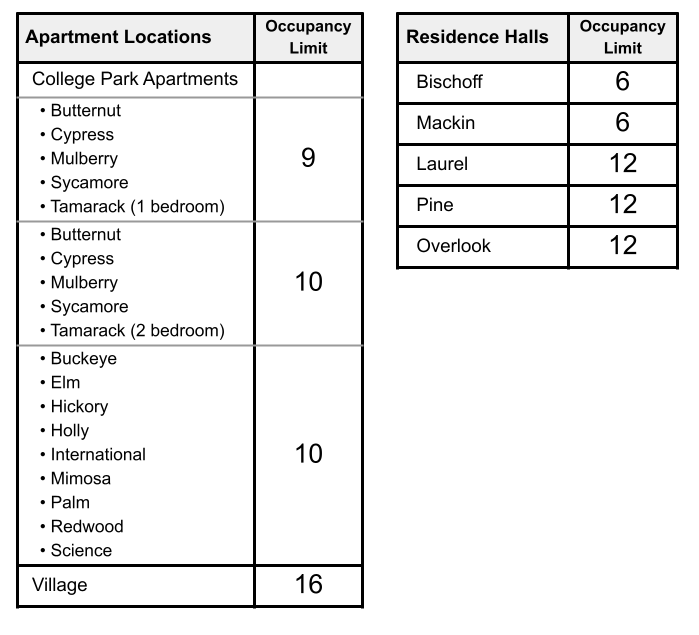
The following guidelines have been established to define Ramapo College’s occupancy limit for each residence unit (room, suite, and apartment) within our Residence Halls and Apartment Complexes. Occupancy limit is defined as the maximum number of persons permitted within a housing unit at any time, including residents assigned to the unit.
The chart below lists the occupancy limits:
Apartment Occupancy Limit
The Village:
- Sixteen (16) is the maximum number of persons permitted within a Village apartment.
The College Park Apartments:
- Nine (9) is the maximum number of persons permitted within a one-bedroom apartment in the following locations: Butternut, Cypress, Mulberry, Sycamore, and Tamarack.
- Ten (10) is the maximum number of persons permitted within a two-bedroom apartment in the following locations: Butternut, Cypress, Mulberry, Sycamore, and Tamarack.
- Ten (10) is the maximum number of persons permitted within the following apartment locations: Buckeye, Elm, Hickory, Holly, International, Mimosa, Palm, Redwood, and Science.
Residence Hall Occupancy Limit
- Six (6) is the maximum number of persons permitted within a Bischoff hall room.
- Six (6) is the maximum number of persons permitted within a Mackin hall room.
- Twelve (12) is the maximum number of persons permitted within a Laurel hall suite.
- Twelve (12) is the maximum number of persons permitted within a Pine hall suite.
- Twelve (12) is the maximum number of persons permitted within an Overlook hall suite.
Click here to see the Occupancy Limit for Residence Units Policy Chart
Should College Staff observe the number of persons present in a residential unit exceeding the occupancy limit, it will lead to an immediate dispersal of the gathering by having all persons not residing in the unit vacate the space. The incident will be documented and referred to the Office of Student Conduct for disciplinary action. Please also see related policies: Alcohol, Cannabis, Other Drugs, and Good Samaritan Policy (Link).
Outdoor Congregations:
In addition to interior occupancy limits, the following guidelines are in place for exterior areas: Obstruction of the free flow of pedestrian or vehicular traffic on College premises or at College-sponsored or supervised events or activities is prohibited. Additionally, congregating in front of buildings/apartment entrances, stairwells, and balconies/landings is prohibited. Individuals or groups who obstruct the free flow of others will be instructed to clear the area and may be referred to the Office of Student Conduct for disciplinary action.
CURRENT STUDENT HOUSING WITHDRAWAL FORM
- All students who wish to withdraw from housing must complete this form.
- Students who voluntarily withdraw from housing, students who are administratively withdrawn from housing or students who lose housing as a result of a judicial sanction must reapply for any future housing requests, as their guaranteed housing status is no longer in effect. Once a student is withdrawn from housing, they are considered a commuter student.
- Students who withdraw from housing and later decide they would like to return to housing must reapply by submitting a commuter housing application and a $200 non-refundable housing deposit. This application may be obtained by e-mailing reslife@ramapo.edu. The $200.00 non-refundable housing deposit must be submitted to the Student Accounts Office. Once your application is received and your deposit is paid, your name will be added to the commuter list. Please note: housing is not guaranteed.
- Before students submit a housing withdrawal form, all belongings must be removed from their room/suite/apartment. Any personal items left in their room/suite/apartment will be considered abandoned and will be discarded. Once a withdrawal form is submitted, it goes into effect immediately.
- Students will be responsible for all housing charges until they have officially completed all check out procedures and withdrawal processes. Students who do not properly follow the check out procedures will be charged a $75 fee for an improper check-out.
- No refunds will be issued for housing or dining plan changes after the 50% refund deadline. Please review the academic calendar on the College website for refund deadlines.
- Requests for forwarding mail will be honored for two weeks (first class mail only). In order for students’ mail to be forwarded, they must fill out forwarding address labels (contact hall/area office for details). After two weeks, mail will no longer be forwarded and will be returned to sender.
- Students who have been granted an approved Medical Leave of Absence (MLOA) must obtain and submit a Temporary Withdrawal Form by emailing the Office of Residence Life. Although, students are guaranteed housing, we are unable to guarantee specific housing assignments. The students’ age as well as credits (on file at the time of placement) will be taken into consideration.
- Students who are withdrawing from housing for Military obligations or a Study Abroad program through Ramapo College must submit a housing withdrawal form and a Temporary Withdrawal Form if they wish to return to campus housing. This form must be submitted to the main Office of Residence Life. Although, students are guaranteed housing, we are unable to guarantee specific housing assignments. The students’ age as well as credits (on file at the time of placement) will be taken into consideration.
- Housing deposits are non-refundable and will be forfeited. Students are encouraged to review their account on-line within four business days to see if the forfeited housing deposit has created a balance on their account or increased a current balance.
Prohibited Items and Conduct List
When it comes to residence hall safety, certain items and actions can compromise the safety of the residential community. If uncertain about a particular item or action listed below, you are encouraged to bring such items to your RA Office who may refer you to the College Fire Marshal in instances of Fire Safety for additional assistance.
Any prohibited items found in the possession of a student may be confiscated. Confiscated items may not be returned and students will not be compensated for confiscated prohibited items. Residence Life Policy states that: Prohibited items will result in an immediate fine starting at $50.00 per item for each resident who is deemed to be responsible for the violation. Multiple items can increase the fine. Additional fines and other disciplinary sanctions may result if additional violations are found upon subsequent and/or follow-up inspections.
FIRE SAFETY
All residents are responsible for adhering to Ramapo College Fire Safety Policies and the New Jersey Uniform Fire Code. Students and staff living in residential housing on campus are expected to follow all policies. Residents may not have prohibited items in campus housing facilities and should be aware of the possible sanctions for violations of the prohibited items list, including prohibited conduct. Staff includes RAs, professional staff in residence, and Faculty/Staff Licensees. In addition to sanctions imposed by the College, violators may also be responsible for fines assessed by the New Jersey Division of Fire Safety.
All residence halls and apartment units are subject to periodic fire and safety inspections and students are expected to cooperate in removing any found violations when requested by the Public Safety, the RCNJ Fire Marshal, the NJ Division of Fire Safety, or the College Administration. The College may require personal furniture or furnishings to be removed from any residence when it determines the situation to be a fire, safety, or health hazard. Under no circumstance should furniture restrict free and easy movement within the room, suite, hallway, or apartment areas, or block egress in any way.
Test Your Knowledge by Taking Our Policy Quiz
PROHIBITED ITEMS LIST:
- Air conditioners (both window and portable units)
- Ammunition/Gun Powder/Black Powder/Primers
- Animals
- Cooking Appliances
- Mug warmers
- Popcorn makers
- Pressure cookers
- Deep fryers
- Grills and barbecues
- Refrigerators (in addition to the College provided refrigerators or micro-fridges)
- Water coolers (with refrigeration/heating elements)
- Other Appliances with exposed heating elements. A general test of this rule is if the element or metal surface that produces the heat is exposed and is hot to the touch, the appliance is prohibited. Exceptions: Irons, Curling Irons
The following items are only permitted in apartment-style housing assignments. Appliances must be placed on the kitchen counter next to the stove or on a separate table immediately adjacent to the kitchen. They are prohibited in traditional residence halls, which include Pine, Laurel, Mackin, Bischoff, and Overlook:
- Air Fryers
- Coffee makers with hot plates
- Crockpots
- Countertop grills (George Foreman-style grills and/or panini makers)
- Electric skillets
- Hot plates
- Instant pots
- Microwaves (only the College provided microwave is permitted in any housing assignment)*
- Rice cookers
- Toasters and toaster ovens
- Waffle makers
*Note: Butternut and Tamarack do not come equipped with microwaves. Students assigned to these buildings may bring their own microwave if they wish.
- Candles (lit or unlit):
- Any type of candle capable of producing a flame is prohibited, even if it has never been used.
- Candle warmer and wax warmer.
- Sage and other smudging materials.
- Chafing Dish Fuel
- Prohibited in residence halls and apartments (unless provided by the College for an approved event).
- Decorations
- Message Boards are not permitted on dwelling unit doors. Dry-erase boards, chalkboards, and similar message boards may not be placed or attached to the exterior of suite or apartment doors.
- “In Group R-2 dormitories, within sleeping units and dwelling units, the permissible amount of curtains, draperies, fabric hangings, and other similar decorative materials suspended from walls…shall not exceed 50 percent of the aggregate wall areas…”
- No cardboard of any kind may be placed on the walls
- Hanging anything on or from a fire sprinkler head, fire sprinkler pipe, smoke detector, or alarm device.
- Hanging anything from the ceiling or windows is prohibited.
- Signs, posters, lights, or decorations on the exterior of buildings or attached to window panes are prohibited.
- Decorations cannot hang over air vents.
- Small signs and decorations may be applied to the exterior of sleeping and dwelling unit doors. Signs must not cover more than 5% of the door, must be attached with removable adhesive (not mechanical fasteners), must not obstruct the operation of the door, and must not further compromise the integrity of the fire-rated assembly or contribute to fire development.
- Village and CPA only: No hanging of flags/tapestries in the kitchen or within 36 inches of the stove.
- Large Exercise equipment
- Treadmills, walking pads or other large or motorized exercise equipment
- Extension Cords, Multi-Plug Adapters (Certain Power Strips/Surge Protectors)
- Extension cords and any devices that have the potential to overload electrical receptacles.
- You are required to use power strips or surge protectors with circuit breakers that automatically shut off when overloaded.
- DO NOT plug additional surge protectors into adapters as this would be an electrical issue.
- Power strips and surge protectors may not be “piggy-backed” or used with one plugged into another. Power strips must be plugged directly into an electrical outlet.
- Certain types of multi-outlet power strips or surge protectors are prohibited. To be allowed, the surge protector must meet the following regulations:
- Must be corded with a maximum cord length of 12 feet
- Provide 600 or more joules of protection
- Ensure compliance with UL 1449 or equivalent standards
- Have a maximum of eight outlets (USB Ports not included)
- Have an independent on-and-off circuit breaker or reset switch
- Surge protectors cannot be tied (or Ziptied) or otherwise attached to furniture such as the bed frame or other items.
- Fireworks/Explosives/Incendiary Devices
- Fireworks are defined as “Any device…intended to produce visible and/or audible effects, by combustion, deflagration, or detonation.”
- While the following items are now authorized in New Jersey for sale, possession, and use, by persons 16 years of age or older, they are prohibited in all facilities on campus:
- Sparklers
- Snakes and glow worms
- Smoke devices
- All fireworks that shoot into the air and/or explode, such as firecrackers, roman candles, bottle rockets, skyrockets, M-80s, and other such items are illegal in New Jersey and are subject to fines and penalties under NJ Statutes.
- Flame Producing Devices
- Except in labs and other permitted areas or as otherwise approved in the Hot Work Policy.
- Anything that produces a flame is not allowed
- Flammable Liquids/substances
- All flammable, hazardous, and toxic liquids/substances including gasoline, motor oil, grill starter fluid, charcoal briquettes, propane, photographic development chemicals, flammable automotive products, tires, pesticides, paint thinners, etc.
- Flammable liquids are prohibited in on-campus student housing facilities. Items powered by flammable liquids such as mopeds, motorcycles, golf carts, or similar vehicles are prohibited.
- Flammable liquids are only approved in permitted areas by the RCNJ Fire Marshal if stored in approved flammable liquid safety cabinets.
- Fog Machines
- Any products including dry ice that produce mist, fog, smoke, or simulated smoke conditions.
- Furniture
- Upholstered, padded, or cushioned furniture, including beanbag chairs (or similar items) that are not affixed with certified (attached tag) documentation from the manufacturer as being flame-retardant are prohibited. The required flame-retardant certification is California Tech. Bulletin 117.
- Large items such as couches, oversized beanbag chairs, etc. may be prohibited at the discretion of the College Fire Marshal, even if they meet the above certification.
- Waterbeds are prohibited.
- Non-College-issued mattresses are prohibited. Apparatuses, or kits designed to extend the size of your bed are prohibited.
- Entertainment/Fitness Poles and/or Aerial Equipment are prohibited.
- Hammocks
- Inside or outside of residence halls, due to risk of injury or damage to property.
- Hoverboards/Electric Scooters/Electric Bicycles/Onewheel
- Use and/or storage (including charging) on campus is prohibited.
- Electric bikes may not be stored inside buildings.
- Humidifiers and Ultrasonic Essential Oil Misters/Diffusers
- Only permitted with medical necessity. The student must discuss the need with OSS who will refer the situation to the Fire Marshal. May require smoke detector heads to be replaced.
- Immersion Coils
- Incense
- Paraphernalia and similar items
- Potpourri burners
- Laser Engraver Machines/3-D Printers
- Lighting
- Dimmers, ceiling fans, or any device that replaces, adds to, or interferes with College fixtures.
- Halogen lamps and sun/heat lamps
- Oil Lamps
- Lava Lamps
- String lights or strip lights—whether LED, USB-powered, or designed to plug into an AC outlet (such as a wall socket or surge protector)—are prohibited in all campus housing. Only standalone, battery-powered string lights with no USB or other power connection options are permitted.
- Lofts
- Bed risers, cinderblocks, and lofted furniture of any kind
- Recalled products at the discretion of the RCNJ Fire Marshal
- Ring doorbells or other electronic devices that photograph, videotape, film, digitally record, or by any other means, to secretly view another person without that person’s consent in any location is not allowed.
- Room partitions, dividers, or bed canopies
- Smoking Paraphernalia
- The presence and/or use of hookahs or illegal smoking paraphernalia in any on-campus student housing facility is prohibited.
- Space Heaters
- Unless provided by Facilities
- Swimming Pools and Hot Tubs
- Inside or outside of residence halls
- Thermometers containing mercury
- Vegetation (decorative)
- Natural trees and wreaths are prohibited.
- Large-size artificial trees and other decorations are also prohibited.
- Weapons
- Knives, rifles, handguns, paintball guns, etc. Real or imitation
- Stun Guns, Tasers, Pepper Spray.
- Spears, Daggers, or Swords
- Other weapons of any kind, even if they are presumed to be solely decorative or collectible. o Weapons that are props used for stage productions in the campus theaters are permitted only in those theater rooms but not in other areas of the campus.
- Nerf weapons, water balloon launchers/slingshots, and similar projectile toys
PROHIBITED CONDUCT:
- Aerosol Product Use
- The use of aerosol products may activate the fire alarm system. The use of these products in a manner that may activate the alarm is prohibited in all residences. This includes hair or body sprays, cleaning products, scented misters, etc. Keep the use of such items in the bathrooms when possible and limit the quantity and direction of the spray away from any smoke detectors.
- Blocking Egress
- Failure to maintain a minimum 36” clearance in the path of egress
- Obstructing and/or blocking EXIT doors
- Propping open fire and smoke doors with wedges and other objects
- Taping over door latches to prevent doors from locking
- Storage behind doors that would prevent complete opening to 90°
- Fire Alarm Activations
- Deliberately causing false fire alarms
- Failure to evacuate during a fire drill
- Fire Equipment Damage
- Breaking a sprinkler head
- Covering or disabling smoke detectors or any other fire devices
- Removing smoke detectors or covers
- Tampering with or damaging fire EXIT lights and/or pull stations
- Tampering with, or damaging fire extinguisher(s) or sprinkler control valves
- Flushable Wipes
- Flushable and/or disposable personal body wipes are not to be flushed down toilets in the Residence Halls.
- Mischief
- Physical activities such as hockey, ball throwing/bouncing, skateboarding, frisbee, etc. that take place near fire suppression and alarm systems, may cause unintentional activations.
- Illegal Parking
- Blocking fire department connections (FDCs)
- In any designated fire zones
- Within 10 feet of a fire hydrant
- Smoking
- Prohibited indoors or anywhere within 25 feet of any building including outdoors, on patios, or balconies.
- Use of Hookahs, vapes, and/or e-cigarettes in any campus building is prohibited. Vapes and E-cigarettes may be used outside in accordance with the campus smoking policy.
- Sports in the Residence Hall
- All sports activities are prohibited inside and in the immediate vicinity of all residence halls, including but not limited to football, darts, wrestling, boxing, hockey, soccer, basketball, baseball, frisbee, water balloon fights, and skateboarding.
ALLOWED ITEMS LIST:
The following are a few of the items that are permitted in both traditional residential buildings and apartment-style housing assignments:
- Animals
- Pet fish in a fish tank not exceeding 10 gallons are permitted.
- Appliances
- Blenders
- Small countertop/portable ice makers
- Residential coffee makers (with an auto-shut-off)
- Hot water/tea kettles (with auto-shutoff)
- In an approved area, appliances must be placed on the kitchen counter next to the stove or on a separate table immediately adjacent to the kitchen.
- Humidifiers, Air Purifiers and Ultrasonic Essential Oil Misters/Diffusers
- Only permitted with medical necessity. The student must discuss the need with OSS who will refer the situation to the Fire Marshal. May require smoke detector heads to be replaced.
- Air Purifiers are permitted.
- Reed oil diffusers are permitted.
- Electric Bicycles
- Electric bikes may be stored outside in approved bike racks.
- Furniture
- Small furniture items that meet California Technical Bulletin 117 (CAL 117) are acceptable. Examples would be folding padded butterfly or hang-a-round style chairs, gaming chairs, etc.
- Imitations candles
- Non-wax-based, that are flameless, or battery-operated.
- Lighting
-
- Only battery-operated string, rope, or strip lights—without any other power connectors (including USB)—are permitted. String, rope, or strip lights with a USB connection option are prohibited.
- Lamps
- Floor and table lamps using incandescent, fluorescent, or LED light bulbs are permitted.
- Plug Adapters (cube adapters)
- USB charging adapters attaching directly to the wall socket and containing no more than 2 AC outlets are permitted.
- Surge Protectors (that meet the following requirements)
- Must be corded with a maximum cord length of 12 feet
- Provide 600 or more joules of protection
- Be UL 1449 compliant or equivalent standards
- Have a maximum of eight outlets
- Have an independent on/off circuit breaker or reset switch
- Vegetation (decorative)
- Small tabletop living plants and flowers are permitted in containers of 1 gallon or less. Plants shall be checked regularly for dryness. Small artificial plants and decorative wreaths are permitted
Additionally, RCNJ reserves the right to have students or resident staff remove from campus any item that is not listed but deemed to be a fire or health and safety hazard by Residence Life, the Department of Environmental Health and Safety, the College Fire Marshal, and/or the State Fire Marshal.
*Policies are subject to change at any time by order of the RCNJ Fire Marshal, Student Conduct, and Residence Life.