September 23, 2026Highlight Your Internship Story: Genaro Sanchez Feliz
Welcome to the DMC’s Highlight Your Internship Story series, where we showcase the impressive work our students are doing during their internships. These stories highlight how hands-on experience is helping them grow professionally and launch successful careers in tech.
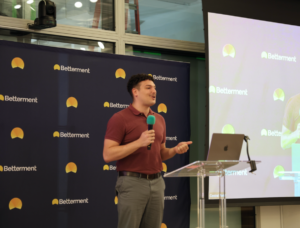
Congratulations to Genaro Sanchez Feliz, Data Science major at Ramapo! This summer, Genaro worked as a Software Engineering Intern at Betterment on the Advisor Solutions team, developing technology that helps financial advisors. He worked on projects focused on improving financial workflows and automating internal processes. This opportunity gave Genaro hands-on software engineering experience while introducing him to the fintech industry, as well as the opportunity to present his work to colleagues and company leadership.
If you are in any of the DMC majors – Computer Science, Data Science, Cybersecurity, Mathematics, and Bioinformatics – and would like to be featured, please contact Dr. Al-Juboori (aaljuboo@ramapo.edu) or Dr. Frees (sfrees@ramapo.edu)!
Categories: Data Science, Internship Story, MSDS
March 24, 2026Ramapo DMC - CFA Infrastructure Internship
Ramapo DMC / Center for Food Action Internship Opportunity
The DMC Center has one paid internship opening on the Center for Food Action (CFA) Data Excellence project — one of the DMC’s flagship Community Impact Projects. This intern will join an active student development team and take on a foundational role: unifying a growing suite of real-world applications into a cohesive, production-ready infrastructure. Read on for project details and how to apply.
About the Center for Food Action
The Center for Food Action is a New Jersey nonprofit providing food assistance and support services to thousands of families across Bergen and Passaic counties. CFA operates multiple pantry locations and relies on accurate data to run its operations, report to funders, and serve its clients effectively.
The DMC Center has been building CFA’s data infrastructure since Phase 1 — a time-series inventory database, a pricing module, a barcode scanner for bulk donation intake, and an analytics dashboard. Phase 2 has expanded that work significantly, with a dedicated team of student interns building applications now actively in use at CFA’s Mahwah and Saddlebrook locations.
The Existing Team
This intern joins a team of three active Phase 2 interns, each working on a distinct application strand:
- Inventory intake and barcode scanning — integrating the DMC scanner directly with PantrySoft via API to automate donation data entry at the warehouse level
- In-kind donor tracking — streamlining drop-off intake, generating electronic confirmations, and pricing donations using the Phase 1 pricing module
- Service analytics and data reporting — working directly with CFA staff across locations to build and refine reports that drive operational decisions
These applications were developed rapidly to meet real CFA needs. The new intern’s role is not to add another application strand — it is to step back and work at the infrastructure level to unify what has been built into a platform that can be maintained, extended, and deployed more broadly.
What You’ll Be Working On
A significant pattern emerging across the DMC’s Community Impact Projects is that common functional building blocks — user account management, intake workflows, automated notifications, reporting, and data export — are appearing independently in multiple applications built for different organizations. The intern in this role will work to identify, consolidate, and standardize these shared components into a coherent shared architecture.
This work has direct real-world stakes: the DMC is actively deploying applications to additional nonprofit partners, and a unified infrastructure dramatically reduces the cost and effort of each new deployment.
Primary Responsibilities
- Audit the existing CFA application suite — codebase review, dependency mapping, documentation of current architecture across all active apps
- Identify duplicated logic and overlapping patterns across applications (authentication, communications, reporting, data models)
- Re-architect shared components into reusable modules with clean, well-documented interfaces
- Improve deployment infrastructure — environment consistency, configuration management, and deployment workflows across hosted applications
- Collaborate with the existing intern team to ensure refactored components integrate cleanly with their active work
- Contribute to technical documentation to support long-term maintainability
Stretch Goals
- Help extend the unified architecture to support deployment to additional DMC partner organizations (FCDC, CUMAC, and others in the pipeline)
- Contribute to the Shared Pricing Module — a reusable pricing component with applications across CFA, MEVO, and other DMC partners
Internship Details
- Start Date: May 2026 (flexible)
- Duration: 12–15 weeks
- Hours: 15 hours/week
- Scheduling: Flexible; may extend into summer as needed
- Location: Primarily remote; some on-site visits to CFA Mahwah may be expected
Who Should Apply
Applicants should be current sophomores or juniors in Computer Science, Cybersecurity, or Data Science. Programming experience is required; web application development experience is strongly preferred. The skills below reflect preferred background — not requirements. Breadth and a systems-level mindset matter more than any single tool.
Preferred skills:
- Web application development (Node.js preferred; other frameworks welcome)
- Database design and SQL
- General full-stack experience
- Experience reading and working within an existing codebase
- Version control (Git)
Significant pluses:
- Interest in software architecture, refactoring, or platform thinking
- Deployment and DevOps experience (Linux, nginx, environment configuration)
- Prior internship or project work outside coursework
- Cybersecurity coursework or experience
How to Apply
Email sfrees@ramapo.edu with the subject line: “CFA Internship Application”
Include:
- A brief introduction — your name, class year, and major
- A short paragraph on why this project interests you
- A summary of relevant skills and experience (coursework, projects, jobs, or certifications)
- A current résumé or CV
Applications are reviewed on a rolling basis. Apply early — the position will be filled as soon as the right candidate is identified.
Categories: Community Impact Feature, Uncategorized
March 23, 2026Ramapo DMC - MEVO Internship
Ramapo DMC / MEVO Internship Opportunity
The DMC Center has one paid internship opening supporting MEVO, a New Jersey-based nonprofit inspiring community action for a healthier environment. This engagement is part of the DMC Center’s broader Community Impact Projects initiative, which partners students with nonprofits and community organizations to build real software solving real problems. The intern will work on an existing volunteer management platform and take the lead on building a brand-new Harvest Tracking Application for MEVO’s farm operations. Read on for project details and how to apply.
About MEVO
MEVO is a New Jersey nonprofit dedicated to inspiring and empowering people to take action for a better environmental future. Through programs ranging from community trail work and farm-to-school partnerships to active farm operations and environmental education, MEVO mobilizes hundreds of volunteers each year in support of its mission.
MEVO operates farms as a core part of its programming — growing produce, supporting food access initiatives, and connecting communities to the land. The organization needs modern digital tools to manage its volunteers and track its agricultural output accurately and efficiently.
The DMC Center has been building MEVO’s volunteer management platform and is now extending that work into a fully integrated harvest tracking system. This intern will be a key contributor to both efforts.
What You’ll Be Working On
The DMC Center is partnering with MEVO to operationalize and extend their volunteer management application, build robust reporting tools, and — most significantly — develop a new Harvest Tracking Application for MEVO’s farm operations. Work is organized across three areas, with the Harvest App as the central deliverable.
Work Area 1: Volunteer App Refinements
The existing volunteer management application is a functional prototype. This area covers refinements to move it toward production readiness for MEVO’s spring event season.
- Password reset and account recovery flows
- Electronic liability / waiver form support at signup
- Mobile UX polish for staff roster and check-in/check-out views
- Shareable per-event registration links and QR codes for MEVO website embedding
- Admin account management improvements and bug fixes
Work Area 2: Export & Reporting Tools
MEVO needs structured exports for year-end reporting, grant applications, and volunteer hour verification. The data is already being captured — this area builds the reporting layer on top of it.
- Year-end volunteer summary export to Excel (total hours per volunteer, all events)
- Per-event roster export with hours logged
- Event cleanup data export (weights, item counts, notes)
- Printable volunteer hours certificate — single-page view per volunteer
- Admin reporting dashboard with summary statistics
Work Area 3: Harvest Tracking Application (Primary Focus)
This is the centerpiece of the engagement — a brand-new application module built alongside the existing volunteer platform. MEVO needs to track what is harvested at each farm session: produce types, quantities, locations, and dates.
- Farm / location management — define and manage MEVO’s farm sites
- Produce type catalog — maintain a list of vegetables, fruits, herbs, and other produce
- Harvest event creation — record date, farm location, and staff present
- Harvest recording UI — log quantities by produce type per session, supporting multiple units (lbs, count, bundles)
- Harvest history — browse and filter past harvests by farm, date, and produce type
- Harvest reports and Excel export — summary views by season, farm, or produce type
- Database schema design and migrations
- Integration with the DMC Shared Pricing Module — a reusable pricing component extracted from the DMC’s Center for Food Action project (stretch goal)
Internship Details
- Start Date: Late March / Early April 2026 (flexible)
- Duration: 12–15 weeks
- Hours: 15 hours/week
- Scheduling: Flexible; may extend into summer as needed
- Location: Primarily remote with periodic on-site coordination
Who Should Apply
Applicants should be current juniors in Computer Science or Data Science, as this project may extend or continue into the following year. The skills below reflect preferred background — not requirements. Breadth of experience matters more than mastery of any single tool.
Preferred skills:
- Web application development (Node.js preferred; other frameworks welcome)
- Database design and SQL
- General full-stack experience
- REST API design
Significant pluses:
- Excel / data export experience
- Mobile-first UI development
- Interest in environmental or nonprofit work
- Prior internship or project work outside coursework
How to Apply
Email sfrees@ramapo.edu with the subject line: “MEVO Internship Application”
Include:
- A brief introduction — your name, class year, and major
- A short paragraph on why this project interests you
- A summary of relevant skills and experience (coursework, projects, jobs, or certifications)
- A current résumé or CV
Applications are reviewed on a rolling basis. Apply early — the position will be filled as soon as the right candidate is identified.
Categories: Community Impact Feature, Uncategorized
March 23, 2026DMC Fair 2026
Center for Data, Mathematical, and Computational Sciences Fair
Tuesday, April 28, 2026, 5:00–7:00 PM
Trustees Pavilion
Ramapo College of New Jersey
Join us for the Data, Mathematical, and Computational Sciences (DMC) Fair on April 28, 2026. This event will feature keynote speaker Eric Thorsen, entrepreneur, technologist, and executive coach with over 30 years of experience at the intersection of business and technology.
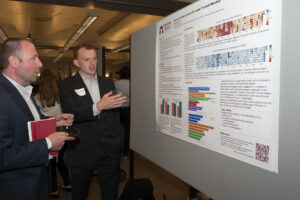
The event will also feature poster presentations from our students’ Senior Capstone projects and Masters Thesis, and is preceded by the DMC Community College Day (see below).
Keynote Speaker: Eric Thorsen
AI, Careers & Your Future: Navigating the New Landscape
Eric Thorsen is a seasoned entrepreneur, technologist, and executive coach with over 30 years of experience at the intersection of business and technology. He founded Thortech, a software consulting firm whose data analytics platform powered live U.S. election coverage for major media networks for over two decades.
Today, Eric is the CEO and cofounder of Clarion Collective AI, helping business leaders turn AI uncertainty into a competitive edge. As a certified executive coach and father of a college-bound student interested in Data Science and Computer Science, Eric brings a unique perspective on how AI is transforming careers — and what it means for students entering the workforce.
His talk will explore:
- How AI is genuinely changing the job market (and how it isn’t)
- What employers are really looking for in new graduates
- Practical strategies for students navigating an AI-driven world
- Why the future is brighter than the headlines suggest
The talk will conclude with a Q&A session.
Register Now
This event is open to current students, prospective students, faculty, staff, industry professionals, and members of the public.

Event Schedule
Food will be served during the student poster and networking reception starting at 6pm.
| Time | Event |
|---|---|
| 5:00 PM | Guests Arrive |
| 5:05 PM | Opening Remarks – President Cindy Jebb |
| 5:10 PM | Overview of DMC Programs |
| 5:15 PM | Keynote: Eric Thorsen |
| 6:00 PM | Student Poster Session & Networking Reception |
| 6:40 PM | Voting Closes |
| 6:50 PM | Poster Awards Ceremony |
| 7:00 PM | Event Concludes |
Call for Poster Submissions — Open Regionally!
This year, we’re expanding our poster session beyond Ramapo! We invite students from colleges and universities throughout the region to showcase their research.
Eligible Fields:
- Computer Science
- Data Science
- Mathematics
- Cybersecurity
- Related disciplines
Important Dates
| Milestone | Date |
|---|---|
| Abstract Submission Deadline | March 23, 2026 |
| Notification of Acceptance | April 1, 2026 |
| Final Posters Due | April 14, 2026 |
Accepted posters will be printed by Ramapo College free of charge (though submitters are welcome to bring their own).
Posters are not due until after you’ve been notify your abstract has been accepted. Please access and review the Poster Guidelines and Resources before preparing your poster
Register Now
To register as a presenter or attendee, please use the form below:
DMC Community College Day
Special Pre-Event for Community College students!
Are you a community college student considering your next steps? Join us early for DMC Community College Day.
Time: 4:00 PM (indicate on your registration)
- Campus Tour — See our facilities and meet current students
- Transfer Information Session — Professor Scott Frees will discuss transfer pathways and options
- Learn about our 4+1 Programs — Earn your MS degree in just one additional year in Data Science, Applied Mathematics, or Computer Science
- Stay for the Fair — Enjoy the keynote and poster session
Click Here to Register for the DMC Fair and be sure to check off the option to attend Community College day as well!
Categories: Uncategorized
March 8, 2026Ramapo DMC / RMI Internship Opportunity
The DMC Center has two paid internship openings supporting the Ramapough Munsee Lenape Nation — one focused on application development and IT support, and one focused on community data intake work ideal for students with digital humanities backgrounds. Both positions carry a $5,000 stipend starting late March; read on for details and how to apply!
About the Partner
The Ramapough Munsee Lenape Nation are descendants of the original inhabitants of New Jersey, southern New York, and parts of Connecticut and Pennsylvania. State-recognized since 1980, the Nation’s approximately 5,000 members are concentrated in the Ramapo Mountains along the NY/NJ border, with others scattered across the United States.
The Nation operates through Ramapough Munsee Lenape, Inc. (RMI) to coordinate services including youth education, elder care, food sovereignty programs, and tribal governance. A central challenge for the organization is membership record keeping — census data is currently fragmented across paper files, individuals, locations, and disconnected digital systems.
Accurate census data is required for:
- State and federal grant applications supporting education, healthcare, and food security programs
- Tribal leadership elections, with changes coming in the near term
Project Description
The DMC Center is partnering with the Ramapough Munsee Lenape Nation to build a modern data infrastructure system supporting their operations and grant-seeking capacity. Two interns will work closely together and directly with tribal staff throughout the project.
Project Deliverables
- Tribal membership database — centralized system consolidating data currently scattered across locations, individuals, paper files, and disconnected digital systems
- Member intake application — user-friendly tool enabling tribal staff to collect, enter, and update member records
- ID card printing system — application to produce official tribal membership ID cards
- Digital document ingestion pipeline — tooling to ingest and organize historical paper and digital records into the new database
- Automated grant reporting system — generates formatted reports for federal and state assistance applications
- IT/cybersecurity support — on-site assessment and hands-on support for the Nation’s systems and data infrastructure
Position 1: Application Developer & IT/Cybersecurity Support
Supervised by: Dr. Scott Frees, Professor of Computer Science
This intern works directly with Dr. Frees to build and deploy the software systems, and provides hands-on IT support to the tribe on-site.
Primary responsibilities:
- Extend DMC created tribal membership database and intake application
- Develop the ID card printing system
- Build the digital document ingestion pipeline
- Conduct an IT/cybersecurity assessment of current infrastructure
- Provide on-site IT support — configuring systems, troubleshooting, documenting infrastructure
- Collaborate with the Data Intake intern to ensure systems reflect real-world field needs
Ideal background:
Note that applicants should be current Juniors, as this project is may extend into next year. The skill below are not required, they are preferred.
- Web application development (Node.js preferred; other frameworks welcome)
- Database design and SQL
- General programming experience — breadth matters more than mastery of any single tool
- A significant plus: IT support experience, cybersecurity coursework
Position 2: Digital Data Curation
Supervised by: Prof. Sarah Koenig, School of Arts, Humanities, and Education
This intern works directly with tribal staff and community members to gather, verify, and digitize membership data — translating real-world records and community knowledge into structured entries that feed the new database.
Students with backgrounds in digital humanities, history, sociology, anthropology, communications, or related fields are strongly encouraged to apply. Students who combine humanities and technical experience are especially competitive for this role.
Primary responsibilities:
- Conduct structured intake sessions with tribal staff and members to gather and verify membership data
- Digitize paper records and legacy documents for ingestion into the database
- Work with tribal staff to identify gaps and develop strategies for reaching members with missing records
- Document data provenance — where records came from and how they were verified
- Assist with quality assurance on incoming data
- Help develop intake workflows that are clear and accessible for tribal staff
Ideal background:
- Experience with community engagement, oral history, archival work, or qualitative research
- Strong interpersonal skills — this role involves direct, sustained work with community members
- Attention to detail and comfort with structured data entry
- A significant plus: Technical skills alongside humanities training — experience with databases, spreadsheets, document scanning, or archival digitization
Internship Details (Both Positions)
- Start Date: Late March 2026 (flexible)
- Duration: 12 weeks · 15–20 hours/week
- Scheduling: Hours may be spread over a longer period, extending into summer if needed
- Compensation: $5,000 per position, paid in three installments over the project period
- Location: On-site at the Ramapough Tribal Center (Stag Hill Road, Mahwah, NJ — approximately 4–5 miles from Ramapo College) plus remote work
- Transportation: A car is required. Both interns will be expected to work on-site at the Tribal Center.
How to Apply
Email Dr. Scott Frees at sfrees@ramapo.edu with the subject line:
“RMI Internship Application — Position 1: Developer” or “RMI Internship Application — Position 2: Data Intake”
Include:
- A brief introduction — your name, year, and major
- Which position you are applying for (you may express interest in both)
- A short paragraph on why this project interests you
- A summary of relevant skills and experience (coursework, projects, jobs, or certifications)
- A current résumé or CV
- Confirmation that you have a car and can travel to Mahwah for on-site work
Applications reviewed on a rolling basis. Apply early — positions will be filled as soon as the right candidates are identified.
Categories: Community Impact Feature, Computer Science, Cybersecurity, Data Science, Internship Story
January 23, 2026Hack Ramapo 2026: AI Integration Challenge
The RCNJ Computer Science Club and Sky Academy is excited to announce Hack Ramapo 2026 – an official Major League Hacking (MLH) event where innovation meets real-world impact.
Event Details
Date: Saturday, February 28, 2026
Time: 9:30 AM – 7:30 PM
Theme: AI Integration in Everyday Life
Prize Pool: $1,000
The Challenge
Build a project that uses AI to improve everyday life. More specific guidelines will be announced at kickoff—come ready to innovate!
Team Formation
Teams consist of three students. Don’t have a team yet? No problem! Register as an individual and join others to form a group during the opening session.
Open to All
Students from outside Ramapo College are welcome to participate. Spread the word to friends at other schools!
Perks
MLH will be on-site providing swag, merch, and T-shirts for participants throughout the day.
Register Now
Spots are limited—register as soon as possible to secure your place.
Register Here
Bring your ideas, skills, and team spirit to Hack Ramapo 2026!
Categories: Computer Science, Cybersecurity, Data Science, News + Updates
January 23, 2026Summer of AI 2026
Online • Asynchronous • 12 Transferable Credits
Master artificial intelligence, machine learning, and agentic systems in one intensive summer. Three 4-credit courses designed to take you from foundations to building autonomous AI agents—all online and asynchronous.
Session 1 (May 27 – June 30):
- Machine Learning
Session 2 (July 9 – August 11):
- Artificial Intelligence
- Agent Engineering
Take one, two, or all three courses!
CMPS 320: Machine Learning
Session 1 (May 27 – June 30) • 4 Credits
Build the mathematical and algorithmic foundation for modern AI. Implement regression, classification, and neural networks from scratch. Master the complete ML pipeline from data preprocessing to model evaluation and deployment.
Topics include: Linear & Logistic Regression, Decision Trees & Ensembles, Neural Networks & Backpropagation, Support Vector Machines, K-Means Clustering, Dimensionality Reduction (PCA), XGBoost & LightGBM, Deep Learning Foundations, Model Evaluation & Cross-Validation
CMPS 331: Artificial Intelligence
Session 2 (July 9 – August 11) • 4 Credits
Explore the core reasoning and representation techniques of AI. From search algorithms and game-playing to probabilistic reasoning and expert systems. Build intelligent systems that reason, plan, and make decisions under uncertainty.
Topics include: Search Algorithms (BFS, DFS, A*), Adversarial Search & Minimax, Alpha-Beta Pruning, Propositional & Predicate Logic, Bayesian Networks, Fuzzy Logic, Expert Systems, Planning & STRIPS, Knowledge Representation
CMPS 367: Agent Engineering
Session 2 (July 9 – August 11) • 4 Credits
The cutting edge of AI engineering. Build autonomous AI agents that perceive, reason, and act. Master LLM integration, tool use, RAG systems, memory architectures, and multi-agent coordination. You’ll build a production-ready coding agent from scratch—then extend it with retrieval, memory, and skills systems.
Topics include: Transformer Architecture & LLMs, Agent Loop Design, Tool Use & Function Calling, Prompt Engineering & Context Engineering, Retrieval-Augmented Generation (RAG), Memory Systems (Conversation, Episodic, Semantic), Multi-Agent Patterns, Model Context Protocol (MCP), LangChain & Framework Evaluation, Guardrails & AI Safety
Prerequisites
Ramapo Students: You should have completed CMPS 231 (Data Structures) or CMPS 240 (Programming II). These courses are designed for Computer Science, Data Science, and Cybersecurity majors.
Students from Other Institutions: If you have coursework in programming (Python, Java, C++, or similar), you’re likely prepared. Earn 12 transferable credits applicable to your CS or related major. Contact us with questions about your preparation.
Technical Requirements: Basic programming proficiency is required. Familiarity with Python is helpful but not required—you’ll gain extensive Python experience throughout the sequence. All courses are fully online and asynchronous.
Questions?
Wondering if this sequence is right for you? Curious about transferring credits or your preparation level? Reach out—we’re happy to help.
Scott Frees, Ph.D.
Convenor, Computer Science & Cybersecurity
Ramapo College of New Jersey
sfrees@ramapo.edu
Categories: Computer Science, Cybersecurity, Data Science, Mathematics, News + Updates
January 22, 2026Mathematics Career Panel with Secaucus High School students
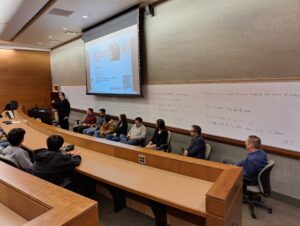
On December 15th 2025 forty (40) mathematically tallented students from Secaucus High School visited Ramapo College to attend an event co-organized by Dr. Katarzyna Kowal, Associate Professor of Mathematics at RamapoCollege, who is also the advisor of Ramapo College Chapter of National Mathematics Honor Society, and by Mr. Jarred Semelmacher, who is a mathematics teacher at Secaucus High School and the advisor of the high school’s Mathematics Honor Society.
The event was titled “Secaucus High School Mathematics Honor Society meets Ramapo College Mathematics Honor Society”. The event included:
- Welcoming remarks by Dean of TAS, Dr. Benny Chan
- Brief interactive sample lecture in mathematics by Dr. Katarzyna Kowal to demonstrate to high school students what Mathematics lectures look like in college
- Presentation by Dr. Katarzyna regarding the benefits of majoring in mathematics at Ramapo College
- Presentation by Dr. Scott Frees, the director and founder of Masters Program in Applied Mathematics at Ramapo College, about the benefits of getting a Master’s Degree in this program
- Dicussion Panel with DMC students, DMC faculty, and industry experts as panelists
During Discussion Panel, the panelists were answering questions that Secaucus High School students had regarding: majoring in mathematics and related disciplines, graduate programs, undergraduate student research in mathematics, what makes Ramapo unique, careers in mathematics and related disciplines, opportunities that mathematics program brings, mathematics competitions.
The student panelists were mathematics majors, data science majors and computer science majors: Afrona Tozluku, Em Dickstein, Amir Sela, Abdurahim Sanginov, Justin Haskoor.
The faculty panelists were: Dr. Debbie Yuster, Dr. Scott Frees, Dr. Katarzyna Kowal (panel moderator).
The industry experts on the panel were:
Dr. Paul Centore and Mr. Paul Park (Wall Street expert).
Mr. Jarred Semelmacher is a recent Ramapo College graduate with Bachelor of Science degree in Mathematics, a certified mathematics high school teacher, and a former officer and an inductee of Ramapo College Chapter of Pi Mu Epsilon Mathematics Honor Society. He received a Masters of Special Education from Ramapo College and is now in the process of obtaining a Masters degree in Computer Science Education. Mr. Semelmacher is also an Adjunct Professor of Mathematics at Ramapo College of New Jersey.
The visiting students had their campus tour later that day, followed by lunch on camus. They were invited to attend the DMC Fair that will be held in April. They were inspired by their visit at Ramapo College.
Categories: Uncategorized
December 4, 2025Ramapo's Internship Training
Build Real Experience with Ramapo’s Internship Training and Simulations
Through our Forage account, we are offering free virtual job simulations from companies like JPMorgan, Y Combinator, and Deloitte.
You work through actual tasks these companies give to interns—data analysis, coding challenges, security assessments—at your own pace. Each simulation takes about 5-6 hours and earns you a certificate for your resume and LinkedIn.
It’s a practical way to explore what different roles actually involve and build skills beyond what we cover in class.
Ramapo students who complete these simulations are 71% more likely to land internships,
DMC Related Job Simulations
We’ve set up landing pages with simulations relevant to our majors:
Getting Started
You can access the trainings using your Ramapo College email, and through Connect. Pick a simulation that interests you, and work through it when you have time. No application required.
Questions? Send emails to Danielle Silvia – Cahill Center – dsilvia@ramapo.edu
Categories: Internship Story
December 1, 2025Ramapo DMC 12/1 - Updates and important events
Dear DMC Students –
As we wind down on the Fall semester, please keep the following in mind:
Spring 2026 Registration
If you have not registered for your Spring 2026 classes yet please do so immediately. The College modifies course offerings based on enrollment – over enrolled and under enrolled courses necessitate changes, and delaying your registration reduces our ability to make those adjustments for you.
If you are eligible for CMPS 366 (Organization of Programming Languages), please register for Spring 2026. There is no guarantee an alternative will be available in Fall 2026, so do not delay taking this course.
Winter 2026 Registration
Two courses being offered relevant to your majors this Winter – CMPS 130 and CMPS 147. CMPS 130 is a required course in Data Science, CMPS 147 is a required course in Computer Science and Cybersecurity. If you have questions about the Winter session, please email me.
Graduate Students – Thesis Proposal Course
If you are an MS student and plan to do your Thesis in either Summer 2026 or Fall 2026, please register for your 1-credit Thesis Proposal in Spring 2026. This is a required course that you must complete prior to your thesis semester. It is currently open for registration. Please contact me if you have any trouble signing up.
4+1 MSDS / MSCS / MSAM (Seniors)
Registration for graduate courses as an undergraduate requires an override (even if you are in the 4+1). Email me to get the override for registration!Read more
Looking for a job? ITS is looking for a programmer
Categories: Computer Science, Cybersecurity, Data Science, Mathematics, MSCS, MSDS, News + Updates
November 18, 2025DMC Partners with South Brunswick High School on AI in Computer Science Education
The DMC Center is collaborating with South Brunswick High School on a research project exploring how generative AI tools can support – rather than replace – student learning in introductory computer science courses.
As AI tools like ChatGPT become increasingly common in education, there’s an open question: how do we help students use these tools effectively without short-circuiting the learning process? This partnership between DMC Director Scott Frees and SBHS Computer Science teacher (and Ramapo adjunct Computer Science professor) Steven Schiff aims to find out.
The study involves high school students across eight sections of “Computer Science in the 21st Century,” testing three different approaches to AI access: no AI, limited AI (where students use it only for understanding), and a custom-build AI assistant – built at the Ramapo DMC Center – designed to explain concepts without writing code for students. By rotating these conditions across different programming topics, the research team hopes to understand which approaches help students learn foundational concepts most effectively.
This collaboration represents the kind of practical research needed as educators adapt to rapidly evolving technology. Rather than banning AI or giving students unlimited access, the project explores middle ground—helping students develop both programming skills and the judgment to use AI tools responsibly. The findings will provide guidance for computer science educators navigating similar questions about AI integration in their own classrooms.
Learn more about the project at codewithgrace.com.
Categories: Computer Science, Cybersecurity, Data Science
November 10, 2025Ramapo DMC 11/10 - Updates and important events
Dear DMC Students –
A few important notes about upcoming events and deadlines. Lot’s of info and some internship opportunities – please read it all!
Are you interested in an MS degree?
If you are a freshman, sophomore, or junior – you have time to enroll in a 4+1! No matter what your major is, you have the option to add an MS in Computer Science, Data Science or Applied Mathematics in just one extra calendar year – while saving 30% on the normal tuition costs. Learn more here, and reach out to me to find out more. Enrolling is simple, and you are not making a commitment to stay for graduate school – you are just giving yourself the option!
Fill out this form to enroll, and send it to me to get started
4+1 MSDS / MSCS / MSAM (Current)
If you are currently in a 4+1 in MSDS, MSCS, MSAM – you should be planning to take a few graduate courses in during the final two semesters on campus. In some cases, you will also need to take some specific courses during your junior year. Please set up an advising meeting with me to discuss your pathway! 5 Year plans are available for your review for every combination of BS and MS degree that we have in the DMC.
4+1 MSDS / MSCS / MSAM (Seniors)
Registration for graduate courses as an undergraduate requires an override (even if you are in the 4+1). Email me to get the override for registration!
[Read more]
Pivoting C.S. Degree into a Career into Forensics and Cyber Security
Please join us in ASB 524 on November 12th at 5:30pm for a career-focused talk by Ramapo Computer Science alum (2008), Craig Brady. For those of you interested in understanding how computer science and cybersecurity overlap, this is a must-attend talk!. Hear how programming skills evolve into building forensic tools, leading security teams, and tackling today’s toughest cyber challenges.
[Read more]
Registration – Winter and Spring 2026
Registration for both the Winter 2026 and Spring 2026 semesters has begun. If you have not registered for your Spring 2026 classes yet please do so immediately. The College modifies course offerings based on enrollment – over enrolled and under enrolled courses necessitate changes, and delaying your registration reduces our ability to make those adjustments for you.
Please note that there are two courses being offered relevant to your majors this Winter – CMPS 130 and CMPS 147. CMPS 130 is a required course in Data Science, CMPS 147 is a required course in Computer Science and Cybersecurity. Both courses are also electives in Bioinformatics and may substitute for some mathematics requirements. If you have questions about the Winter session, please email me.
Schedule Virtual Office Hours / Advisement Appointment
Schedule On Campus Office Hours (ASB 409)
Categories: News + Updates
November 3, 2025Ramapo DMC 11/3 - Updates and important events
Dear DMC Students –
A few important notes about upcoming events and deadlines:
Pivoting C.S. Degree into a Career into Forensics and Cyber Security
Please join us in ASB 524 on November 12th at 5:30pm for a career-focused talk by Ramapo Computer Science alum (2008), Craig Brady. For those of you interested in understanding how computer science and cybersecurity overlap, this is a must-attend talk!. Hear how programming skills evolve into building forensic tools, leading security teams, and tackling today’s toughest cyber challenges.
[Read more]
Fall 2025 Graduation
If you plan to graduate after the Fall semester, you must complete your graduation application by November 6th. This goes for both undergraduates and graduate (MS) students.
- Your first step: Contact your academic advisor and request that they lift your graduation hold. If you have trouble reaching your academic advisor, please contact me.<
- Once the hold is removed: You can access and complete the application in Self-Service.
- Please note: If you are planning to graduate after the Spring 2026 semester (May 2026), this is not relevant to you – you will apply for graduation next semester.
Registration – Winter and Spring 2026
Registration for both the Winter 2026 and Spring 2026 semesters has begun. If you have not registered for your Spring 2026 classes yet please do so immediately. The College modifies course offerings based on enrollment – over enrolled and under enrolled courses necessitate changes, and delaying your registration reduces our ability to make those adjustments for you.
Please note that there are two courses being offered relevant to your majors this Winter – CMPS 130 and CMPS 147. CMPS 130 is a required course in Data Science, CMPS 147 is a required course in Computer Science and Cybersecurity. Both courses are also electives in Bioinformatics and may substitute for some mathematics requirements. If you have questions about the Winter session, please email me.
Schedule Virtual Office Hours / Advisement Appointment
Schedule On Campus Office Hours (ASB 409)
4+1 MSDS / MSCS / MSAM Seniors
If you are graduating at the end of Spring 2026 or Fall 2026, and you are in a 4+1 in MSDS, MSCS, MSAM – you should be planning to take a few graduate courses in Spring 2026. If you aren’t sure which ones to take, you should be setting up a time to meet with me! Registration for graduate courses as an undergraduate requires an override (even if you are in the 4+1). Email me to get the override for registration!
Read more
Categories: News + Updates
October 30, 2025Highlight Your Internship Story: Pranish Khanal - Workforce Opportunity Services
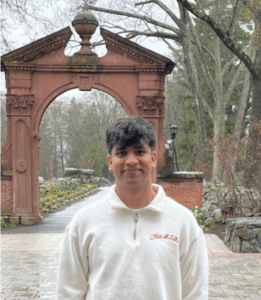
Welcome to the DMC’s Highlight Your Internship Story series, where we showcase the impressive work our students are doing during their internships. These stories highlight how hands-on experience is helping them grow professionally and launch successful careers in tech.
Congratulations to Pranish Khanal, Computer Science major at Ramapo! This fall Pranish has been working for Workforce Opportunity Services (WOS) in New York City as a Junior Development Intern. So far he hashelped redesign two organizational websites. He also provide technical support, helping troubleshoot issues and adapt to various projects in a fast-paced small company environment. Beyond coding, He has had the chance to work on digital marketing campaigns across LinkedIn and Google Ads which has been a completely different experience that taught him a lot new perspectives. This provided valuable insights into marketing a company and the science behind it. Interning at WOS has been one of his best learning experiences, combining web development, data analysis, marketing strategy, and how businesses operate beyond just the technical side.
If you are in any of the DMC majors – Computer Science, Data Science, Cybersecurity, Mathematics, and Bioinformatics – and would like to be featured, please contact Dr. Al-Juboori (aaljuboo@ramapo.edu) or Dr. Frees (sfrees@ramapo.edu)!
Categories: Computer Science, Internship Story
October 29, 2025DMC Students Develop AI-Powered Gut Health Platform for Microsoft Imagine Cup
Interdisciplinary team combines wearable biosensing, machine learning, and personalized nutrition
Two DMC students are pioneering the future of personalized nutrition with GutFeel, a digital health platform that uses artificial intelligence to predict how individual bodies respond to food in real-time. The project merges wearable technology, continuous glucose monitoring, and machine learning to help people understand their unique digestive and metabolic patterns before symptoms occur.
The Vision
Magdalena Nikolova, a Biology/Neuroscience major, and Hristo Denev, a Computer Science major, recognized that more than 60% of adults experience gastrointestinal discomfort, yet existing diet apps treat everyone the same. Their solution: integrate continuous glucose monitors (CGM) with heart rate variability (HRV) data from smartwatches, then use Azure Machine Learning to build predictive models tailored to each person’s physiology.
“We’re shifting from reactive symptom tracking to proactive prediction,” the team explains. By analyzing how specific foods, timing, and stress levels affect digestion and metabolism, GutFeel empowers users – from pre-diabetic individuals to athletes to clinical patients – to make informed decisions based on their unique biology.
Building a Research-Grade Platform
The project leverages Microsoft’s cloud infrastructure, combining Azure IoT Central for data collection, Azure Machine Learning for prediction (using Random Forest and LSTM models), and a .NET MAUI + Blazor interface for the user experience. The result is what the team calls “the world’s first adaptive gut-response intelligence system.”
IRB-Approved Study
Under the guidance of faculty advisors Dr. Paramjeet Bagga and Dr. Scott Frees, Nikolova and Denev secured IRB approval to conduct a controlled study with approximately 20 participants from Ramapo College and the local community. Participants will wear CGM sensors and Garmin Vivosmart 5 smartwatches for two weeks while logging meals and symptoms through a custom web application.
Industry Recognition and Support
The project has already attracted significant external support:
- Dexcom and Abbott, two of the world’s largest continuous glucose monitoring companies, provided funding for 44 CGM sensors (valued at approximately $2,200) – more than double what the team initially requested
- The team is entering Microsoft’s Imagine Cup, one of the world’s largest technology and innovation competitions for students, which encourages young developers and researchers to use technology to solve meaningful real-world problems. The competition provides mentorship, funding opportunities, and global visibility for selected projects. If GutFeel wins in May 2026, the team will receive $50,000 USD to scale their platform into a startup. Participation in the competition also grants the team access to $1,000 in Microsoft Azure credits to support the project’s cloud computing and machine learning infrastructure needs.
Impact Beyond Campus
By participating in Microsoft’s Imagine Cup, the GutFeel project brings international visibility to Ramapo College while connecting DMC students with leaders in AI, cloud computing, and digital health. The platform’s potential extends from reducing gastrointestinal-related healthcare costs to improving quality of life at the population level through personalized, data-driven nutritional guidance.
The DMC continues to demonstrate how interdisciplinary collaboration – combining biology, computer science, data analytics, and cloud computing – can address real-world health challenges while providing students with hands-on research experience and entrepreneurial opportunities.
Categories: Uncategorized
October 24, 2025Ramapo DMC 10/24 - Updates and important events
Dear Students –
Registration begins October 27th (Monday). You should be reviewing the Spring 2026 schedule and identifying courses you plan to take.
If you have an advisement hold, you must meet with your academic advisor. If you don’t know how your advisor is, you can contact either myself or Student Success (success@ramapo.edu). You will not be able to register if your hold is not removed.
Winter session course registration begins 10/27 as well. There are a number of introductory level courses in CMPS offered, along with other courses across the college.
Please note that when making an appointment with your advisor, you should prepare. Review the schedule of offered courses, your 4-year plan, and your degree audit.
You may schedule advisement with me here:
Schedule Virtual Office Hours / Advisement Appointment
Schedule On Campus Office Hours (ASB 409)
4+1 MSDS / MSCS / MSAM Seniors
If you are graduating at the end of Spring 2026 or Fall 2026, and you are in a 4+1 in MSDS, MSCS, MSAM – you should be planning to take a few graduate courses in Spring 2026. If you aren’t sure which ones to take, you should be setting up a time to meet with me! Registration for graduate courses as an undergraduate requires an override (even if you are in the 4+1). Email me to have the override in place for registration!
Read more
Pivoting C.S. Degree into a Career into Forensics and Cyber Security
Please join us in ASB 524 on November 12th at 5:30pm for a career-focused talk by Ramapo Computer Science alum (2008), Craig Brady. For those of you interested in understanding how computer science and cybersecurity overlap, this is a must-attend talk!. Hear how programming skills evolve into building forensic tools, leading security teams, and tackling today’s toughest cyber challenges.
[Read more]
Categories: News + Updates
October 13, 2025Ramapo DMC 10/13 - Updates and important events
Dear DMC Students –
Registration will start 10/27. You should be reviewing the Spring 2026 schedule and identifying courses you plan to take.
If you have an advisement hold, you must meet with your academic advisor. If you don’t know how your advisor is, you can contact either myself or Student Success (success@ramapo.edu). You will not be able to register if your hold is not removed.
Winter session course registration begins 10/27 as well. There are a number of introductory level courses in CMPS offered, along with other courses across the college.
4+1 MSDS / MSCS / MSAM Seniors
If you are graduating at the end of Spring 2026 or Fall 2026, and you are in a 4+1 in MSDS, MSCS, MSAM – you should be planning to take a few graduate courses in Spring 2026. If you aren’t sure which ones to take, you should be setting up a time to meet with me! Registration for graduate courses as an undergraduate requires an override (even if you are in the 4+1). Email me to have the override in place for registration!
Read more
DMC (NSF S-STEM) Scholarship – APPLY NOW
Don’t miss this opportunity! The deadline has been extended – if you are a sophomore, this scholarship can start now, and pays up to $65,000 over the next four years. If you aren’t sure if you are eligible, apply – we’ll work through the details to establish eligibility. Learn more and apply here. If you want to apply, email me by Tuesday October 14th, 5pm. If I receive your email, I can consider your application even if we are waiting on additional materials from you.
Event: Internship Experience Panel Talk
Join us on Tuesday, October 14, 2025, from 6:00 p.m. to 7:00 p.m. in ASB 429, as Ramapo students share their internship experiences, insights, and lessons learned in tech and beyond. Hear more about how they got their internships, what they learned, and what’s next.
Please register here
Event: Career Conversations: Communication Careers in a Tech Driven World
I encourage you to join us for Career Conversations: Communication Careers in a Tech Driven World on Wednesday, October 15 at 6pm in the Trustees Pavilion. Alumni and professionals – including Jeff Rayvid, DMC Advisory Board member and adjunct professor this Spring, who also works with Amazon – will share their career journeys and insights. Additional panelists from FanDuel and NBC Universal will share their experiences as well. This is a great chance to learn, network, and explore opportunities in tech, computer science, and communications. Please sign up on Handshake if you plan to attend. Refreshments will be provided. All majors are welcome!
Categories: News + Updates
October 13, 20254+1 Program: Graduate Courses for Senior Year Students
Students enrolled in one of the DMC 4+1 programs (MSDS, MSCS, or MSAM) should plan to take three graduate courses during their senior year. These courses are taken exclusively in your final or second-to-last semester as an undergraduate and count toward both your Bachelor’s and Master’s degrees.
Registration Information
Registration opens October 27, 2025
Important: You must email Prof. Scott Frees at sfrees@ramapo.edu for an override prior to registering for any graduate courses.
MS in Data Science (MSDS)
Senior year students will take the following three graduate courses:
- DATA 620 – Ethics in Data & Computing (Spring 2026)
- DATA 601 – Introduction to Data Science (Fall)
- CMPS 530 – Python for Data Science (Fall)
MS in Computer Science (MSCS)
Senior year students will take the following three graduate courses:
- CMPS 531 – Data Structures & Algorithms (Spring 2026)
- DATA 620 – Ethics in Data & Computing (Spring 2026)
- Category 1 elective (Fall)
MS in Applied Mathematics (MSAM)
Senior year students will take the following three graduate courses:
- DATA 620 – Ethics in Data & Computing (Spring 2026)
- DATA 590 – Data Storytelling (Spring 2026)
- MATH 680 – Advanced Mathematical Modeling (Fall)
Additional Information
MATH 570 – Applied Statistics is offered in Summer 2026. Summer courses are recommended to be taken after you graduate with your Bachelor’s degree to avoid additional undergraduate tuition charges.
For questions about the 4+1 program or course selection, please contact Prof. Scott Frees at sfrees@ramapo.edu.
Categories: Uncategorized
October 1, 2025Spring 2026 MS Course - DATA STORYTELLING

With registration approaching, check out this new course we are offering in the Spring. It’s online, and doesn’t have prerequisites!
This course, DATA 690 TOPICS: DATA STORYTELLING, equips students with the essential skills to effectively communicate insights from data. Building upon the principles of data visualization, the curriculum integrates techniques from writing, public speaking, and strategic communication. Students will learn to craft compelling narratives using data, employing frameworks such as the STAR method to structure their stories for maximum impact. The course focuses on transforming complex data analysis into clear, persuasive, and memorable presentations for diverse audiences.
- MSDS Technical Elective
- MSCS Category 1 Elective
- MSAM Category Category 2 Elective
Semester: Spring 2026
Delivery Mode: Online (Asynchronous)
Instructor: Jeff Ravid
Instructor Bio
Jeff Rayvid is a data analytics professional with 8+ years of experience at Amazon, Disney Streaming Services, and Google. At Amazon, he manages business strategy and analytics for Prime Gaming. Previously, he led analytics for Disney+, ESPN+, and Disney Bundle marketing campaigns, and developed machine learning algorithms for Google’s advertising at Essence.
Jeff holds an M.S. in Data Analytics from Fordham University and specializes in Python, R, SQL, machine learning, and big data technologies including Hadoop and Spark. He brings real-world experience in predictive modeling, data visualization, and translating analytics into business decisions across entertainment, advertising, and e-commerce industries.
Categories: Uncategorized
September 30, 2025Ramapo DMC 9/30 - Updates and important events
Dear DMC Students –
Registration is coming up for Spring 2026. The actual calendar for when you can register will be posted here: https://www.ramapo.edu/web-resources/registration/. Check back soon, as the calendar should be published in the next few weeks.
You should start thinking about what classes you are interested in taking, and reach out to your academic advisor to resolve any academic holds you might have now. If you would like to meet with me, please use the appointment links at the bottom of this email.
Please see below for some upcoming events and news about your major.
DMC (NSF S-STEM) Scholarship – APPLY NOW
Don’t miss this opportunity! The NSF S-STEM Roads Scholarship provides up to $15,000 per year during your undergraduate studies and up to $20,000 per year in graduate school for selected students. The program also includes mentoring, networking, and career preparation to support your success. Learn more and apply here – This scholarship is administered by DMC – please don’t miss out!
Internship: Data Science for Social Good: Paid DMC Internships Available
The DMC is partnering with the Center for Food Action to offer paid internships for undergraduate and graduate students to use data science to combat hunger in Bergen and Passaic Counties. Students will work on real-world projects including inventory forecasting, mobile app development, and geographic impact analysis. Note – we are hiring 4-5 interns, and you will be placed on a project that best suits your background – don’t hesitate to apply, there’s plenty of opportunity!
Read more
Event: Internship Experience Panel Talk
Join us on October 14, 2025, as Ramapo students share their internship experiences, insights, and lessons learned in tech and beyond. Hear more about how they got their internships, what they learned, and what’s next.
Read more
Event: Career Conversations: Communication Careers in a Tech Driven World
I encourage you to join us for Career Conversations: Communication Careers in a Tech Driven World on Wednesday, October 15 at 6pm in the Trustees Pavilion. Alumni and professionals – including Jeff Rayvid, DMC Advisory Board member and adjunct professor this Spring, who also works with Amazon – will share their career journeys and insights. Additional panelists from FanDuel and NBC Universal will share their experiences as well. This is a great chance to learn, network, and explore opportunities in tech, computer science, and communications. Please sign up on Handshake if you plan to attend. Refreshments will be provided. All majors are welcome!
Categories: News + Updates
September 23, 2025Ramapo DMC 9/23 - Updates, Important Events and Internship Opportunity
Dear DMC Students
Thank you to those of you who attended our first lecture series event on September 9th, the event was a great opportunity to hear about how AI is affecting our industry, and many of you participated in a really insightful Q/A following the meeting. We’ll have another Ramapo alum to campus to talk about Cybersecurity in November – stay tuned for more info!
Here are some things worth taking a look at happening at Ramapo over the next few weeks:
Data Science for Social Good: Paid DMC Internships Available
The DMC is partnering with the Center for Food Action to offer paid internships for undergraduate and graduate students to use data science to combat hunger in Bergen and Passaic Counties. Students will work on real-world projects including inventory forecasting, mobile app development, and geographic impact analysis.
[Read more]
Internship Experience Panel Talk
Join us on October 14, 2025, as Ramapo students share their internship experiences, insights, and lessons learned in tech and beyond. Hear more about how they got their internships, what they learned, and what’s next.
[Read more]
NSF Scholarship Award – DMC
We’ve been awarded an NSF S-STEM grant to support the next generation of STEM leaders, creating new opportunities for students in Computer Science, Data Science, Mathematics, Cybersecurity, and Bioinformatics. Current sophomores – APPLY NOW for Cohort A – DON’T MISS THIS OPPORTUNITY:
- Expected awards: ~ 6 students
- Up to $15,000 (undergraduate) $20,000 (graduate) per academic year
- Covers unmet financial need for tuition, fees, room & board, books, and supplies (including Fall 2025)
- Applications Accepted starting: September 12th, 2025
- Application Deadline: October 3rd, 2025
- Decision Date: October 20th 2025
- Minimum GPA: 2.5
- You must be a current Sophomore – 24-48 credits completed at time of application
Scholarship window for funding unmet needs: Fall 2025 through Spring 2028 (undergraduate); Summer 2028 through Summer 2029 (graduate – optional) - [Read more] – Scroll to the bottom to apply! Ask me if you have any questions
Categories: News + Updates
September 23, 2025Ramapo College Partners with Center for Food Action to Combat Hunger Through Data Science Innovation
Ramapo College’s Center for Data, Mathematical, and Computational Sciences (DMC) has partnered with Center for Food Action (CFA) to use data science in the fight against food insecurity across Bergen and Passaic Counties. Thanks to generous support from the Daffron Family Foundation, this collaboration will provide paid internships for Ramapo students to solve real-world challenges facing our region’s most vulnerable residents.
The partnership centers on four projects supporting CFA’s mission and resource optimization. Students will develop tools to forecast demand and identify funding gaps using real-time food pricing, create systems that consolidate data into standardized reports, build a mobile app for grocery categorization, and design maps to highlight service gaps and improve distribution routes.
Working under faculty supervision, student teams will collaborate directly with CFA leadership over 12 weeks to deliver these solutions. Students will gain hands-on experience with web scraping, statistical modeling, mobile app development, and geospatial analytics while seeing how their technical work directly impacts families facing food insecurity.
This partnership creates a pipeline for socially conscious data scientists while delivering immediate benefits to CFA’s mission of preventing hunger and homelessness in northern New Jersey.
For Students: Join the Fight Against Hunger
Data Science and Computer Science students can apply now for these paid internship opportunities. We’re seeking up to 5 students total: 1-3 seniors or graduate students and 2-3 underclassmen ready to apply their skills for social good. Internships will pay up to $5,000 over the project period (12-15 weeks, ~20 hours/week). We are seeking students with a strong coding background, solid communication and presentation skills, and a genuine interest in social good.
To apply, send your resume to Dr. Scott Frees (sfrees@ramapo.edu) and a brief (250 word) personal statement describing your skills, experience, and interest in the position by October 3rd, 2025. We will be interviewing candidates during the second week of October. Internships will start by the end of October and continue for approximately 12-15 weeks.
For Community Organizations: Partner with Ramapo DMC
Does your organization have data challenges that student teams could help solve? The DMC is eager to create more community partnerships. Contact Dr. Scott Frees (sfrees@ramapo.edu) to explore how our talented students can support your mission while gaining real-world experience.
Categories: Uncategorized
September 22, 2025DMC Student Publishes Cybersecurity Research at IEEE International Conference
Master of Science in Data Science (MSDS) student Chris Hainzl and his faculty advisor Dr. Sourav Dutta have published their research at the 12th IEEE International Conference on Cyber Security and Cloud Computing (IEEE CSCloud 2025). Their paper, titled “Dynamic Feature Clustering for Anomaly Detection in Streaming Cybersecurity Data,” addresses one of the most pressing challenges in modern cybersecurity: detecting anomalous behavior in real time from continuous data streams such as firewall logs, intrusion detection systems, and network monitors.
The research introduces Adaptive Feature Clustering for Streaming Data (AFCSD), a novel clustering approach that incrementally updates feature groupings by tracking covariance matrix drift. This dynamic method allows feature clusters to adapt as data distributions shift, enhancing both the accuracy and computational efficiency of anomaly detection in non-stationary environments.
The publication of this work at a premier IEEE conference underscores the significant contributions Ramapo students and faculty are making in advancing scalable, real-time solutions to critical cybersecurity challenges.
Congratulations to Chris and Dr. Dutta on this outstanding achievement!
Categories: Cybersecurity
September 11, 2025Save the date: Pivoting C.S. Degree into a Career into Forensics and Cyber Security

Join us for the second DMC Lecture Series of Fall 2025 – and the second by a Ramapo CS Alum!
Pivoting a C.S. Degree into a Career in Forensics and Cyber Security
November 12th, 5:30pm
ASB 524
A degree in Computer Science provides the foundation for solving real-world problems in cybersecurity and digital forensics. In this presentation, I will share how core programming and problem-solving skills translated into developing custom forensic scripts, building in-house automation tools, and streamlining complex data processes. I will also highlight how computer science fundamentals extend into my everyday work dealing with developers to senior leadership.
Craig Brady is a Senior Director of Cybersecurity with over 17 years of experience leading high-performing teams across incident response, threat intelligence, engineering, and vulnerability management. Craig specializes in building scalable security operations programs, developing insider threat frameworks, and guiding organizations through complex mergers, compliance requirements, and emerging threat landscapes. Beyond his technical expertise, Craig is recognized as a collaborative leader and mentor, focused on professional growth, team development, and fostering a culture of accountability. Outside of cybersecurity, he enjoys 3D printing, smart home projects, and traveling.
Categories: Cybersecurity, Lecture Series, MSCS, MSDS
September 9, 2025Highlight Your Internship Story: Emily Morra - New Jersey Jackals
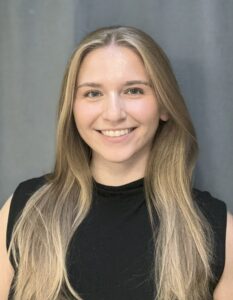
Welcome to the DMC’s Highlight Your Internship Story series, where we showcase the impressive work our students are doing during their internships. These stories highlight how hands-on experience is helping them grow professionally and launch successful careers in tech.
Congratulations to Emily Morra, Data Science major at Ramapo! This summer, Emily worked with the New Jersey Jackals, a semi-professional baseball team, as an Analytics Intern. She manned the TrackMan Baseball system, which uses AI cameras around the stadium to track pitches and generate information on a wide variety of useful statistics, such as spin rate, exit velocity, launch angle, and more. The analytics team uses this data to create scouting reports for coaching staff and players ahead of each series or trade transaction. Being able to translate the raw data into understandable reports was a skill that could be translated into any concentration of data science, and the fast-paced environment tested her quick learning and thinking skills. Emily has a Sports Management minor and is looking to pursue a career in Sports Analytics, and this experience served as a meaningful step towards her future.
If you are in any of the DMC majors – Computer Science, Data Science, Cybersecurity, Mathematics, and Bioinformatics – and would like to be featured, please contact Dr. Al-Juboori (aaljuboo@ramapo.edu) or Dr. Frees (sfrees@ramapo.edu)!
Categories: Data Science, Internship Story
September 8, 2025Ramapo DMC 9/8 - Updates and important events
Dear DMC Students –
I hope the semester has started well for you! Please see below for some upcoming events and news about your major. Make sure you register for Tuesday’s AI talk by Devinder Sodhi if you plan on attending!
DMC Lecture Series: The Future Is Not Fixed
AI is reshaping work, shifting from certainty to probability. Come hear Devinder Sodhi (’16) on how to thrive in a world of non-deterministic AI. Sept 9 @ 5:45pm, ASB 429.
[Read more]
MS Thesis Proposal + Info Session
Are you thinking about joining one of our 4+1 programs in Computer Science, Data Science, or Applied Mathematics? Join the info session right after The DMC Lecture series on Sept 9 in ASB 123 to learn more.
[Read more]
Internship Experience Panel Talk
Join us on October 14, 2025, as Ramapo students share their internship experiences, insights, and lessons learned in tech and beyond. Hear more about how they got their internships, what they learned, and what’s next.
[Read more]
NSF Scholarship Award – DMC
We’ve been awarded an NSF S-STEM grant to support the next generation of STEM leaders, creating new opportunities for students in Computer Science, Data Science, Mathematics, Cybersecurity, and Bioinformatics. Current sophomores – watch your email in the coming days for details on how you can benefit.
[Read more]
Important dates on the Academic Calendar
Tomorrow is the last day for Add/Drop with 50% tuition refund
Deregistration for non-payment is September 11th, if you have an outstanding balance please contact student accounts – studentaccts@ramapo.edu
Categories: News + Updates
September 8, 2025Save the Date - Internship Experience Panel Talk
We’re excited to announce that our upcoming event will take place on Tuesday, October 14, 2025, from 6:00–7:00 pm. This session will feature a student panel highlighting their internship experiences—covering everything from the projects they worked on and skills they gained to the challenges they overcame and the advice they have for peers. More details will be shared soon, but for now, mark your calendars and get ready for an engaging and insightful evening.
This event is co-sponsored by the Computer Science Club, Cahill Center and the DMC Lecture Series.
Please check back for more information about location and event registration.
Categories: Internship Story, Lecture Series
August 30, 2025Ramapo College Awarded Prestigious NSF S-STEM Grant to Support Next Generation of STEM Leaders
Ramapo College of New Jersey has received a $2M U.S. National Science Foundation S-STEM (Scholarships in Science, Technology, Engineering, and Mathematics) grant to launch the Ramapo Opportunities for Advanced Degrees in STEM (ROADS) program. This multi-year award will provide comprehensive scholarship support and specialized academic programming for academically talented students with financial need.
ROADS targets five high-growth disciplines through our Center for Data, Mathematical, and Computational Sciences: Computer Science, Data Science, Cybersecurity, Mathematics, and Bioinformatics. These fields are experiencing unprecedented demand, with job growth projections ranging from 11% to 36% over the next decade – far exceeding the national average.
What makes this program particularly innovative is its integration with Ramapo’s accelerated 4+1 degree pathways. Students can complete both their bachelor’s and master’s degrees in just five years, with significant cost savings. During their senior year, students take three graduate courses covered by undergraduate tuition, saving over $12,000 toward their graduate degree.
The scholarship program addresses both financial and developmental barriers that often prevent talented students from succeeding in STEM fields. Selected students will receive full coverage of their unmet financial need – up to $15,000 annually for undergraduates and $20,000 for graduate students. Beyond financial support, ROADS scholars will participate in a unique four-course research sequence designed to develop their identity as researchers and prepare them for advanced careers or graduate study.
The program’s comprehensive support system includes cohort-based mentorship, one-on-one faculty advising, undergraduate research opportunities, and professional development activities. Students will have access to conference presentations, career fairs, and networking events with industry professionals through our established advisory board.
This award builds on Ramapo’s strong tradition of supporting STEM, including our Upward Bound-Math Science Program and Educational Opportunity Fund initiatives. The ROADS program specifically serves the New York-New Jersey region, which ranks as the number one area nationally for job postings in data and computer science fields.
Applications for the first cohort of ROADS recipients will open soon, with separate application cycles for incoming freshmen and current students. The program aims to support 35 students over five years, with the goal of achieving 95% retention rates and ensuring 90% of graduates enter ROADS-related careers within two years.
This investment in STEM education directly supports national priorities in innovation and economic competitiveness, preparing graduates to contribute to cybersecurity, data analysis, and technological advancement in an increasingly digital world.
More information about application processes and program requirements are available NOW.
Categories: Uncategorized
August 29, 2025Learn how Ramapo's MSDS aligns with the nationally recognized ADSA core Data Science competencies
The Academic Data Science Alliance (ADSA) Data Science Taxonomy represents a comprehensive framework of competencies for Master’s-level data science programs, developed through collaboration with leading academic institutions and federal partners including NSA, DOD, NIH, and NSF.
This nationally recognized taxonomy establishes standardized competencies that ensure graduates possess the critical skills needed in today’s data-driven economy, making it highly valued by employers across industries.
Ramapo College’s Master of Science in Data Science program aligns exceptionally well with this prestigious framework, demonstrating our commitment to providing students with industry-relevant, federally-recognized competencies that will distinguish them in the competitive data science job market. It’s one of the reasons Ramapo’s MSDS has been consistently listed as one of Fortune’s Best Masters degrees in Data Science.
Our Master of Science (MS) in Data Science degree is a 30-credit program with course work in Python, R, Data Visualization, Database Systems, Machine Learning, Statistics and Mathematical Modeling. Full-time students will complete their degree in 18 months. Courses are delivered as a combination of online, hybrid, and evening in-seat format – you can complete the degree while being on campus just one night a week.
Explore the detailed mappings below to see how each course in our program contributes to building these essential, nationally-recognized data science skills.
| Foundations of Analytics: Statistics | |
|---|---|
Data Collection DesignMethodical approach to gather observations, measurements and information from different sources |
|
InferenceProcess of using statistics to make conclusions about a population based on a random sample |
|
Modeling (Stochastic)Method of generating sample data and making real-world predictions using statistical models |
|
Multivariate AnalysisStatistical techniques that simultaneously look at three or more variables |
|
Statistical LearningProcess of learning from data using statistical algorithms |
|
Bayesian MethodsTheory based on Bayesian interpretation of probability |
|
Causal inferenceProcess of determining independent effect of a phenomenon |
|
Model uncertaintyLevel of understanding of world representation for mathematical modeling |
|
Experimental designCarrying out research in objective and controlled fashion |
|
SamplingSelection of subset from statistical population to estimate characteristics |
|
| Foundations of Analytics: Mathematics | |
Set theory and basic logicFundamental mathematical concepts dealing with collections of objects and logical reasoning |
|
Matrices and basic linear algebraMathematical structures and operations for solving systems of linear equations |
|
Optimization – algorithmMathematical techniques for finding the best solution from all feasible solutions |
|
Probability theoryMathematical framework for analyzing random phenomena and uncertainty |
|
Arithmetic and GeometryBasic mathematical operations and study of shapes, sizes, and properties of space |
|
Graph Theory and NetworksStudy of graphs as mathematical structures used to model pairwise relations |
|
| Foundations of Analytics: Data Analytics | |
Exploratory AnalysisApproach to analyzing data sets to summarize their main characteristics |
|
Variable DistributionsDescription of how values of a variable are spread or distributed |
|
Scatter PlotsGraph using Cartesian coordinates to display values for two variables |
|
Correlation AnalysisStatistical method used to evaluate the strength of relationship between variables |
|
Conditional ProbabilityProbability of an event occurring given that another event has occurred |
|
Spatial AnalysisExamining locations, attributes, and relationships of features in spatial data |
|
Data VisualizationRepresentation of data through graphics like charts, plots, infographics |
|
Artificial IntelligenceTechnologies that enable computers to perform advanced functions including analysis |
|
Classical AITraditional artificial intelligence approaches using symbolic reasoning |
|
Modern AI/Data Driven AIContemporary AI approaches based on machine learning and data analysis |
|
Machine LearningSubfield of AI using data and algorithms to learn and improve accuracy over time |
|
Classical MLTraditional machine learning algorithms and statistical methods |
|
Deep LearningMachine learning based on artificial neural networks with multiple processing layers |
|
NLPBranch of AI allowing computers to interpret human language similarly to humans |
|
Uncertainty Quantification/CharacterizationAssessment and representation of uncertainties in computational models |
|
Data MiningPractice of analyzing large databases to generate new information |
|
| Foundations of Analytics: Data Modeling | |
Model Development and DeploymentProcess of creating, testing, and implementing predictive models |
|
Model Risks and Mitigation StrategiesIdentification and management of potential model failures |
|
Model analysis and ValidationEvaluation of model performance and reliability |
|
Data VisualizationRepresentation of data through graphics like charts, plots, infographics |
|
| Systems and Implementation: Computing and Computer Fundamentals | |
Data StructuresWays of organizing and storing data in computer programs |
|
AlgorithmsStep-by-step procedures for solving computational problems |
|
SimulationsImitation of real-world processes or systems using computational models |
|
Data EngineeringPractice of designing and building systems for collecting and analyzing data |
|
Database DesignProcess of producing detailed data models and database structures |
|
Data Preparation and CleaningProcess of detecting and correcting corrupt or inaccurate records |
|
Records Retention and CurationManagement and preservation of data records over time |
|
Big Data SystemsTechnologies for processing data sets too large for traditional software |
|
Data Security and PrivacyProtection of data from unauthorized access and ensuring privacy |
|
Cloud ComputingDelivery of computing services over the internet |
|
High Performance ComputingUse of parallel processing for running advanced computation programs |
|
| Systems and Implementation: Software Development and Maintenance | |
ProgrammingProcess of creating computer programs using programming languages |
|
Collaboration and version controlTools and practices for team software development |
|
Database/data warehousingSystems for storing and managing large amounts of structured data |
|
| Data Science Project Design: Users and Impacted Groups | |
Implications of analysis and resultsUnderstanding the broader impact and consequences of data analysis |
|
Defining the user and UX designCreating user-centered design for data products and interfaces |
|
Story-telling with dataCommunicating insights and findings through compelling data narratives |
|
Human-centered designDesign approach that focuses on human needs and experiences |
|
| Data Science Project Design: Research Methods | |
Hypothesis developmentFormulating testable predictions based on observations |
|
Defining data-driven questionsCrafting questions that can be answered through data analysis |
|
Computational logicApplication of logical reasoning in computational problem-solving |
|
Data-driven decision makingMaking decisions based on data analysis rather than intuition |
|
Data/research lifecycleComplete process from data collection to research conclusions |
|
Analysis and presentation of decisionsCommunicating analytical findings to support decision-making |
|
| Data Science Project Design: Data | |
Data acquisitionProcess of gathering data from various sources |
|
Data governanceManagement of data availability, usability, integrity and security |
|
Data provenance and citationDocumentation of data sources and proper attribution |
|
| Data Science Project Design: Open Science by Design | |
Reproducibility, replicability, repeatabilityEnsuring research can be verified and repeated |
|
Interactive computingComputing environment that allows real-time user interaction |
|
| Data Science Project Design: Visualization | |
Grammar of graphicsSystem for describing and building statistical graphics |
|
Static and dynamic visualization designCreating both fixed and interactive data visualizations |
|
| Data Science In Practice: Responsible Practices | |
Relevant domain knowledge for effective decision-makingUnderstanding the specific field or industry context |
|
Legal considerationsUnderstanding legal requirements and constraints in data use |
|
Data privacyProtection of personal and sensitive information in datasets |
|
Data and product/system security and resilienceEnsuring robust protection against threats |
|
Data and product/system governanceOversight and management of data systems |
|
Research integrityAdherence to ethical principles in research conduct |
|
Assessment, monitoring, and management of risksSystematic approach to identifying and controlling risks |
|
Understanding and uncovering biasIdentifying and addressing systematic errors in data and analysis |
|
Interpretability and ExplainabilityMaking complex models understandable to humans |
|
Human impacts of designConsidering how design decisions affect people and communities |
|
Responsible data collectionEthical approaches to gathering data from individuals and communities |
|
Understanding impacted communitiesRecognizing how data work affects different groups of people |
|
| Data Science In Practice: Effective Collaboration | |
Working with stakeholdersCollaborating effectively with various project participants |
|
Working with domain expertsPartnering with subject matter experts |
|
Project managementPlanning, executing, and controlling project activities |
|
Infrastructure cost and benefitsEvaluating financial and operational aspects of technology infrastructure |
|
Participatory research / stakeholder engagementIncluding community members in research processes |
|
| Data Science In Practice: Communication | |
Technical writing skillsCommunicating complex technical information clearly |
|
Communication (oral) and presentation skillsEffectively presenting information to audiences |
|
DocumentationCreating clear and comprehensive project documentation |
|
Categories: Data Science, MSDS
August 26, 2025Thesis Information - Fall 2025 and Spring 2026
If you’re aiming to graduate in Spring 2026, you must register for Thesis Proposal (DATA/CMPS/MATH 745) this Fall semester. This one-credit, pass/fail course guides you through crafting and securing approval of your formal thesis proposal; upon passing, it enables you to enroll in Thesis (750) the following term.
The Thesis (750) is a two-credit, independent research project requiring a written deliverable, presentation, and faculty panel evaluation.
Who should attend the info session?
Any student planning to graduate in Spring 2026 and needing to complete the 745/750 sequence should join. Come right after the DMC Lecture Series talk on September 9th, and join us in ASB 123 around 7:15pm for all the essential details: what to expect from 745, how to prepare, timeline checkpoints, and next steps.
Categories: Uncategorized
August 26, 2025Join the ICPC Programming Competition
The ICPC (International Collegiate Programming Contest) Regional Competition will take place during the Fall 2025 semester (likely at the end of October or mid-November). This is a great opportunity to enhance your programming and problem-solving skills while collaborating with students from other schools in New Jersey, New York, and Connecticut.
Each team will consist of three students, who will work together to solve 10 challenging programming problems within 5 hours. Training will be provided during the semester and in preparation for the contest.
If you are interested in joining a team, contact Dr. Ali Juboori – aaljuboo@ramapo.edu. Once your participation is confirmed, additional resources and guidance will be shared to help you prepare.
Learn more about ICPC
This is an excellent way to strengthen your programming abilities, critical thinking, and teamwork skills!
Categories: Uncategorized
August 26, 2025Ramapo DMC 8/26 - Updates and important events
Dear DMC Students –
Welcome back! You’re receiving this because you are in Computer Science, Data Science, Mathematics, or Cybersecurity (undergraduate, graduate, or 4+1).
- If you’re a graduate student, I am your primary advisor.
- If you’re a 4+1 student, I’ll meet with you to plan schedules junior and senior year, and you can always reach out with questions.
- I’m also the Convenor of Computer Science and Cybersecurity, so don’t hesitate to ask me about those programs.
- I hold in-person and virtual office hours, with times added throughout the semester. Please check often and schedule a meeting: Virtual Office Hours — On Campus (ASB 409)
Here’s some upcoming dates and events to keep in mind:
DMC Lecture Series: The Future Is Not Fixed
AI is reshaping work, shifting from certainty to probability. Come hear Devinder Sodhi (’16) on how to thrive in a world of non-deterministic AI. Sept 9 @ 5:45pm, ASB 429.
[Read more]
ICPC Programming Competition
Test your skills in the ICPC Regional Contest this fall—teams of three compete to solve 10 challenging problems in 5 hours. Great way to boost programming, problem-solving, and teamwork.
[Read more]
MS Thesis Proposal + Info Session
Planning to graduate (Masters degree) Spring 2026? You must register for Thesis Proposal (745) this Fall. Join the info session right after The DMC Lecture series on Sept 9 in ASB 123 to learn more.
[Read more]
Add/Drop Deadline
Deadline for 100% refund is Sept 2; 50% refund ends Sept 9. Please make sure you review the academic calendar for Fall 2025
[Read more]
Congrats to Our Interns
Check out stories of our interns featured on the DMC site. If you had an internship or co-op and want to be recognized, contact Dr. Al-Juboori.
[Read more]
DMC Center – ASB 123
Students in CS, Data, Math, and Cyber can use ASB 123 for study, group work, and events. Need card access? Just let me know.
Hope the Fall semester starts out well for you!
Categories: News + Updates
August 15, 2025DMC Lecture Series: The Future Is Not Fixed: How AI & Non‑Deterministic Systems Are Reshaping Work
The first event for this year’s DMC Lecture series features a Ramapo Computer Science alum – Save the date!
Tuesday September 9th, 2025
ASB 429 @ 5:30pm
Artificial intelligence is changing how we work, moving us from predictable processes to systems that operate on probabilities and uncertainty. This talk explores what this shift means for students entering the workforce. Devinder will examine how humans and AI collaborate in practice, what skills are becoming essential, and how to make responsible decisions when working with uncertain technologies. Students will learn practical strategies for thriving in careers where adaptability and critical evaluation of AI outputs are key professional skills.
Speaker Bio
Devinder Sodhi is a Ramapo College Computer Science graduate (2016), who currently shapes AI curriculum development at DataCamp and leads technology communities at Frontier Tower and AICamp SF. His engineering background spans diverse industries, including jet engine testing systems at Qt, surgical robotics at Johnson & Johnson, and medical imaging platforms at Canfield Scientific. Sodhi focuses on practical AI implementation and education, teaching professionals how to effectively integrate AI tools into their workflows while maintaining critical oversight of probabilistic outputs.
Categories: Data Science, Lecture Series, MSCS, MSDS
July 30, 2025Highlight Your Internship Story: Prashant Shah - Trimble Inc
Welcome to the DMC’s Highlight Your Internship Story series, where we showcase the impressive work our students are doing during their internships. These stories highlight how hands-on experience is helping them grow professionally and launch successful careers in tech.
Congratulations to Prashant Shah, Computer Science / Data Science double major at Ramapo! Prashant’s summer as a Software Engineering intern at Trimble Inc. was an invaluable experience. The theoretical concepts from database design principles to software architecture patterns he learned at Ramapo became the foundation for solving actual business challenges. Working with C# .NET framework and Blazor WebAssembly, he developed configuration interfaces that users depend on, bridging the gap between academic learning and industry demands.
The fast-paced environment taught Prashant skills beyond coding. He mastered Agile development practices, learned to navigate complex enterprise systems, and discovered how to balance technical constraints with user needs. Database optimization techniques from his coursework proved essential when handling performance challenges, while his data science background helped him understand the broader implications of the systems we were building. Perhaps most valuable was learning the collaborative nature of software development. Dev meetings revealed how feedback shapes features, while working with APIs and distributed services showed Prashant the interconnected reality of modern applications. The introduction of AI-powered development tools like Cursor and Copilot opened his eyes to how the industry is evolving, demonstrating that staying current with emerging technologies is crucial.
By the final showcase, Prashant had contributed to a production-ready application, experienced the complete software development lifecycle from conception to deployment, and gained confidence in his ability to deliver meaningful solutions in professional settings. This internship reinforced his passion for technology while providing practical skills that will serve his throughout his career.
If you are in any of the DMC majors – Computer Science, Data Science, Cybersecurity, Mathematics, and Bioinformatics – and would like to be featured, please contact Dr. Al-Juboori (aaljuboo@ramapo.edu) or Dr. Frees (sfrees@ramapo.edu)!
Categories: Internship Story
July 27, 2025Highlight Your Internship Story: Edy Martinez - Bristol Myers Squibb
Welcome to the DMC’s Highlight Your Internship Story series, where we showcase the impressive work our students are doing during their internships. These stories highlight how hands-on experience is helping them grow professionally and launch successful careers in tech.
Congratulations to Edy Martinez, Cybersecurity major at Ramapo! This summer, Edy is interning at Bristol Myers Squibb as an IT Systems Intern, working at the intersection of AI and pharmaceutical research. He’s been involved in AI-driven data extraction projects and the management of asset and oncology research data. This experience has given him valuable insight into the corporate world and taught him what it means to work in an environment where patient safety is the top priority. Edy has especially enjoyed connecting with colleagues from diverse backgrounds, and the vanilla lattes from the office’s coffee machine!
If you are in any of the DMC majors – Computer Science, Data Science, Cybersecurity, Mathematics, and Bioinformatics – and would like to be featured, please contact Dr. Al-Juboori (aaljuboo@ramapo.edu) or Dr. Frees (sfrees@ramapo.edu)!
Categories: Internship Story
July 23, 2025Highlight Your Internship Story: Ritika Dawadi - Pfizer
Welcome to the DMC’s Highlight Your Internship Story series, where we showcase the impressive work our students are doing during their internships. These stories highlight how hands-on experience is helping them grow professionally and launch successful careers in tech.
Congratulations to Ritika Dawadi, Computer Science major at Ramapo with a minor in Bioinformatics. Ritika is spending her summer as a Research and Development Intern at Pfizer, one of the world’s premier biopharmaceutical companies committed to delivering breakthroughs that improve patients’ lives. Ritika is part of the QIDO team (Quality, Informatics, and Data Operations), which plays a critical role in ensuring quality and maintaining data integrity within Pfizer’s research and development efforts, particularly in bioanalytical laboratories. She is applying her background in computer science and bioinformatics to support informatics initiatives that enhance data workflows, automation, and quality assurance. She shares that she is thoroughly enjoying her internship experience, gaining valuable industry exposure while contributing to meaningful scientific work
If you are in any of the DMC majors – Computer Science, Data Science, Cybersecurity, Mathematics, and Bioinformatics – and would like to be featured, please contact Dr. Al-Juboori (aaljuboo@ramapo.edu) or Dr. Frees (sfrees@ramapo.edu)!
Categories: Internship Story
July 20, 2025Highlight Your Internship Story: Collins Otieno - Michigan State University
Welcome to the DMC’s Highlight Your Internship Story series, where we showcase the impressive work our students are doing during their internships. These stories highlight how hands-on experience is helping them grow professionally and launch successful careers in tech.
Congratulations to Collins Otieno, Computer Science major at Ramapo. This summer, Collins is interning at Michigan State University as a research assistant in the Secure and Intelligent Things (SEIT) Lab, led by Dr. Qiben Yan. He’s working on a privacy-preserving, multimodal anomaly detection system for smart homes that integrates sensor, audio, and visual data to detect critical events like falls. A highlight of the project is the use of cross-knowledge transfer to train a sensor-only model that inherits the accuracy of multimodal learning while preserving user privacy. This experience strengthens his skills in machine learning, IoT security, and ethical data handling while allowing him to contribute to research that supports safer living for older adults.
If you are in any of the DMC majors – Computer Science, Data Science, Cybersecurity, Mathematics, and Bioinformatics – and would like to be featured, please contact Dr. Al-Juboori (aaljuboo@ramapo.edu) or Dr. Frees (sfrees@ramapo.edu)!
Categories: Internship Story
June 26, 2025Ramapo students shine at 2025 NJUMC
Congratulations to Ramapo students for placing in the 2025 annual New Jersey Undergraduate Mathematics Competition NJUMC!
Adrian Zaremba, Afrona Tozluku and Bibhu Bhatta placed 4th in the team competition out of 24 teams. Adrian Zaremba placed 4th in the individual competition, out of 72 students.
Congratulations to all Ramapo College’s representatives at this year’s NJUMC:
- Adrian Zaremba (Mathematics major)
- Afrona Tozluku (Mathematics major)
- Bibhu Bhatta (Computer Science major)
- Amir Sela (Mathematics major and Data Science major)
- Abdurahim Sanginov (Computer Science major)
- Genaro Sanchez Feliz (Data Science)
- Justin Haskoor (Computer Science major)
- Shane Fleischman (Mathematics Major)
Thank you to Dr. Katarzyna Kowal for assembling and advising Ramapo’s students and leading them at the competition! Dr. Kowal’s student advisee, Justin Haskoor, also presented a research poster at the competition on the Central Limit Theorem. Adrian Zaremba, Bibhu Bhatta, and Justin Haskoor are also members of the Ramapo College Chapter of Pi Mu Epsilon National Mathematics Honor Society. By their participation in the NJUMC competition, they fulfilled one of the activities for the chapter.
Categories: Uncategorized
June 22, 2025Highlight Your Internship Story: John Warren - Amazon Web Services (AWS)
Welcome to the DMC’s Highlight Your Internship Story series, where we showcase the impressive work our students are doing during their internships. These stories highlight how hands-on experience is helping them grow professionally and launch successful careers in tech.
Congratulations to John Warren, Computer Science major at Ramapo. This summer, John is interning at Amazon Web Services (AWS) as a Cloud Support Associate Intern. He is currently getting up to speed with AWS technologies and preparing to take both the AWS Certified Cloud Practitioner and the AWS Certified Solutions Architect Associate certifications. A major highlight of this experience has been working side by side with AWS Cloud Support Engineers and learning how they diagnose and resolve real-world technical issues for large-scale clients. This internship has already helped him grow tremendously in his understanding of cloud infrastructure and AWS services.
If you are in any of the DMC majors – Computer Science, Data Science, Cybersecurity, Mathematics, and Bioinformatics – and would like to be featured, please contact Dr. Al-Juboori (aaljuboo@ramapo.edu) or Dr. Frees (sfrees@ramapo.edu)!
Categories: Internship Story
June 22, 2025Highlight Your Internship Story: Hristo Denev - UPS
Welcome to the DMC’s Highlight Your Internship Story series, where we showcase the impressive work our students are doing during their internships. These stories highlight how hands-on experience is helping them grow professionally and launch successful careers in tech.
Congratulations to Hristo Denev, Computer Science major at Ramapo. This summer, Hristo is interning at UPS as a Technology Intern. He is working on the team that is developing the software and hardware for the sorting automation and labeling processes and is responsible for the sorting of over 16 million packages daily. This experience is helping him become a better software developer by exposing him to the real-world problems of one of the biggest delivery and logistics companies in the world. He is especially enjoying the environment at work because it allows him to maintain a good work-life balance while enabling him to perform at his best.
If you are in any of the DMC majors – Computer Science, Data Science, Cybersecurity, Mathematics, and Bioinformatics – and would like to be featured, please contact Dr. Al-Juboori (aaljuboo@ramapo.edu) or Dr. Frees (sfrees@ramapo.edu)!
Categories: Internship Story
May 2, 2025DMC Masters Thesis Defenses - Spring 2025
Come support our DMC students defending their MS defense, and see the good work they’ve done! Open to Ramapo students, faculty, and the public!
Wednesday April 30th
Kasmi Yussof – MS Data Science
Quantitative Model Tools
11:15am-12:15pm – ASB 423
Tuesday May 6th
Daniel Figueiras – MS Data Science
Using Free-Text Clinical Notes to Improve Model Performance in Healthcare
9am-10am – ASB 220
Tuesday May 6th
Olivia Church – MS Applied Mathematics
Exploring Jane Addams Papers Project Documents Through Topic Modeling and Multilabel Classification
11am-12pm – ASB 220
Wednesday May 7th
Olivia Arva Diana – MS Data Science
Predictive Modeling for Email Marketing Success: Optimizing Campaign Deliverability and Google Postmaster Metrics via Tree-Based Regression
11am-12pm – ASB 525
Wednesday May 7th
Harshitha Dalli Sai – MS Data Science
The Impact Of Natural Disasters On Border Crossings In The US
1pm-2pm – Greenhouse Classroom
Friday May 9th
Maxwell Bilyk – MS Data Science
Analyzing Artificial Intelligence’s Ability to Detect Misinformation
10:30-11:30am – Virtual
Request link from Kathleen Walsh, kwalsh@ramapo.edu
Wednesday May 14th
Anthony Messana – MS Computer Science
An Empirical Comparative Analysis of Skyline Query Algorithms for Incomplete Data
1pm-2pm – Virtual
Request link from Ali Al-Juboori, aaljuboo@ramapo.edu
Wednesday May 14th
Brian DeNichilo – MS Data Science
Building a Collaborative Recommender System for Magic the Gathering
7pm-8pm – Virtual
Request link from Donovan McFeron, dmcferon@ramapo.edu
Categories: Uncategorized
March 27, 2025Humanity in the Age of AI & Cybersecurity: An Interdisciplinary Exploration

Please join us for a Presidential Speaker Series fireside chat with President Jebb and Charlie Lewis, McKinsey & Co. Partner, exploring AI and Cybersecurity’s transformative impact. Drawing from military, academic, and corporate expertise, Lewis will unpack critical insights for business, education, government, and humanity. Q&A to follow. All welcome!
April 7th, 1pm
Trustees Pavilion
No registration is required!
Categories: Uncategorized
March 27, 2025New Cybersecurity Major featured in Ramapo Magazine

DMC’s new Cybersecurity major, created in Fall 2024, is featured in this semester’s Ramapo Magazine. Check out what the College has to say about the program, cybersecurity, and career opportunities in the field!
We are addressing the growing demand for cybersecurity professionals. More than a traditional technical program, this degree integrates technical skills with insights from psychology, ethics, and criminal justice.
Students will gain comprehensive training that prepares them for the complex challenges of cybersecurity, learning not just coding and network protection, but also the critical human and ethical dimensions of digital security. With over 700,000 unfilled cybersecurity jobs in the U.S., this program offers an exciting opportunity for students to enter a dynamic and essential field.
Read the full Ramapo Magazine article
Categories: Uncategorized
February 19, 2025Interested in double majoring in Computer Science and Cybersecurity at Ramapo?

If you are wondering if you can double major in Computer Science and Ramapo’s newest tech major – Cybersecurity, the answer is yes! Here’s a guide with the things you need to consider, along with a possible 4-year plan.
Double majors are able to double count up to 9 courses for both their Computer Science and Cybersecurity BS degree. The guide helps you understand which courses are double counted, which cannot be, and how to make sure you stay on track.
Categories: Uncategorized
February 21, 2024Save the date! 2024 DMC Fair - April 18th
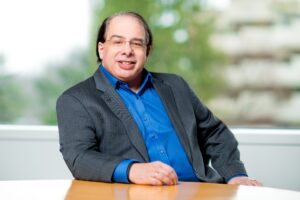
Date/Time: Thursday, 4/18/24, 5-7 pm
Location: Ramapo College, Trustees Pavilion
Join us for the Data, Mathematical, and Computational Sciences (DMC) Fair on April 18th, 2024. This event will feature keynote speaker Dr. Anthony Scriffignano. Anthony Scriffignano is an internationally recognized data scientist with experience spanning over 40 years, in multiple industries and domains. He is a Distinguished Fellow and member of the Loomis Council of The Stimson Center, a nonprofit, nonpartisan Washington, D.C. think tank.
The event will also feature poster presentations from our students’ Senior Capstone projects and Masters Thesis.
Keynote Speaker
Hyperdisruption: How is the datasphere changing? How are we changing with it?
Anthony Scriffignano, PhD
Computer and information sciences are nothing new. Several generations have now been born into a world where computers, databases, information processing and even artificial intelligence exist. However, things are changing lately. Sometimes, when things change and you are part of that change, it can be difficult to notice.
The amount of information available on Earth, sometimes called the Datasphere, is doubling at a rate which arguably can no longer be measured. Much of this information is unstructured, encrypted, or available only with specific access. Other data is created by devices. Even data itself creates data as it moves from one context to another. We are awash in data.
The amount of computing power and processing capability is also at a critical inflection point. Massive computing power and the advent of Generative AI and Quantum computing are challenging the way that computer scientists think about tractability – or how solvable any given problem is.
Against all of this change, the world itself, connected with this massive data and technology is changing. Global disruption such as pandemic, nation-state actions, and social phenomena have created unprecedented challenges. Responding to any one of these challenges might be overwhelming, but the reality is even more sobering, as there isn’t time to completely respond to one disruption before another comes along, producing a sort of disrupted-disruption, or hyper-disruption.
In this session, Dr. Anthony Scriffignano, Distinguished Fellow and Loomis Innovation Council Member at the Stimson Center, a well-respected Washington DC think tank, and CDO Club’s 2018 Chief Data Officer of the Year will explore how the massive availability of data and technology, advances in AI, and response to disruption are creating massive opportunity and ominous risk. This session will cover three main themes: Our Curious World (how the data around us continues to change), The Risks and Our Response (practical examples of using data and AI in the context of disruption to make better decisions), and Future Trends and Recommendations. This talk will challenge our thinking about the skills leaders
need to succeed.
Anthony Scriffignano, Ph.D. is an internationally recognized data scientist with experience spanning over 40 years in multiple industries and enterprise domains. Scriffignano has extensive background in advanced anomaly detection, computational linguistics and advanced inferential methods, leveraging that background as primary inventor on multiple patents worldwide. He also has extensive experience with various boards and advisory groups. Scriffignano was recognized as the U.S. Chief Data Officer of the Year 2018 by the CDO Club, the world’s largest community of C-suite digital and data leaders. He is a Distinguished Fellow with The Stimson Center, a nonprofit, nonpartisan Washington, D.C. think tank that aims to enhance international peace and security through analysis and outreach.. He has served as a member of the OECD Network of Experts on AI working group on implementing Trustworthy AI, focused on benefiting people and planet. He has served as a commissioner for the Atlantic Council, most recently contributing to a Report on the Geopolitical Impacts of New Technologies and Data. He has briefed the US National Security Telecommunications Advisory Committee and contributed to three separate reports to the President, on Big Data Analytics, Emerging Technologies Strategic Vision, and Internet and Communications Resilience.
Additionally, Scriffignano provided expert advice on private sector data officers to a group of state Chief Data Officers and the White House Office of Science and Technology Policy. Scriffignano serves on various advisory committees in government, private sector, and academia. Most recently, he has been called upon to provide insight on data science implications in the context of a highly disrupted datasphere and the implications of the global pandemic. He has published, delivered keynote presentations and participated in panel presentations extensively in various settings internationally concerning emerging trends in AI and advanced analytics, the “Big Data” explosion, artificial intelligence applications and implications for business and society, multilingual challenges in business identity and malfeasance in commercial and public-sector contexts.
Categories: Uncategorized
February 21, 2024Eric Wohltman - Discussion on Software Development at JP Morgan Chase - February 28th @ 6pm
The Computer Science Club is happy to announce their first big event for the semester! Eric Wohltman, a Senior Lead Software Engineer working at the biggest bank in the US (Chase), will give an online presentation. He will share his story about what he did as a college student, how he got his first job at Chase, and how he grew in the company to become a senior lead developer. He’ll also share some tips and some of the mistakes he made along the way. Sure, you do not want to miss it!
DATE: February 28 @ 6 PM
LOCATION: Google Meets
Make sure to RSVP below via Archway 🙂
Categories: Lecture Series, MSCS
February 20, 2024A personal view of the Design and Evolution of C++ - Bjarne Stroustrup

Bjarne Stroustrup, inventor of the C++ language and a pioneer in the field of Computer Science, is coming to Ramapo College on March 13th at 3:30 pm. Join us to learn about the past, present, and future of the language, and Dr. Stroustrup’s personal insights on its impact on the field of Computer Science . Dr. Stroustrup is currently a Professor of Computer Science at Columbia University in New York, NY.
All are welcome! Food will be available, along with a raffle for Google earbuds – courtesy of the Computer Science Club and co-sponsors. Check back here for room information as we get closer to the event.
Categories: Data Science, Lecture Series, MSCS, MSDS
November 7, 2023Balancing business goals with ethical considerations
Monday 11/20 at 6:30pm – Room ASB 136
Please join us for a fireside chat between Prof Jane Riff and Larry Shapiro – Global Engagement Product Director (Oracle) at PwC. The talk will cover balancing business goals with ethical considerations:
- Discuss the challenges of balancing business goals with ethical considerations; explain how you learn to navigate challenges and make decisions that align with both business goals and personal ethical principles.
- The importance of communication skills – the ability to explain a complex technology to non-technical stakeholders and conveying the appropriate ethical considerations to decision-makers.
- How is PwC positioning itself for trends in AI and how will these trends impact your decisions and the ethical considerations that may arise.
All are welcome! Note this is part of DATA 225: Ethics in Technology curriculum.
Categories: Lecture Series
November 6, 2023DMC Thesis Information Session
The Fall 2023 Thesis Information session was held November 6th, if you missed it – here’s the link to the slides from the presentation. Reach out to Dr. Frees or Dr. Beecher for more information!
For graduate students looking to complete their Thesis in Spring 2024, you should be getting started with your thesis proposal – or at least starting to bounce ideas off potential thesis advisors!
For more information, take a look at the Thesis Handbook and Thesis Archive page as well.
October 26, 2023Science in Business: Challenges and Opportunities
Thursday, November 9, 2023, 11:15am – 12pm – Virtual (WebEx)
Please join us for a talk by Dr. Seyma Guven, Senior Applied Scientist at Amazon!
Dr Guven will share her personal journey to realizing how science works in a business setting. The talk will cover perspectives on the challenges and how students can be
better prepared to meet those challenges. This will be an open ended discussion – so bring your questions!
Dr. Guven have a Ph.D. in Operations Research from Georgia Tech, specializing in optimization in supply chain & logistics applications. She has been working for Amazon for 4+ years, in Supply Chain and Optimization Technologies (SCOT) department. She develops mathematical models and methodologies to solve inventory and transportation problems with high uncertainty using operations research and statistics techniques.
WebEx link provided to registrants prior to event
Categories: Data Science, Lecture Series, Uncategorized
October 24, 2023DMC Students meet with Mike Marusic, President and CEO of Sharp Imaging and Information Company of America
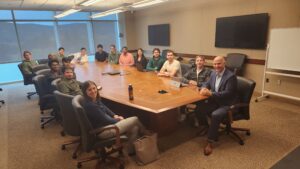
Thursday, October 19, 2023
Students from the Computer Science and Data Science clubs met with Mike Marusic, the CEO of Sharp, following his Presidential Speaker Series talk. This provided Ramapo students with the unique experience of engaging in a small group discussion with the chief executive of a major corporation. Mr. Marusic emphasized the importance of having a strong work ethic and investing time in building a professional network. “I learned that networking on LinkedIn is very important as a student,” said Computer Science Club president Daniel Rajakumar ’26. Students were given the opportunity to ask Mr. Marusic anything, such as what it’s like to work as a CEO, career advice, predictions of future trends in the job market, and more. Data Science Club faculty advisor Dr. Debbie Yuster adds, “Our students had great questions, and Mr. Marusic’s answers were very enlightening. One of the secrets to his success has been taking risks, such as moving between roles in completely new areas of the company. It was amazing for our students to have the opportunity to chat with and learn from such an important leader in business.”
Categories: Uncategorized
May 2, 2023Congratulations to the Data Science Club - New Club of the Year!
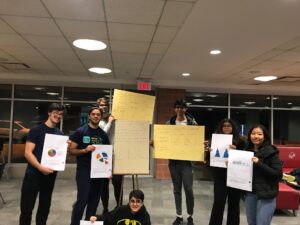
The Ramapo College SGA recognized the Data Science Club with its 2023 “New Club of the Year” award! The club had a great first year, discussing topics such as web scraping, natural language processing, agile software development, and more. They also held social activities, a scavenger hunt, and a “Bad Graph of the Week” series on data visualization.
Congratulations to the Data Science Club membership and a big thank you to the executive board: Founding President Thomas Ortega, Vice President Zainab Makhdum, Secretary Ankit Kafle, and Treasurer Merit Kayastha. Thanks also to the club’s faculty advisor, Prof. Debbie Yuster.
Interested in joining one of the DMC Student clubs? Take a look at the membership and get in touch with one of the club officers or the club’s faculty advisor today!
Categories: Uncategorized
March 29, 2023Bytes & Bites: Dinner and Data with Industry Professionals
Thursday, April 20, 3:30 PM – 6:30 PM (Alumni Lounges)
Please join us for sessions with Jane Riff, Product Manager, Business Intelligence & Advanced Analytics at KPMG and Peter Podolski, Senior Data Scientist at UPS
These sessions will focus on discussing the Capabilities of a Data Science Center of Excellence and on Theory, Practice and Pragmatism in Enterprise Data and Computer Science. This is a 3 part event, with a dinner for attendees served in between the 2 lectures for an opportunity for students to mingle with presenters and to informally discuss topics relating to the presentations.
Event Schedule:
-
- 3:30 PM – 4:30 PM: Presentation on Capabilities of a Data Science Center of Excellence by Jane Riff, KPMG
- 4:30 PM – 5:30 PM: Dinner and mingle with DMC students
- 5:30 – 6:30 PM: Presentation on Theory, Practice, and Pragmatism in Enterprise Data and Computer Science by Peter Podolski, UPS
Categories: Data Science, Lecture Series
March 29, 2023Data in the Music Industry
Tuesday, April 4, 5:00 PM – 6:30 PM – SC-158 (Alumni Lounges)
Please join us for a talk by MSDS Alum Keith Osani, VP of Global Technology Data & Analytics at Sony Music!
This session will discuss the type of data available to music companies from digital platforms such as Spotify, Apple Music, Amazon, YouTube, TikTok and more. We will also explore the increasing volumes of data and the data engineering required to handle it all. Insight will also be given into the tools that data analysts are using to access the data and what types of analysis they are performing.
Categories: Data Science, Lecture Series, MSDS
March 15, 2023Decoding Data Science: A secret recipe for success
Thursday, March 30, 2023 7-8pm – ASB 323
Please join us for a DMC Lecture Series event: Decoding Data Science: A secret recipe for success, given by Dr. Kanad Basu, Data Science Leader & Applied Mathematician!
Abstract of talk:
Data Science has completely transformed all major business sectors such as IT, Banking, Healthcare, Entertainment, Sports & much more. In order to make better & smarter decisions, businesses all over the world have long gathered & analyzed data. The global data science platform market was worth US $ 3.93 billion in 2019 and US $ 4.89 billion in 2020. From 2020 to 2027, it is predicted that the Data Science market will increase at a compound annual rate of 26.9 percent. There has never been a better time to study analytics & data science and contribute to this exciting field.
In this talk Kanad will share his transition journey, lessons picked up along the way, the skills one must develop for being a successful data scientist and how to prepare & market yourself for the job market.
About the author:
Kanad Basu, an interdisciplinary scientist who has 18+ years of analytics and data science experience spanning across academia and industry. Kanad holds the prestigious “Professor of Practice” position at Thunderbird School of Global Management, Arizona State University. He also led a market research data science team at Medallia that focuses on building a consumer behavioral intelligence and benchmarking platform that combines millions of consumer activities to allow businesses to understand where, how, and why consumers spend their time and money. Before Medallia, he led the computer vision data science team at Covisus where he and his team implemented state of the art computer vision algorithms to keep our nation safe by securing supply chains, protecting global compliance for pharmaceutical and medical industries and aiding brands in the prevention of product tampering.
Kanad holds a PhD in Applied & Computational Mathematics, has multiple publications, patents & book chapters around big data analytics and statistical applications in the field of Mathematical Biology & Mathematical Finance. Kanad is a frequent speaker at national & international conferences in AI & Data Science.
Categories: Data Science, Lecture Series, MSCS, MSDS
March 2, 2023Ramapo College DMC - Community College Day
Tuesday, April 18, 2023, 3:00-7:00pm
505 Ramapo Valley Road, Mahwah NJ 07430
- Learn about transfer pathways to complete your BS degree at Ramapo College.
- Earn your MS degree in just one additional year as part of our 4+1 programs in Data Science, Applied Mathematics and Computer Science.
- Come for a campus tour, meet our faculty, and stay for our evening fair, featuring keynote speaker Dr. Luke DuBois (NYU), followed by a student research poster showcase.
Categories: Uncategorized
February 20, 2023Save the date! 2023 DMC Fair - April 18th
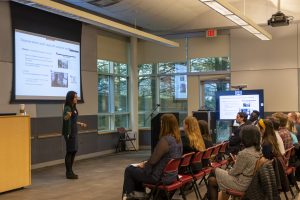
Joint event with the Music Program
Date/Time: Tuesday, 4/18/23, 5-7 pm
Location: Ramapo College, Trustees Pavilion
Join us for the Data, Mathematical, and Computational Sciences (DMC) Fair on April 18th, 2023. This year’s DMC Fair is a joint event with Ramapo’s Master of Fine Arts in Creative Music Technology program. This event will feature keynote speaker Dr. R. Luke DuBois, Associate Professor and Director of Research, Integrated Design & Media at New York University. Here is a link to Dr. DuBois’ TED talk, which weaves information from a multitude of sources into art and music exploring the tensions between algorithms, portraiture, and temporal space.
Description of Talk: For the last twenty-five years Dr. DuBois has been making music and art that comment on the intersection of 21st century culture and our obsession with the quantification of our world. These projects sit somewhere in between portraiture and composition, in that they leverage media, information, algorithms, and emotion to invoke the big picture narratives behind this century of data.
About the Speaker: R. Luke DuBois is a composer, artist, performer, designer, and software engineer who explores the
temporal, verbal, and visual structures of cultural and personal ephemera. He holds a doctorate in music
composition from Columbia University, and is the co-author of Jitter, a software suite for the real-time
manipulation of matrix data developed by San Francisco-based software company Cycling’74; he is a
regular contributor to other toolkits for creative coding, including p5.js and RTCmix. He is the research
director of the IDM program at NYU Tandon, and was a founding co-director of the NYU Ability Project.
Luke’s research interests range from inclusive design to cyber-physical systems to telepresent
collaboration. He works across many disciplines and has collaborated with NYU faculty in departments
ranging from Computer Science to Occupational Therapy, and teaches in a triple appointment between
IDM at NYU Tandon and the programs in Music Technology at NYU Steinhardt and ITP/IMA at NYU Tisch.
He is currently a co-investigator on multiple NSF-funded projects, including SONYC, a multi-year
investigation around noise pollution in New York City; and the NYU Holodeck, a research platform for
investigating what happens when VR, motion capture, and telecommunication infrastructure reach the
level of everyday use. Finally, Luke designs, builds, and restores analog and hybrid analog/digital
modular synthesizers in the audio lab, making open-source designs for creative signal processing.
Following the keynote speech, attendees can view posters showcasing Ramapo students’ research projects in Data, Mathematical, Computational Sciences, and Creative Music Technology. Attendees will be able to network with Ramapo students and faculty as well as industry professionals. Awards will be given for the best posters.
This event was supported by a grant from the Ramapo College Foundation.
Categories: Uncategorized
February 14, 2023Maximum Likelihood Estimation for Discretely Observed Multivariate Vasicek Processes
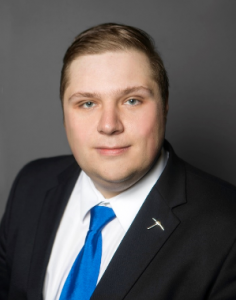
Tuesday, February 21, 2023 – Via WebEx
Please join us for a DMC Lecture Series event: Maximum Likelihood Estimation for Discretely Observed Multivariate Vasicek Processes, given by Dr. Michael Pokojovy, Assistant Professor, Department of Mathematical Sciences, PhD Program in Data Science, PhD Program in Computational Science, The University of Texas at El Paso (UTEP)!
This talk will discuss analyzing multiple zero-coupon bonds simultaneously to forecast future short rate dynamics. Those forecasts can play important roles in risk management, portfolio optimization, and other applications.
Because of low correlation with other asset classes, bonds play major roles in portfolio diversification efforts. A pure discount or a zero-coupon bond is a contract that does not involve intermediate interest payments but is traded at a deep discount, rendering yields at maturity when redeemed at full face value. As investment funds can create robust diversified portfolios with bonds, it is imperative that multiple bonds be analyzed simultaneously. The classical Vasicek model studies individual zero-coupon bonds and assumes the instantaneous interest rate follows a mean reverting process. In this talk, we consider an extension of the original Vasicek model to multiple zero-coupon bonds. The resulting coupled model is given by a stochastic differential equation driven by a p-dimensional white noise process. Given a set of observations over an equispaced time grid, our goal is to calibrate the system and forecast future short rate dynamics. Those forecasts can play important roles in risk management, portfolio optimization, and other applications. This is joint work with Ebenezer Nkum and Thomas M. Fullerton (UTEP).
Michael Pokojovy is an Assistant Professor of Data Science and Statistics. He holds a Ph.D. and a Dipl.-Math. degree in Mathematical Sciences, both from the University of Konstanz, Germany. Prior to his current appointment at UTEP, Dr. Pokojovy has held several postdoctoral positions in Europe and the US. His research interests include Statistical & Machine Learning, Big Data Analytics, Scientific Computing, etc. In addition to numerous theoretical and methodological developments, he has a track record of collaborative research in statistical process control, quantitative finance, engineering, biomedical sciences, rational mechanics, etc. He has authored and co-authored a number of publications in a variety of professional journals. Dr. Pokojovy has also mentored and advised numerous undergraduate, graduate and doctoral students as well as postdoctoral scholars who are now successfully pursuing various exciting careers in industry or academia.
This talk was supported by a grant from the Ramapo College Foundation.
WebEx information will be provided upon registration
Categories: Data Science, Lecture Series, MSCS, MSDS
February 3, 2023Ramapo College and CCM Sign New Jersey’s First Data Science Transfer Agreement!
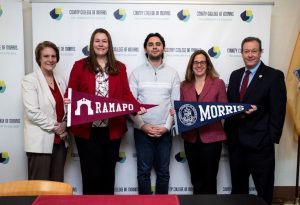
Ramapo College of New Jersey and County College of Morris (CCM) have partnered to create pathways for aspiring data scientists to earn a masters in data science in as little as five years. Through the 2+2+1 agreement, students can begin their education at CCM to earn their associate degree and then seamlessly transfer to Ramapo to earn their bachelors degree and then a masters in data science if they wish. Thomas Ortega, a graduate of Morris Hills High School and CCM, is in his fourth year in the 2+2+1 program and serves as the founder and President of the Ramapo College Data Science Club. Ramapo’s Master of Science in Data Science program is nationally ranked a Top 30 Masters program by Fortune Magazine, making it the #1 graduate data science program in New Jersey. By taking a number of graduate courses as an undergraduate at Ramapo, the masters can be completed in one year, allowing students to enjoy significant savings on their higher education. CCM now has more than 170 transfer agreements to ease the process of earning an associate and then a bachelors degree.
Read more here!
Categories: Uncategorized
January 3, 2023Data Storytelling: The Secret to Delivering Business Impact with Analytics
Thursday, January 26, 2023 – 7-8pm – Location ASB 323
Please join us for a DMC Lecture Series event on Data Storytelling: The Secret to Delivering Business Impact with Analytics, given by Ganes Kesari, the Co-founder and Chief Decision Scientist at Gramener!
Did you know that over 50% of analytics projects fail due to bad data storytelling? Organizations invest heavily in hiring data science experts, buying expensive licenses, and setting up analytics processes. However, without the right data visualization, all this effort will go to waste. Stories have the power to engage people and inspire them to action. This session will introduce you to the concept of data storytelling. It will reveal the 4 steps to mastering visual storytelling with data using exciting industry examples.
Takeaways:
- Understand the top challenges in converting data into actionable business decisions
- Learn the 4-steps to building powerful data stories using real-world case studies
- Find out how data visualization can drive decision-making at organizations
Ganes Kesari is the Co-founder and Chief Decision Scientist at Gramener , a data science company that helps organizations present data insights as stories. He advises executives on data-driven leadership and helps organizations adopt a data culture. Ganes is a TEDx speaker and Forbes Contributor. Find his latest work here: gkesari.com.
This talk was supported by a grant from the Ramapo College Foundation.
Categories: Data Science, Lecture Series, MSCS, MSDS
November 6, 20222022 Information Technology, Data Science & Computer Science Career Fair
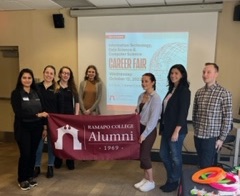
Wednesday October 12, 1-3 pm, Alumni Lounges
On October 12, the Cahill Career Center hosted a specialized fair for Computer Science, Mathematics, Data Science and Information Technology majors to connect them to leading employers within their fields. 13 employers from a wide range of industries attended this event, with nearly 100 DMC students in attendance. Employer feedback was very positive, with high praise for RCNJ students on their preparedness and levels of knowledge. 100% of employers indicated that they would come back and attend more RCNJ events, with a highlight being the amount of engagement they each received from students in attendance. On the student end, surveys indicated more positive outcomes, with a focus on networking and the wide range of job opportunities that were discussed at the fair by employers.
The following employers were represented at this event: ACord Insurance, Aspen Insurance, Brooksource, Crestron Electronics, Gain Theory, Reckitt, SciTec, In., Selective Insurance Company of America, Sharp Electronics, United States Secret Service, UPS as well as the DMC Center and RCNJ Graduate Admissions. Of note, 7 RCNJ alumni represented their respective Employers at this Fair!
Categories: Data Science, MSCS, MSDS
October 25, 20222022 Raciti Memorial Lecture - The Curious Economics of Big-time College Sports
Thursday October 27, 6 pm, ASB 136
Please join us for a DMC Lecture Series event on economics, data, and sports – given by Dr. Brad Humphreys, West Virginia University and the Eastern Economic Association!
Dr. Humphreys is one of the leading sports economists in the world today, mainly known for his contributions to the economics of sports stadiums and the economics of college athletics. He is the 2016-17 Benedum Distinguished Scholar in Social and Behavioral Sciences at WVU and is the recipient of the 2022 Peter Sloane Award for his research contributions to European sports economics. He served as the President of the Eastern Economic Association in 2021-2022.
He is Editor-in-Chief of Contemporary Economic Policy, a general interest economics journal and serves on the editorial boards of the Journal of Sports Economics, the International Journal of Sport Finance, the International Journal of Sport Management and Marketing, and International Gambling Studies. Dr. Humphreys has published over 100 peer reviewed journal articles in leading economics journals.
This talk is sponsored by the Eastern Economic Association in partnership with the Sabrin Center and the Center for Data, Mathematical, and Computational Sciences.
Categories: Data Science, Lecture Series, MSDS
October 11, 2022Using Data and Analytics in Sports
Friday, October 21st at 12-1pm in ASB 225
Please join us for a DMC Lecture Series event on Using Data and Analytics in Sports, given by Dr. Scott Nestler, Principal Data Scientist & Optimization Lead, SumerSports LLC!
The use of data and analytics in sports has changed significantly in the nearly two decades since the release of the book “Moneyball” in 2003. Moving from descriptive to predictive and prescriptive (in terms of the types of analytics used), this evolution was enabled by changes in the type (box score, play-by-play, tracking) of data, as well as growth in quantity and improvements in quality. Analytic methods are being used to measure and predict individual and team performance, prevent injuries, and improve business outcomes. Besides providing a variety of examples from across different sports, I will provide suggestions on how those seeking to get into the growing field of sports analytics can ensure that they have the skills that are sought by teams and other organizations.
This talk was supported by a grant from the Ramapo College Foundation.
Scott is a “pracademic” who joined the Sumer Sport team in 2022, after a variety of experiences, including: Data Science Senior Manager / Director of Statistics & Modeling at Accenture Federal Services; Academic Director for the MS in Business Analytics program at Notre Dame, and a full career as an operations research analyst (and leader of analytic teams) in the U.S. Army. He teaches as an Adjunct Faculty Member for Notre Dame and SMU. Scott is very involved as a volunteer and leader with the Institute for Operations Research and the Management Sciences (INFORMS), where he served as the first Chair of the Analytics Certification Board, the governing body for the Certified Analytics Professional (CAP) program. He has a PhD in Management Science from the University of Maryland – College Park, is a CAP, and also an Accredited Professional Statistician (PStat). He is co-author of the book
“Mathletics: How Gamblers, Managers, and Fans Use Mathematics in Sports,” Princeton University Press, 2002.
His motto is, “Make yourself useful, doing something hard, with good people.” Scott enjoys traveling (he’s been to all 50 states and 25 countries), reading, cooking, and sitting around the firepit with family and friends.
Categories: Lecture Series
September 27, 2022Data Assimilation and Dynamical Systems Analysis of Circadian Rhythmicity and Entrainment
Wednesday, October 12th at 6-7pm in ASB 327
Please join us for a DMC Lecture Series event on Data Assimilation and Dynamical Systems Analysis of Circadian Rhythmicity and Entrainment, given by Dr. Casey Diekman of the New Jersey Institute of Technology!
Circadian rhythms are biological oscillations that align our physiology and behavior with the 24-hour environmental cycles conferred by the Earth’s rotation. In this talk, I will discuss two projects that focus on circadian clock cells in the brain and the entrainment of circadian rhythms to the light-dark cycle. Most of what we know about the electrical activity of circadian clock neurons comes from studies of nocturnal (night-active) rodents, hindering the translation of this knowledge to diurnal (day-active) humans. In the first part of the talk, we use data assimilation and patch-clamp recordings from the diurnal rodent Rhabdomys pumilio to build the first mathematical models of the electrophysiology of circadian neurons in a day-active species. We find that the electrical activity of circadian neurons is similar overall between nocturnal and diurnal rodents but that there are some interesting differences in their responses to inhibition. In the second part of the talk, we use tools from dynamical systems theory to study the reentrainment of a model of the human circadian pacemaker following perturbations that simulate jet lag. We show that the reentrainment dynamics are organized by invariant manifolds of fixed points of a 24-hour stroboscopic map and use these manifolds to explain a rapid reentrainment phenomenon that occurs under certain jet lag scenarios.
This talk was supported by a grant from the Ramapo College Foundation.
Casey Diekman is a mathematical biologist and Associate Professor in the Department of Mathematical Sciences at the New Jersey Institute of Technology. He obtained his PhD in Bioinformatics and Industrial & Operations Engineering from the University of Michigan in 2010. Diekman was then a Postdoctoral Fellow at the Mathematical Biosciences Institute at Ohio State University until joining the NJIT faculty in 2013. Recently, he spent a year in residence at the University of Exeter as a US-UK Fulbright Scholar. Diekman’s research interests include mathematical and computational modeling of circadian (~24-hour) rhythms such as the sleep-wake cycle, data assimilation, machine learning, and dynamical systems analysis. His research has been supported by the National Science Foundation and the US Army Research Office.
Categories: Lecture Series
September 12, 2022Welcome new MS and 4+1 in Data, Mathematical, and Computational Sciences students!
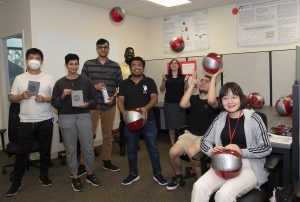
We are excited to welcome students into our new MS in Applied Mathematics and MS in Computer Science programs at Ramapo College! They join our MS in Data Science students as members of our DMC community. All of these new programs are taught by our dedicated full-time faculty. We had a chance to meet them on Thursday, September 8th at the DMC Meet-and-Greet. We are so happy you chose to continue your education with us!
Categories: Uncategorized
August 25, 2022Ramapo College’s Master of Data Science Program Recognized by ‘Fortune’ among the Best in the Country
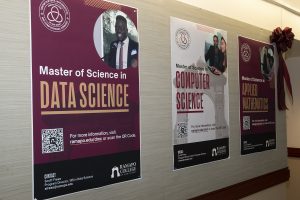
Ramapo College of New Jersey’s Master of Science in Data Science (MSDS) program has been determined by Fortune to be among the top programs in the country. Ramapo’s program is also the only New Jersey program to be included in Fortune’s first-ever ranking list of 28 graduate-level data science programs nationwide.
Categories: Data Science, MSDS
July 2, 2022DMC Advisory Board Member - Keith Osani
Ramapo College’s Center for Data, Mathematical, and Computational Sciences welcomes Keith Osani to our Advisory Board! Our Advisory Board’s mission is to assist the Center in aligning our curriculum with industry needs and expectations, helping us to promote our curriculum, and guide us in developing our sponsored fieldwork experiences to our students.
Keith earned a BS in Computer Science and Applied Physics from SUNY Albany and graduated from Ramapo College in 2022 with a Master’s Degree in Data Science. The
early part of his career was spent working as a consultant where he focused on custom software and web development for a variety of clients. For the last 20 years, Keith has worked in the music industry for Sony Music Group. Over the years with Sony, he has had the opportunity to work in royalties, digital supply chain and most recently data reporting and analytics. He is currently the Vice President of Data and Analytics in the Global Technology group. In this role, Keith leads a data engineering team responsible for the collection and storage of vast amounts of streaming consumption data reported by providers such as Spotify, Apple Music and Amazon. His team is also responsible for supporting Sony’s global community of analysts.
Categories: Data Science, MSCS, MSDS
April 15, 2022Grand Opening of the Center for Data, Mathematical, and Computational Sciences

Wednesday, April 27th at 6pm
ASB 123
Join us in opening the new Center for Data, Mathematical, and Computational Sciences. This research space serves as a place for graduate students and students in 4+1 programs to work in groups, deliver presentations, and hold team meetings. It’s a great place to hold faculty/student meetings and research discussions, and to invite our external partners to campus.
For more information contact Dr. Amanda Beecher (abeecher@ramapo.edu)
Categories: Data Science, MSCS, MSDS
April 4, 2022Fall 2022 DMC Course Schedule
1st Year Students
Welcome to Ramapo College of New Jersey! Whether you are entering the MS in Data Science, Applied Mathematics, or Computer Science, there are a few things you will want to take care of to get ready for your first semester. Admissions has a guide for admitted students, which outlines the registration process and a number of other things of interest.
Fall 2022 Course Schedule
-
CMPS 547 – Foundations of Computer Science
This course provides a foundational overview of programming language design, including compiled languages as well as higher level scripting languages. The course introduces students to concepts such as grammars, binding, scope, flow control, and data abstraction – through the lense of multiple languages. Students will also gain experience programming across language interfaces. This course serves 3 core purposes as a foundational course for MSCS students: (1) Principles of Programming Languages – this course serves as a general introduction to the theory of computation and programming language design. Topics cover basic theory of computation, and language principles such as context free grammars; binding and scope; static and dynamic semantics; type safety; recursion; concurrency. The theoretical topics covered throughout the course will be demonstrated / mapped to the programming topics languages introduced. (2) The C programming language – students are introduced to the C as a way to prepare them for courses such as Operating Systems and so they understand aspects of low level programming language to support the Computer Architecture course as well. The fundamental topics in C include types, control flow, structures, arrays, pointers, and relationship to hardware via compilation. (3) Python Programming – students will learn how higher level languages differ from C, and how they map to lower level languages. Significant time will be spent covering a variety of language concepts through the lens of Python, culminating with extending Python via C through Cython.
Monday nights – 6:05pm – 7:20pm
Required for MS Computer Science first year students.
Category 2 elective for MS Applied Mathematics students -
MATH 680 – Advanced Mathematical Modeling
This course requires students to develop, use, and assess models to solve real-world problems using the mathematical modeling process. Models developed in a variety of disciplines, including linear programming, network science, decision theory, machine learning, are studied and used to solve problems in other disciplines.
Monday nights – 6:05pm – 7:20pm
Required for MS Data Science second year students.
Required course for MS Applied Mathematics students (any year, with pre-requisites).
Category 2 elective for MS Computer Science students (with pre-requisites).DATA 601 – Introduction to Data Science
This course serves as the foundation for all DATA graduate level coursework. It will cover programming, data analysis, data visualization, ethics and security / privacy concerns surrounding data, and other topics students are expected to master in the program. The course will also feature a Seminar component designed to acclimate students to working with Industry Sponsors and to hear first hand from people working in Data Science.
Tuesday nights – 6:05pm – 7:20pm
Required for MS Data Science first year students.
Category 2 elective for MS Applied Mathematics (recommended for first year students).MATH 570 – Applied Statistics
This course gives an introduction to statistical methods used in data science with an emphasis on applications. Topics may include foundations of probability, univariate and multivariate random variables and distributions, special distributions, Central Limit Theorem, one- and two-sample methods, point estimation, interval estimation, hypothesis testing, regression analysis, Bayesian analysis, data analysis and model building.
Tuesday nights – 8pm – 9:15pm
Required for MS Data Science full time first year students. May be deferred to future semester for part time MSDS students.
Required for MS Applied Mathematics students full time first year students. May be deferred to future semester for part time MSAM students.
Category 2 elective for MS Computer Science students (recommended for first year students).CMPS 530 – Python for Data Science
This course introduces students to fundamental programming concepts and skills utilized by Data Scientists – in particular parallel computing, I/O, and visualization – all through the Python programming language and associated libraries (i.e. numpy, pandas, etc.). The course is suitable for students with a basic knowledge of programming, and prepares students to take more advanced computing courses in databases, big data analytics, machine learning, and other DATA and CMPS electives.
Required for MS Data Science full time first year students. May be deferred to future semester for part time MSDS students.
Category 2 elective for MS Applied Mathematics students (strongly recommended for first year students).
Category 1 elective for MS Computer Science students (recommended for first year students).MATH 562 – Applied Linear Algebra
This course is a foundational course for the study of Linear Algebraic structures used in a variety of scientific and computational applications, such as data fitting, clustering, feature engineering, image processing, machine learning, optimization, and dynamical systems. In order to achieve this purpose, this course will cover topics in linear algebra including vector and matrix operations, linear transformations, linear independence, norms, decomposition, and least squares.
Thursday nights – 8pm – 9:15pm
Category 1 elective for MS Data Science students.
Required for MS Applied Mathematics (strongly recommended for first year students).
Category 2 elective for MS Computer Science students (recommended for first year students).Categories: Uncategorized
March 24, 2022DMC Advisory Board Member - Dobri Yordanov
Ramapo College’s Center for Data, Mathematical, and Computational Sciences welcomes Dobri Yordanov to our Advisory Board! Our Advisory Board’s mission is to assist the Center in aligning our curriculum with industry needs and expectations, helping us to promote our curriculum, and guide us in developing our sponsored fieldwork experiences to our students.
Dobri is a Ramapo ’15 graduate with a BS in Computer Science and Mathematics. He started his career with web and flash freelancing even prior to attending and was a part of developing the infrastructure behind most of the ramapo.edu websites. After graduation, he spent 4 years at Google, working on critical infrastructure on Google Maps, Google Assistant and Daydream (virtual / augmented reality). Facebook was the next prototyping home for him, where he led engineering on a music collaboration experience called Collab as a part of NPE, Facebook’s experiences incubator. Most recently, he’s joined Manticore Games as a principal engineer, leading major efforts to build out the next big thing in game development. Dobri is also an adjunct faculty in computer science at Ramapo, most recently running a course on computer graphics in Unreal Engine 5.
Categories: Uncategorized
March 22, 2022DMC Advisory Board Member - Yoav Nathaniel
Ramapo College’s Center for Data, Mathematical, and Computational Sciences welcomes Yoav Nathaniel to our Advisory Board! Our Advisory Board’s mission is to assist the Center in aligning our curriculum with industry needs and expectations, helping us to promote our curriculum, and guide us in developing our sponsored fieldwork experiences to our students.
Yoav Nathaniel was born in Israel and grew up in New Jersey, where he attended Ramapo College to study computer science. In 2015, while in school, Yoav joined Avanan, a cloud security startup that was later acquired by CheckPoint, as it’s first employee. Initially focused on QA for Avanan’s product, but later shifted to development, sales, marketing and cloud security thought leadership. Yoav later joined Goldman Sachs and led its firm wide cloud security engineering team, governing the cloud security standards of over 10,000 engineers. In early 2022, Yoav co-founded Silk Security to help security teams accelerate their remediation processes and save hours of work per week.
Categories: Data Science, MSCS, MSDS
March 1, 2022Center for Data, Mathematical, and Computational Sciences Fair
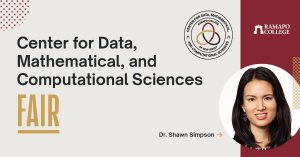
Date/Time: Tuesday, 4/5/22, 5-7pm
Location: Ramapo College, Trustees Pavilion 1Join us for the Data, Mathematical, and Computational Sciences Fair on April 5th, 2022! This event will feature keynote speaker Dr. Shawn Simpson, Principal Data Scientist at BlackRock AI Labs, who will share practical tips gleaned from her career as a Data Scientist in finance, media, and advertising. Following the keynote speech, attendees will have the chance to view posters showcasing Ramapo students’ research projects in Data, Mathematical, and Computational Sciences. Attendees will be able to network with Ramapo students and faculty, as well as prospective employers who may be looking to hire interns or full-time employees. Awards will be given for the best posters.
This event is open to current and prospective students, faculty, staff, and members of the public.
This page will be updated as more information about the event is announced
Schedule
- 5:00-5:05pm Guests arrive
- 5:05pm-5:10pm Welcome remarks (President Cindy Jebb)
- 5:10-5:20pm Welcome and overview of Ramapo’s bachelor and master degree programs in Data, Mathematical, and Computational Sciences (Scott Frees and Amanda Beecher)
- 5:20-6:15pm Keynote speech: “Field notes for future data scientists: tips from a career in industry” by
Dr. Shawn Simpson, Principal Data Scientist, BlackRock AI Labs. See additional information below. - 6:15-7:00pm Student poster session and networking event
Keynote Speaker
Speaker: Dr. Shawn Simpson, Principal Data Scientist, BlackRock AI Labs
Title: Field notes for future data scientists: tips from a career in industry
Abstract: When training to be a data scientist there is an emphasis on data analysis and modeling
techniques — but what happens once you are out in industry? This talk will provide practical suggestions based on my career in data science, with examples drawn from applications in news and media, finance, and advertising technology. Topics will include going deep with data, understanding uncertainty, joining forces with engineers, taking a product mindset, knowing your end user, and architecting end-to-end systems.Speaker bio: Shawn Simpson, Ph.D. is Principal Data Scientist in BlackRock AI Labs, where she leads an initiative that builds AI-powered decision tools for traders. Previously she was Senior Data Scientist at Tapad, a cross-device advertising technology firm. She built large-scale predictive models for telco applications using Scala, Spark/PySpark, Python, Hadoop MapReduce, and Google Cloud Platform technologies, and acted as lead data scientist on cross-functional product teams. Prior to that Shawn was Head of Data Science at Dow Jones. She was responsible for multivariate paywall testing on WSJ.com, predictive models for subscriptions and cancellations, company-wide data science training,
and internal consulting for newsroom, finance, and customer teams.Before joining industry Shawn was an Assistant Professor of Statistics at Columbia University. Her research focused on analysis of recurrent events, Bayesian methods for large-scale data, and post-
marketing drug safety surveillance. She has a Ph.D. in Statistics from Columbia University and a B.S. in Electrical Engineering from the University of Illinois at Urbana-Champaign.Categories: Uncategorized
February 15, 2022Multifractal Analysis of Daily US COVID-19 Cases
Wednesday, March 23rd at 6-7pm in ASB 323
In this talk we discuss how the multifractal detrended fluctuation analysis (MFDFA) technique can be used to explore the highly irregular behavior or volatility clustering of daily COVID-19 cases in the United States. By using the multifractal spectrum of the MFDFA we will characterize the path and predict the short or long memory behavior of the US COVID-19 Cases on different time scales.
Biography: Osei Tweneboah is Assistant Professor of Data Science at Ramapo College of New Jersey. His main research is Stochastic Analysis, Machine Learning and Scientific Computing with applications to Big Data and Complex Data sets arising in Finance, Public Health, Geophysics, and others. Dr. Tweneboah is co-author of the textbook Data Science in Theory and Practice: Techniques for Big Data Analytics and Complex Data Sets recently published by Wiley.
Categories: Data Science, Lecture Series, MSDS
February 7, 2022How to fail your tech interview successfully
Feb 22nd at 6-7pm in ASB 332
Computer Science is hard. Being a Software Engineer is hard. Translating your computer science skills into a successful Software Engineer gig after college shouldn’t be hard. After interviewing close to 100 candidates at all levels for Google, Facebook and Manticore, Dobri Yordanov has a few tips and tricks to share, as well as pitfalls to avoid. Join us if you’d like to hear about them, be it out of curiosity or practicality. Everyone is welcome!
Biography: Dobri is a Ramapo College ’15 graduate, originally from Bulgaria. Since graduating, he’s built a career as a Software Engineer and a self-described Prototype Wizard in large tech working for Google and Facebook, and most recently landing in the game industry as a principal engineer at Manticore Games. As of ’21, you can occasionally catch him in Ramapo teaching some of our Computer Science classes. He likes long walks on the beach in VR and philosophical ponderings about the nature of our existence and ethics in technology. He will also absolutely listen to you about your favorite algorithm or design paradigm – he is 100% that kind of dork.
Categories: Lecture Series, Uncategorized
November 16, 2021Data is the new OIL - Slides and Thank you
Thank Arnab Mukhopadhyay for his insightful overview of how corporations view data, and how that view has evolved. In case you missed it, take a Data is the new OIL from the presentation.
Categories: Data Science, MSDS
November 3, 2021Data Science in Theory and Practice: Techniques for Big Data Analytics and Complex Data Sets
Congratulations to Ramapo’s Data Science Professor Osei Tweneboah. Dr. Tweneboah has co-authored the textbook Data Science in Theory and Practice: Techniques for Big Data Analytics and Complex Data Sets recently published by Wiley. This book is perfect for data practitioners, undergraduate and graduate students in Data Science, Business Analytics, and Statistics programs. It provides a comprehensive treatment of the mathematical and statistical models useful for analyzing data sets arising in various disciplines, like banking, finance, health care, bioinformatics, security, education, and social services.
Categories: Uncategorized
November 1, 2021Lecture Series: Data is the New Oil- Why Now?
Wednesday, November 10, 2021 at 5:00 PM until 6:00 PM – Eastern Standard Time
Ramapo College is proud to host a Graduate Lecture Series about a variety of interesting topics throughout the year.
During the RCNJ Lecture Series: Data is the New Oil- Why Now, you’ll have the opportunity to hear from Arnab Mukhopadhyay, Head of Enterprise Architecture at Valley Bank more about exploring a systemic or architecture-based viewpoint on exploring various aspects of data – ranging from an overview on data technologies, data integration, data analytics, data governance, and industry usage of data.
For more information about this particular topic, or questions about the event, please email Professor Scott Frees at sfrees@ramapo.edu and we will be happy to assist you.
You won’t want to miss this exciting and informative Graduate Lecture Series Event.
Categories: Lecture Series, Uncategorized
October 11, 2021Using Machine Learning to Analyze and Predict the Movement of Horseshoe Crabs in Long Island Sound - Recording
We want to thank Dr. Samah Senbel for the wonderful talk on using Machine Learning to analyze the movement of Horseshoe Craps in the Long Island Sounds. In case you missed it, her talk can be viewed here.
Categories: Uncategorized
August 27, 2021Using Machine Learning to Analyze and Predict the Movement of Horseshoe Crabs in Long Island Sound
Dr. Samah Senbel, Assistant Professor of Computer Science at Sacred Heart University will be describing her work on developing machine learning models to predict animal movement patterns. Please join us (virtually) on Monday, September 27th at 1pm to learn more about this important area of study in ecology, conservation and wildlife management.
Connection details will be provided after registration.
Abstract: Developing models to predict animal movement patterns is an important area of study in ecology, conservation and wildlife management. Models can be used to decipher patterns in mark-recapture data and machine learning can help to make predictions about future animal movement patterns. Project Limulus (PL), a community research program, has been tracking the movement of tagged individuals in the population of American horseshoe crabs (Limulus polyphemus) in Long Island Sound since 1997. During the spring spawning season, horseshoe crabs are captured by hand in spawning areas along the Connecticut (CT) shoreline, tagged and then released. Recaptured horseshoe crabs give valuable information about their behavior, if they exhibit site fidelity and movement patterns around the Sound. In this paper, we tested various models to find the best predictor for the movement of spawning horseshoe crabs to shorelines in the Sound based on the observed movement activity in previous years. The dataset consists of all the previous horseshoe crab movements: initial longitude and latitude, sex, initial date, and recapture longitude and latitude and recapture date. This dataset has 19,219 recapture records covering twenty years of activity. We experimented with three different models: Linear Regression, Decision Tree, and Random Forest Regression models. We used the data for 2018 as our test set and the data of all previous years as our training set. The Random Forest Regression model proved to be the best predictive model for animal movement and resulted in the smallest RMSE and MAE, as well as the smallest maximum error in prediction. The predicted horseshoe crab locations can be targeted in the next season for recapturing previously tagged horseshoe crabs, which provides valuable information about their movement patterns. It also concentrates the scientists’ effort and time to find the maximum number of horseshoe crabs.
This talk is supported by a grant from the Ramapo College Foundation.
Categories: Data Science, Lecture Series, MSDS
April 21, 2021MSDS Students at Scholars Week - College Football Recruiting Using Machine Learning Techniques
Colette Barca, Keith Osani, Nisha Srishan, and William “Brady” Wulster are inaugural members of the Master’s in Data Science program. During their MATH 570 Applied Statistics course with Professor Osei Tweneboah, they designed and completed a research project to predict high school football recruits’ college commitments using several Machine Learning techniques.
The four designed their project with the understanding that college football is big business. To create a winning team that will continue to generate revenue, Division I Football Bowl Subdivision (FBS) Power Five schools need to choose their recruits wisely. Recruits are selected
based on certain player attributes. Power Five schools are the most frequented schools by NFL scouts, making these schools highly desired by recruits. In this regard, Barca, Osani, Srishan, and Wulster built a model to predict whether a high school recruit will commit to a school in one of the Power Five Conferences. Such a model could allow a school to optimize its recruiting process, maximizing its return on investment. They used their dataset to fit several Machine Learning models. After completing the project, it was determined the Random Forest model produced the most accurate results. This model also revealed which particular attributes are indisputably the most important predictors of commitment to a Power Five school. This final model has the potential to be successfully used to improve the recruiting process.Categories: Data Science, MSDS
January 21, 2021From Data Ethics to Data Justice: The Challenge of Building Better Worlds through Data Science
Dr. Andrea Pitts, Assistant Professor of Philosophy at the University of North Carolina, Charlotte will be describing this new new branch of study within applied ethics, a subfield in professional ethics that includes areas of research and practice such as computing ethics, media ethics, and biomedical ethics. This new branch of applied ethics responds, specifically, to novel applications and technologies for data storage, maintenance, and processing that add new layers to the study of morally relevant considerations within information ethics, business ethics, and AI ethics, for example.
Categories: Lecture Series, Uncategorized
August 22, 2020Convolutional Neural Networks for Face Recognition
We are happy to announce that Dr. Ausif Mahmood has rescheduled his talk on Convolutional Neural Networks this fall virtually.
Dr. Mahmood is the Director of The School of Engineering at the University of Bridgeport in Bridgeport, CT. His research areas involve Artificial Intelligence, Computer Vision, Machine Learning, and Deep Learning – bridging ties between Computer Science and Data Science.
Please join us virtually on September 17th at 1:00pm – 2:00pm. Registration is required, registrants will receive web conferencing information a few days prior to the event.
You’ll also have the opportunity to learn more about Ramapo’s new Data Science programs, launching this coming fall.
Categories: Uncategorized
August 6, 2020MSDS - Fall 2020 Course Delivery Update
As we look forward to the start of our Fall 2020 semester, we wanted to share with you our plans for course delivery starting in September.
As you hopefully know, Ramapo College is required to adhere with the State of New Jersey’s phased reopening plan. This plan identifies which activities and classes colleges and universities may conduct on campus, and the precautions we must take.
Based on current public health conditions as of August 3rd, NJ is currently still in Phase 2 – which prohibits on-campus meetings for all courses other than laboratory (i.e. biology labs) and studio (i.e. theatre) meetings. Regrettably, this means our MSDS courses will not meet on campus this coming semester, and will be conducted virtually.
As you know, MSDS had planned for all three of our Fall courses (DATA 601, MATH 570, and CMPS 530) to meet for approximately one hour each Thursday evening, with the rest of the course instruction asynchronous and online. Our virtual instruction format will be quite similar – each of the three MSDS courses will include synchronous WebEx (or Zoom) meetings on Thursday evenings, as scheduled. The individual instructors for each course will soon be in contact with you concerning the details for their particular course. Each of us have experience teaching in this format, and while we prefer us all to be on campus in the classroom, we are confident the mix of synchronous and asynchronous online instruction will be a success.
International Students: Please contact the Roukema Center, specifically Rajesh Adhikari (adhikar@ramapo.edu), to discuss your student visa status. There have been a number of USCIS delays due to the pandemic, along with specific federal policy changes concerning visa status for students in 100% online programs. Rajesh Adhikari can discuss your options with you.
Many of you have already received a bill for the Fall 2020 semester. There are three fees associated with these bills that require your attention:
Health Insurance Reminder: As indicated in a previous email, your bill will include healthcare insurance students may purchase through Ramapo. If you already have health insurance, you may opt out. Click here to opt out or email the Office of Student Accounts at studentaccts@ramapo.edu.
Parking Lab Fees: Since we will not have classes on campus, most of you will not utilize campus parking unless coming to campus for other reasons. If you do not intend on coming to campus, you may complete a waiver to avoid parking fees. Parking charges are NOT REMOVED from student accounts; they are offset by the credit of the waiver transaction. STUDENT ACCOUNTS WILL REFLECT BOTH THE CHARGE AND THE CREDIT.
Course Lab Fees: We are in the process of reviewing all courses across the campus to determine which courses will still have computer lab fees – due to their dependence on remote / cloud hosted software that the College maintains whether students are physically present or not. Lab Fees for courses that do not fit into this category will be credited to your account. In all likelihood, MSDS courses will not have a lab fee. Please be patient as we work through this process.
As a reminder to all, the Fall schedule can be found here. For those of you who have not yet registered for your courses, or have not set up your Ramapo College email, please take a look at Admissions’ guide for admitted students. To complete the MSDS in 2 years, we advise students to register for DATA 601, CMPS 530, and MATH 570 in the Fall semester. DATA 601 and CMPS 530 are of particular importance, as they are prerequisites for courses you will take in the Spring ‘21 semester.
Categories: Uncategorized
April 25, 2020MSDS Fall course delivery options related to COVID-19
With uncertainty surrounding the upcoming Fall semester due to the COVID-19 pandemic, we want you to know our contingency plans in case of disruption.
All MSDS courses for the Fall 2020 semester are scheduled to be delivered as hybrid courses. This means a large portion of course content will be delivered online, however the course will meet once a week on campus. We’ve scheduled all three MSDS courses to meet on Thursday evenings.
There are two scenarios that could alter these plans:
- Ramapo College converts the Fall 2020 semester to online-only / remote delivery. In the unlikely event this happens, our hybrid format is well suited to move to 100% online, and our faculty have ample experience with this format. While we’d prefer to have the on-campus component, we will be well prepared and will still have a successful semester.
- Ramapo College holds on-campus courses as normal, however you, personally, are unable to be on campus. This could be because you are in a high risk category for COVID-19 and prefer not to attend in-person classes. This could also happen if you have difficulty obtaining a student visa to enter the United States due to delays related to the pandemic. In anticipation of these situations, we are committed to allowing students to attend the on-campus meetings virtually, through live stream or recording.
As we move through the summer and details of the Fall become more clear, we will provide additional details about remote delivery options.
Please stay safe, and we very much hope to see you in the Fall!
Categories: Data Science
February 10, 2020Ramapo adds new Mathematics faculty to support Data Science
Ramapo College is excited to welcome Matthew Jobrack to our Mathematics faculty.
Matthew Jobrack holds a B.S. in mathematics from Longwood University with a concentration in secondary education, a M.A. in mathematics from Appalachian State University, and a M.S in Statistics from Washington State University. He is currently a doctoral candidate in mathematics at Washington State University specializing in analytic number theory, with additional research interests in statistical wildlife population models. He has coauthored peer-reviewed publications in both mathematics and math education. He currently lives with his wife, daughter, 2 cats and 1 dog.
Categories: Data Science
January 13, 2020Ramapo welcomes new Data Science faculty member
Ramapo College is excited to welcome new Data Science faculty member Dr. Debbie Yuster. Dr. Yuster holds a B.A. in Mathematics with a concentration in Computer Science from Cornell, and a Ph.D. in Mathematics from Columbia, specializing in the field of Combinatorics.
Dr. Yuster joins us from SUNY Maritime College, where she has been a math professor for over a decade, earning accolades such as the SUNY Chancellor’s Award for Excellence in Teaching. Dr. Yuster served as a Visiting Data Science Scholar at the Wall Street Journal, and has cultivated industry partnerships leading to student research projects. She has authored peer-reviewed journal publications in mathematics, and has given numerous invited lectures. Dr. Yuster is also interested in K-12 STEM outreach, having worked with secondary school math teachers and students for many years. As part of Ramapo’s Data Science program, Dr. Yuster will teach courses in Data Science, Mathematics, and Computer Science.
Categories: Data Science
December 10, 2019Ramapo welcomes first new Data Science faculty member
Ramapo College is excited to welcome our first new Data Science faculty member, Osei Tweneboah. Osei is a Ph.D. Candidate in the Computational Science Program at the University of Texas at El Paso (UTEP) and will be joining Ramapo this coming Fall – where he will be teaching courses in Python and Applied Statistics.
Osei’s research interests include data science and stochastic analysis with applications to big data analytics and complex data sets arising in finance, health care, geophysics etc. Osei has co-authored fourteen (14) peer reviewed papers in the areas of statistics and data science, applied mathematics and computational science. His most recent work involves applying mathematical modeling processes originally applied to financial data to predicting natural phenomenon – such as earthquakes.
Categories: Data Science
November 20, 2019Data Science at ESPN: NBA player performance

Join us on December 5th to hear Brian Macdonald showcase how Data Science identifies the value of box score statistics in estimating NBA players’ contribution to on-court performance. Dr. Macdonald is the Director of Sports Analytics at ESPN, and has a doctorate in Mathematics from Johns Hopkins University.
Please join us in the York Room (Mansion) on December 5th at 4pm to hear about how these approaches can be applied to a variety of sports such as hockey, soccer, football, and eSports.
You’ll also have the opportunity to learn more about Ramapo’s new Data Science programs, launching this coming fall.
Categories: Data Science, Lecture Series