- About Ramapo
- Academics
- Admissions & Aid
- Student Life
- Athletics
- Alumni
- Arts & Community
- Quick Links
- Apply
- Visit
- Give
Center for Data, Mathematical and Computational Sciences
March 8, 2026Ramapo DMC / RMI Internship Opportunity
The DMC Center has two paid internship openings supporting the Ramapough Munsee Lenape Nation — one focused on application development and IT support, and one focused on community data intake work ideal for students with digital humanities backgrounds. Both positions carry a $5,000 stipend starting late March; read on for details and how to apply!
About the Partner
The Ramapough Munsee Lenape Nation are descendants of the original inhabitants of New Jersey, southern New York, and parts of Connecticut and Pennsylvania. State-recognized since 1980, the Nation’s approximately 5,000 members are concentrated in the Ramapo Mountains along the NY/NJ border, with others scattered across the United States.
The Nation operates through Ramapough Munsee Lenape, Inc. (RMI) to coordinate services including youth education, elder care, food sovereignty programs, and tribal governance. A central challenge for the organization is membership record keeping — census data is currently fragmented across paper files, individuals, locations, and disconnected digital systems.
Accurate census data is required for:
- State and federal grant applications supporting education, healthcare, and food security programs
- Tribal leadership elections, with changes coming in the near term
Project Description
The DMC Center is partnering with the Ramapough Munsee Lenape Nation to build a modern data infrastructure system supporting their operations and grant-seeking capacity. Two interns will work closely together and directly with tribal staff throughout the project.
Project Deliverables
- Tribal membership database — centralized system consolidating data currently scattered across locations, individuals, paper files, and disconnected digital systems
- Member intake application — user-friendly tool enabling tribal staff to collect, enter, and update member records
- ID card printing system — application to produce official tribal membership ID cards
- Digital document ingestion pipeline — tooling to ingest and organize historical paper and digital records into the new database
- Automated grant reporting system — generates formatted reports for federal and state assistance applications
- IT/cybersecurity support — on-site assessment and hands-on support for the Nation’s systems and data infrastructure
Position 1: Application Developer & IT/Cybersecurity Support
Supervised by: Dr. Scott Frees, Professor of Computer Science
This intern works directly with Dr. Frees to build and deploy the software systems, and provides hands-on IT support to the tribe on-site.
Primary responsibilities:
- Extend DMC created tribal membership database and intake application
- Develop the ID card printing system
- Build the digital document ingestion pipeline
- Conduct an IT/cybersecurity assessment of current infrastructure
- Provide on-site IT support — configuring systems, troubleshooting, documenting infrastructure
- Collaborate with the Data Intake intern to ensure systems reflect real-world field needs
Ideal background:
Note that applicants should be current Juniors, as this project is may extend into next year. The skill below are not required, they are preferred.
- Web application development (Node.js preferred; other frameworks welcome)
- Database design and SQL
- General programming experience — breadth matters more than mastery of any single tool
- A significant plus: IT support experience, cybersecurity coursework
Position 2: Digital Data Curation
Supervised by: Prof. Sarah Koenig, School of Humanities and Global Studies
This intern works directly with tribal staff and community members to gather, verify, and digitize membership data — translating real-world records and community knowledge into structured entries that feed the new database.
Students with backgrounds in digital humanities, history, sociology, anthropology, communications, or related fields are strongly encouraged to apply. Students who combine humanities and technical experience are especially competitive for this role.
Primary responsibilities:
- Conduct structured intake sessions with tribal staff and members to gather and verify membership data
- Digitize paper records and legacy documents for ingestion into the database
- Work with tribal staff to identify gaps and develop strategies for reaching members with missing records
- Document data provenance — where records came from and how they were verified
- Assist with quality assurance on incoming data
- Help develop intake workflows that are clear and accessible for tribal staff
Ideal background:
- Experience with community engagement, oral history, archival work, or qualitative research
- Strong interpersonal skills — this role involves direct, sustained work with community members
- Attention to detail and comfort with structured data entry
- A significant plus: Technical skills alongside humanities training — experience with databases, spreadsheets, document scanning, or archival digitization
Internship Details (Both Positions)
- Start Date: Late March 2026 (flexible)
- Duration: 12 weeks · 15–20 hours/week
- Scheduling: Hours may be spread over a longer period, extending into summer if needed
- Compensation: $5,000 per position, paid in three installments over the project period
- Location: On-site at the Ramapough Tribal Center (Stag Hill Road, Mahwah, NJ — approximately 4–5 miles from Ramapo College) plus remote work
- Transportation: A car is required. Both interns will be expected to work on-site at the Tribal Center.
How to Apply
Email Dr. Scott Frees at sfrees@ramapo.edu with the subject line:
“RMI Internship Application — Position 1: Developer” or “RMI Internship Application — Position 2: Data Intake”
Include:
- A brief introduction — your name, year, and major
- Which position you are applying for (you may express interest in both)
- A short paragraph on why this project interests you
- A summary of relevant skills and experience (coursework, projects, jobs, or certifications)
- A current résumé or CV
- Confirmation that you have a car and can travel to Mahwah for on-site work
Applications reviewed on a rolling basis. Apply early — positions will be filled as soon as the right candidates are identified.
Categories: Computer Science, Cybersecurity, Data Science, Internship Story
January 23, 2026Hack Ramapo 2026: AI Integration Challenge
The RCNJ Computer Science Club and Sky Academy is excited to announce Hack Ramapo 2026 – an official Major League Hacking (MLH) event where innovation meets real-world impact.
Event Details
Date: Saturday, February 28, 2026
Time: 9:30 AM – 7:30 PM
Theme: AI Integration in Everyday Life
Prize Pool: $1,000
The Challenge
Build a project that uses AI to improve everyday life. More specific guidelines will be announced at kickoff—come ready to innovate!
Team Formation
Teams consist of three students. Don’t have a team yet? No problem! Register as an individual and join others to form a group during the opening session.
Open to All
Students from outside Ramapo College are welcome to participate. Spread the word to friends at other schools!
Perks
MLH will be on-site providing swag, merch, and T-shirts for participants throughout the day.
Register Now
Spots are limited—register as soon as possible to secure your place.
Register Here
Bring your ideas, skills, and team spirit to Hack Ramapo 2026!
Categories: Computer Science, Cybersecurity, Data Science, News + Updates
January 23, 2026Summer of AI 2026
Online • Asynchronous • 12 Transferable Credits
Master artificial intelligence, machine learning, and agentic systems in one intensive summer. Three 4-credit courses designed to take you from foundations to building autonomous AI agents—all online and asynchronous.
Session 1 (May 27 – June 30):
- Machine Learning
Session 2 (July 9 – August 11):
- Artificial Intelligence
- Agent Engineering
Take one, two, or all three courses!
CMPS 320: Machine Learning
Session 1 (May 27 – June 30) • 4 Credits
Build the mathematical and algorithmic foundation for modern AI. Implement regression, classification, and neural networks from scratch. Master the complete ML pipeline from data preprocessing to model evaluation and deployment.
Topics include: Linear & Logistic Regression, Decision Trees & Ensembles, Neural Networks & Backpropagation, Support Vector Machines, K-Means Clustering, Dimensionality Reduction (PCA), XGBoost & LightGBM, Deep Learning Foundations, Model Evaluation & Cross-Validation
CMPS 331: Artificial Intelligence
Session 2 (July 9 – August 11) • 4 Credits
Explore the core reasoning and representation techniques of AI. From search algorithms and game-playing to probabilistic reasoning and expert systems. Build intelligent systems that reason, plan, and make decisions under uncertainty.
Topics include: Search Algorithms (BFS, DFS, A*), Adversarial Search & Minimax, Alpha-Beta Pruning, Propositional & Predicate Logic, Bayesian Networks, Fuzzy Logic, Expert Systems, Planning & STRIPS, Knowledge Representation
CMPS 367: Agent Engineering
Session 2 (July 9 – August 11) • 4 Credits
The cutting edge of AI engineering. Build autonomous AI agents that perceive, reason, and act. Master LLM integration, tool use, RAG systems, memory architectures, and multi-agent coordination. You’ll build a production-ready coding agent from scratch—then extend it with retrieval, memory, and skills systems.
Topics include: Transformer Architecture & LLMs, Agent Loop Design, Tool Use & Function Calling, Prompt Engineering & Context Engineering, Retrieval-Augmented Generation (RAG), Memory Systems (Conversation, Episodic, Semantic), Multi-Agent Patterns, Model Context Protocol (MCP), LangChain & Framework Evaluation, Guardrails & AI Safety
Prerequisites
Ramapo Students: You should have completed CMPS 231 (Data Structures) or CMPS 240 (Programming II). These courses are designed for Computer Science, Data Science, and Cybersecurity majors.
Students from Other Institutions: If you have coursework in programming (Python, Java, C++, or similar), you’re likely prepared. Earn 12 transferable credits applicable to your CS or related major. Contact us with questions about your preparation.
Technical Requirements: Basic programming proficiency is required. Familiarity with Python is helpful but not required—you’ll gain extensive Python experience throughout the sequence. All courses are fully online and asynchronous.
Questions?
Wondering if this sequence is right for you? Curious about transferring credits or your preparation level? Reach out—we’re happy to help.
Scott Frees, Ph.D.
Convenor, Computer Science & Cybersecurity
Ramapo College of New Jersey
sfrees@ramapo.edu
Categories: Computer Science, Cybersecurity, Data Science, Mathematics, News + Updates
December 1, 2025Ramapo DMC 12/1 - Updates and important events
Dear DMC Students –
As we wind down on the Fall semester, please keep the following in mind:
Spring 2026 Registration
If you have not registered for your Spring 2026 classes yet please do so immediately. The College modifies course offerings based on enrollment – over enrolled and under enrolled courses necessitate changes, and delaying your registration reduces our ability to make those adjustments for you.
If you are eligible for CMPS 366 (Organization of Programming Languages), please register for Spring 2026. There is no guarantee an alternative will be available in Fall 2026, so do not delay taking this course.
Winter 2026 Registration
Two courses being offered relevant to your majors this Winter – CMPS 130 and CMPS 147. CMPS 130 is a required course in Data Science, CMPS 147 is a required course in Computer Science and Cybersecurity. If you have questions about the Winter session, please email me.
Graduate Students – Thesis Proposal Course
If you are an MS student and plan to do your Thesis in either Summer 2026 or Fall 2026, please register for your 1-credit Thesis Proposal in Spring 2026. This is a required course that you must complete prior to your thesis semester. It is currently open for registration. Please contact me if you have any trouble signing up.
4+1 MSDS / MSCS / MSAM (Seniors)
Registration for graduate courses as an undergraduate requires an override (even if you are in the 4+1). Email me to get the override for registration!Read more
Looking for a job? ITS is looking for a programmer
Categories: Computer Science, Cybersecurity, Data Science, Mathematics, MSCS, MSDS, News + Updates
November 18, 2025DMC Partners with South Brunswick High School on AI in Computer Science Education
The DMC Center is collaborating with South Brunswick High School on a research project exploring how generative AI tools can support – rather than replace – student learning in introductory computer science courses.
As AI tools like ChatGPT become increasingly common in education, there’s an open question: how do we help students use these tools effectively without short-circuiting the learning process? This partnership between DMC Director Scott Frees and SBHS Computer Science teacher (and Ramapo adjunct Computer Science professor) Steven Schiff aims to find out.
The study involves high school students across eight sections of “Computer Science in the 21st Century,” testing three different approaches to AI access: no AI, limited AI (where students use it only for understanding), and a custom-build AI assistant – built at the Ramapo DMC Center – designed to explain concepts without writing code for students. By rotating these conditions across different programming topics, the research team hopes to understand which approaches help students learn foundational concepts most effectively.
This collaboration represents the kind of practical research needed as educators adapt to rapidly evolving technology. Rather than banning AI or giving students unlimited access, the project explores middle ground—helping students develop both programming skills and the judgment to use AI tools responsibly. The findings will provide guidance for computer science educators navigating similar questions about AI integration in their own classrooms.
Learn more about the project at codewithgrace.com.
Categories: Computer Science, Cybersecurity, Data Science
October 30, 2025Highlight Your Internship Story: Pranish Khanal - Workforce Opportunity Services
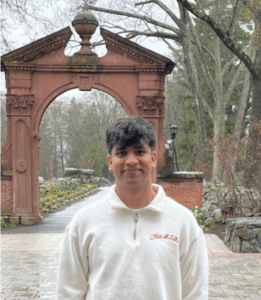
Welcome to the DMC’s Highlight Your Internship Story series, where we showcase the impressive work our students are doing during their internships. These stories highlight how hands-on experience is helping them grow professionally and launch successful careers in tech.
Congratulations to Pranish Khanal, Computer Science major at Ramapo! This fall Pranish has been working for Workforce Opportunity Services (WOS) in New York City as a Junior Development Intern. So far he hashelped redesign two organizational websites. He also provide technical support, helping troubleshoot issues and adapt to various projects in a fast-paced small company environment. Beyond coding, He has had the chance to work on digital marketing campaigns across LinkedIn and Google Ads which has been a completely different experience that taught him a lot new perspectives. This provided valuable insights into marketing a company and the science behind it. Interning at WOS has been one of his best learning experiences, combining web development, data analysis, marketing strategy, and how businesses operate beyond just the technical side.
If you are in any of the DMC majors – Computer Science, Data Science, Cybersecurity, Mathematics, and Bioinformatics – and would like to be featured, please contact Dr. Al-Juboori (aaljuboo@ramapo.edu) or Dr. Frees (sfrees@ramapo.edu)!
Categories: Computer Science, Internship Story

505 Ramapo Valley Road
Mahwah, NJ 07430
p: 201-684-7500
e: information@ramapo.edu
Copyright ©2026 Ramapo College Of New Jersey | Statements And Policies | Accessibility | Contact Webmaster.