This article is part of an ongoing Faculty Friday series, highlighting Ramapo College of New Jersey professors and their impact on students and the world.
December 5, 2025
by Lauren Ferguson
As a professional historian and writer, Ramapo College of New Jersey Associate Professor of History Dr. Stacie Taranto often refers back to the 1977 National Women’s Conference.
During the federally-funded four-day event, about 2,000 delegates from across the United States came together in Houston to assess the state of women’s rights in the country and develop a policy platform to make women equal to men – socially, politically and legally. They delved into issues such as reproductive rights, child care funding and education reform.
The plan of action developed was never adopted, but the experience shaped the activism and futures of many of the delegates. And the conference remains a touchstone for historians and writers – like Taranto – who focus on feminism, anti-feminism and women’s rights.
But Taranto and fellow historians never had a central repository to access information on the diverse group of delegates. “Even just to find out who attended the conference, there was no institutional home or repository for all of that information. There were like drips and drabs,” Taranto explained.
Then a pair of University of Houston professors came up with the idea for a digital database featuring biographies of the delegates. But with so many delegates, someone had to write the biographies.
Enter undergraduate students from Ramapo College.
Taranto’s “A History of Women in American Politics” class has spent the fall semester researching delegates from New York and drafting 500-700 word biographies, which will ultimately be published on the National Endowment for the Humanities-funded digital database called “Sharing Stories from 1977: Putting the National Women’s Conference on the Map.”
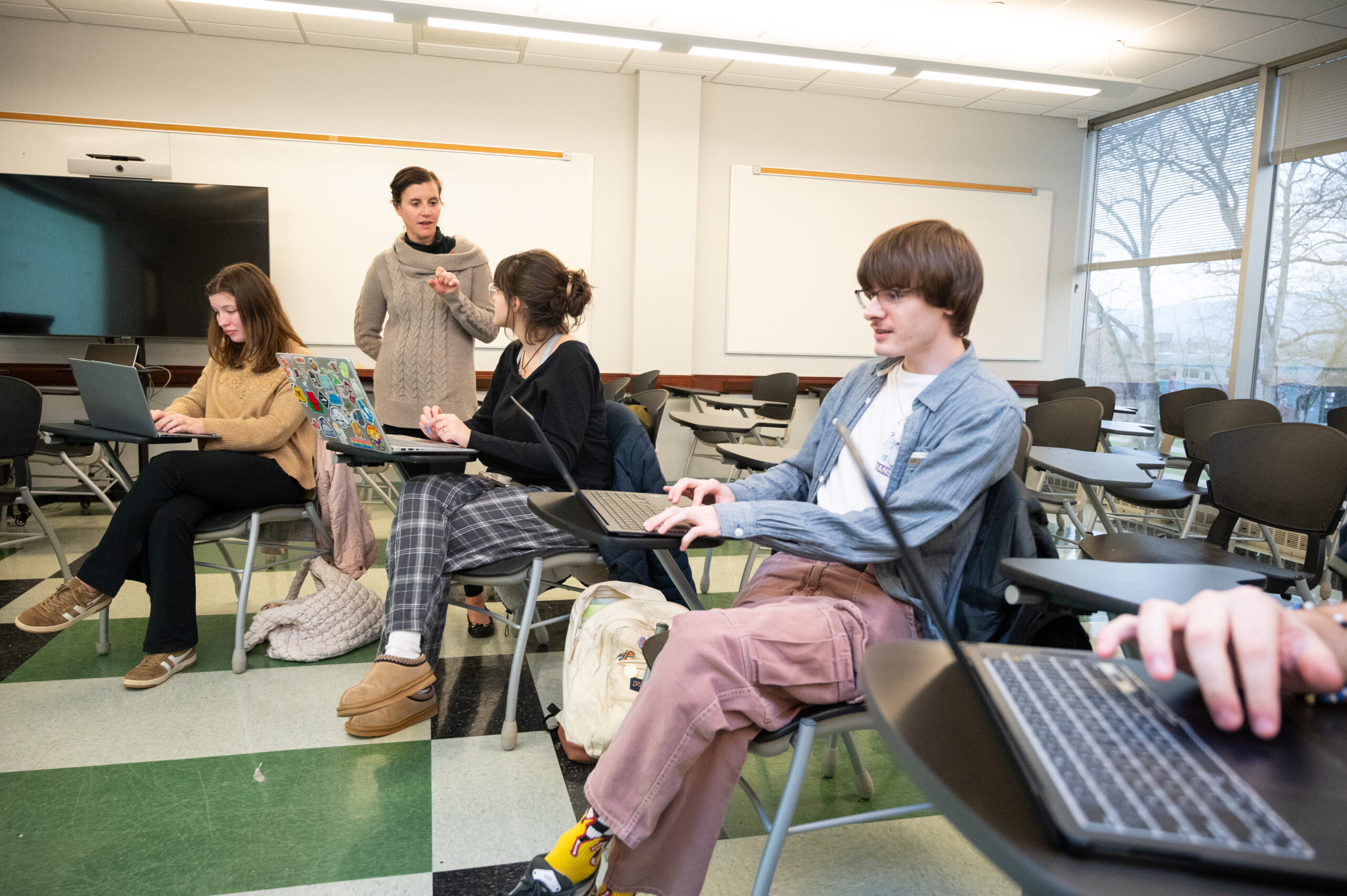
Dr. Stacie Taranto, standing, teaches Roadrunners in her “A History of Women in American Politics” class.
“I am very gratified at the thought of Ramapo undergraduates becoming published authors on a database that is used frequently by historians of U.S. women’s politics like me,” Taranto said. Taranto also serves as a faculty advisor on the national editorial board for the project, where she advises a pod of graduate students who edit and fact check the work of undergraduates. Undergraduates from about 40 institutions including Ramapo are working on the digital database.
At Ramapo, Taranto said she is giving her students “a real hands-on experience of being a historian.”
At the beginning of the semester, each student was given a PDF of a person’s one-page application to be a delegate. The applications included simple information such as a delegate’s name, hometown, when the person applied, and their occupation. From there, the students followed a research plan to approximate the process of historical research. Each week they used different tools and databases to research their delegates, and came back to class to discuss their discoveries.
“Every week, they are putting together the pieces,” Taranto said, adding that the students tend to get very attached to their subjects, just like historians do.
History major Hailey Bysterbusch ‘27, of Tuxedo Park, NY, was assigned to research and write a biography on Joyce Massey, an assistant teacher at a school in Queens, NY. She couldn’t find much on Massey until around week 9 of the project when she finally hit a trove of information.
“Each week we used a different database, and every week, everyone else was getting these giant revelations, like finding children or grandchildren, and I pretty much knew nothing,” Bysterbusch said. “And then newspapers.com was kind of the last thing we were doing, and I looked her up and originally couldn’t find anything. I just changed a few filters. All of a sudden, I had like 10 newspaper articles about her, so it was super exciting.” Bysterbusch said she learned Massey was the public relations chair of her volunteer group and organized health fairs.
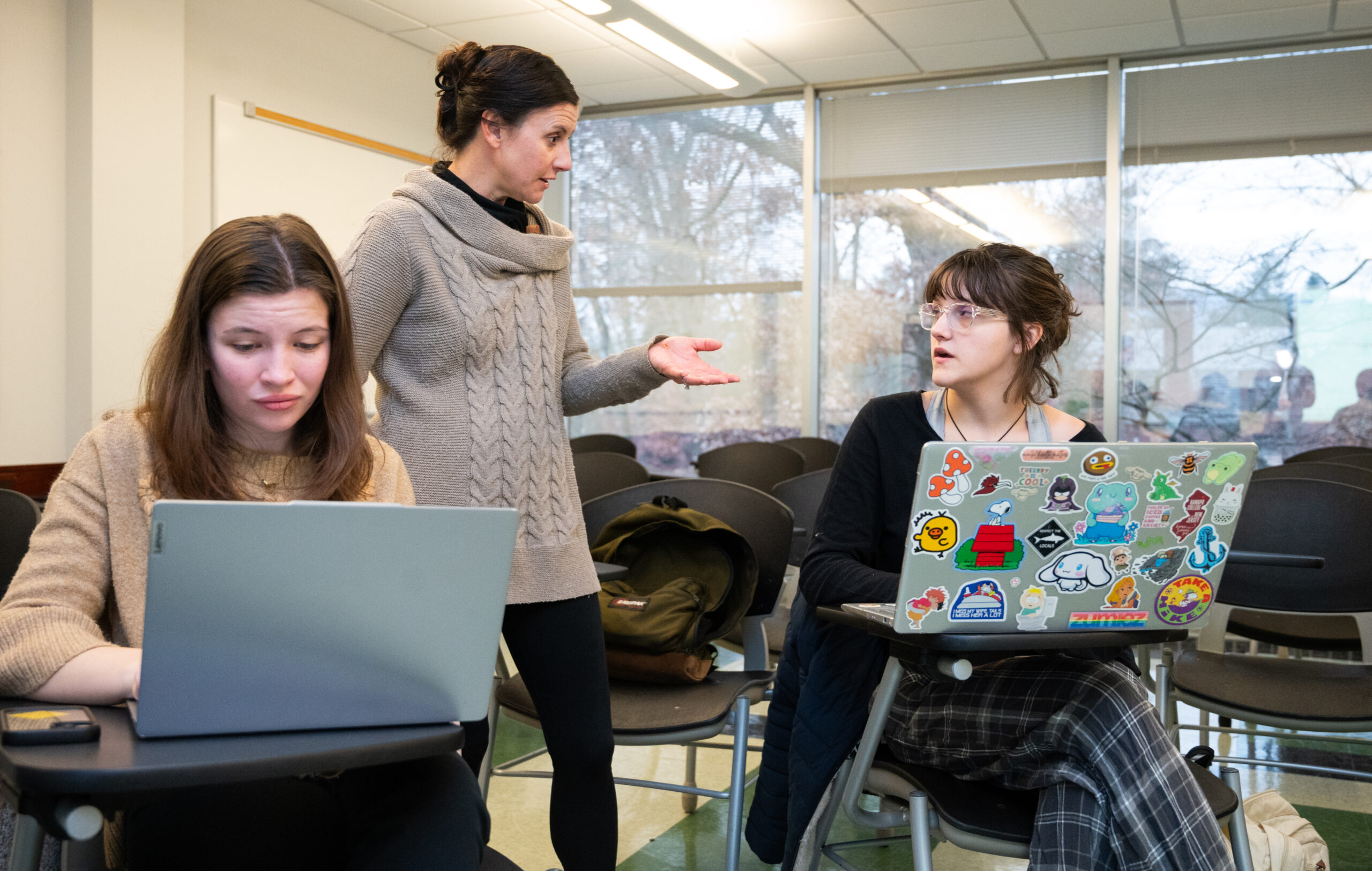
Students in Dr. Stacie Taranto’s “A History of Women in American Politics” class gain hands-on experience by researching delegates of the 1977 National Women’s Conference and writing their biographies.
Finance major Gavin Byrne ‘27 of Totowa, NJ researched Dianne Jackson, an advocate for public housing who served as president of the Cooper Park Tenant Association in Brooklyn, NY for 27 years.
Byrne found an interview with Jackson that was recorded at the conference, where she spoke about what brought her to the conference. He also learned that Jackson passed away in 2024, and had a street in Brooklyn named after her in August of 2025. He got in touch with the founder of the National Congress of Neighborhood Women, who for years worked with Jackson and also helped to approve the delegates chosen for the conference.
“It feels really cool to know that something I am writing has a little bit of meaning behind it and people are going to look at it and read it,” Byrne said.
Taranto said she wants her students “to do what historians actually do.”
She grouped the students together to give each other feedback and tips, similar to the peer review process that historians partake in, she explained. From the time the students start their research, to the time the biographies are ultimately published, will take a while, “just like it does for a historian,” she said.
For Bysterbusch, the hands-on experiential learning experience has been instrumental. She plans to go to graduate school for history or museum studies, and said she would love to teach at a high level herself one day.
“To have my work out there on a website that anyone can access is a really exciting idea and it definitely encourages me for my future in the field to keep working and researching,” Bysterbusch said.
To learn more about the project, visit Sharing Stories from 1977.
Follow Ramapo