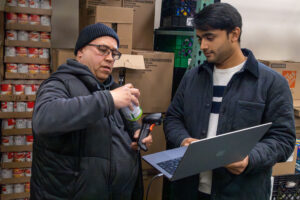
March 18, 2026
by Lauren Ferguson
A small group of Ramapo College of New Jersey STEM students is making a big impact on an organization combating hunger in Northern New Jersey and the thousands of people it serves.
Five interns from the Community Impact program within the College’s Data, Mathematical, and Computational Sciences (DMC) Center were deployed to the Center for Food Action (CFA) during the Fall 2025 semester to undertake a project to improve the way CFA collects, tracks and forecasts data.
The students first analyzed CFA’s inventory records – delving into data on topics such as how much food is collected, how much food is given out, who donates it, who receives it, and how it gets distributed through CFA’s six food pantries across Bergen and Passaic counties – in Englewood, Hackensack, Mahwah, Ringwood, Saddle Brook, and at Bergen Community College in Paramus.
Then, the students built a data platform and web application for CFA employees to view charts, reports and dashboards on subjects such as how inventory moves, who visits each location, how far clients drive, and how many people are in their families. They also built a barcode scanner application to help employees efficiently track incoming donations – and ensure the accuracy of the data entered into the platform.
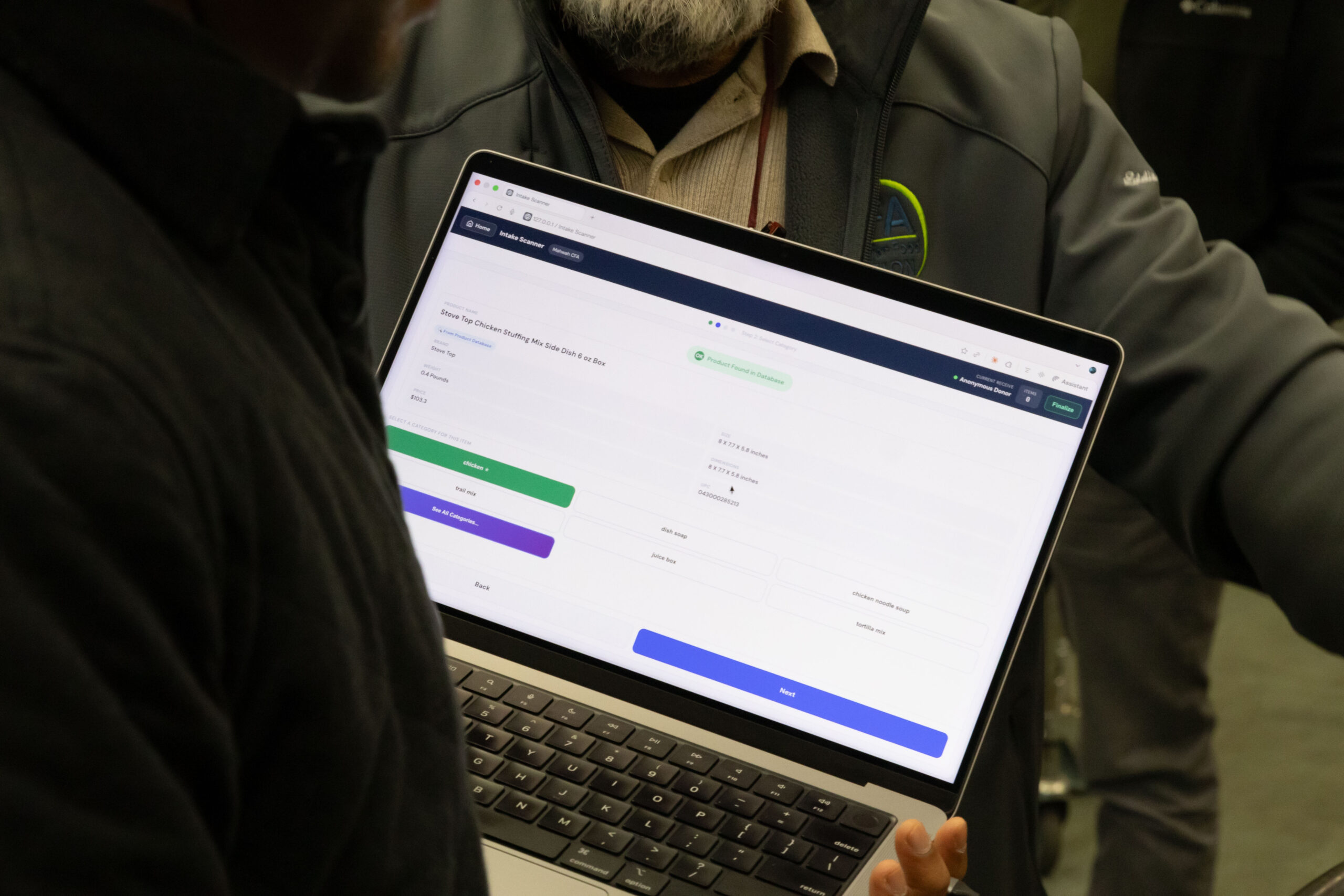
Ramapo interns developed a web application for CFA employees to view charts, reports and dashboards on logistical data and trends.
“This is an amazing game changer for us,” said CFA Executive Director Nicole Davis, who leads the non-profit on its mission to prevent hunger and homelessness and improve the lives of individuals and families living in poverty. Davis said the system – which CFA can now keep – will “help us understand what people really want, what people really need to help sustain themselves and get back on track.” It will also help the organization that serves about 40,000 people annually track data that can be used to explain its story and impact to attract funding.
CFA’s Director of Operations Frank Ruiz oversees logistics for all CFA sites. He shared his excitement for the project during a recent visit to CFA’s Mahwah location.
“With the new scanning system, and new inventory program that Ramapo College is putting together, this is something that’s going to be extraordinary to us, because we’ve been doing inventory manually for many, many years,” Ruiz said. “Now we finally got what we wanted the whole time, which is being able to scan our products that we get in from the Community Food Bank and our private donors, and be able to put it into inventory much quicker, rather than doing it manually.”
Gaining Hands-On Experience
The students who worked on the project said the experiential learning opportunity was a highlight of their Ramapo education, and an experience that will prepare them for their future careers.
“One of the reasons this was so exciting was because it was essentially my first hands-on experience as a data science major, applying what I’ve learned in the real world,” said Emily Morra ‘26, a data science major and sports management minor from Mahwah, NJ. “I feel like that gives me an upper hand to be able to say that yes, I’ve done the things. I’ve taken the courses, I’ve done the projects, but I’ve also done it in a real-world scenario. And here’s the actual difference that I made with those things that I did.”
Other interns on the project were: Vedika Shaily ‘26, a data science major from Dayton, NJ; Prashant Shah ‘26, a computer science major and mathematics minor from Parsa, France; Bibhu Bhatta ‘26, a computer science major from Frisco, Texas; and Tina Nosrati ‘26, a computer science major and visual arts minor from Upper Saddle River, NJ.
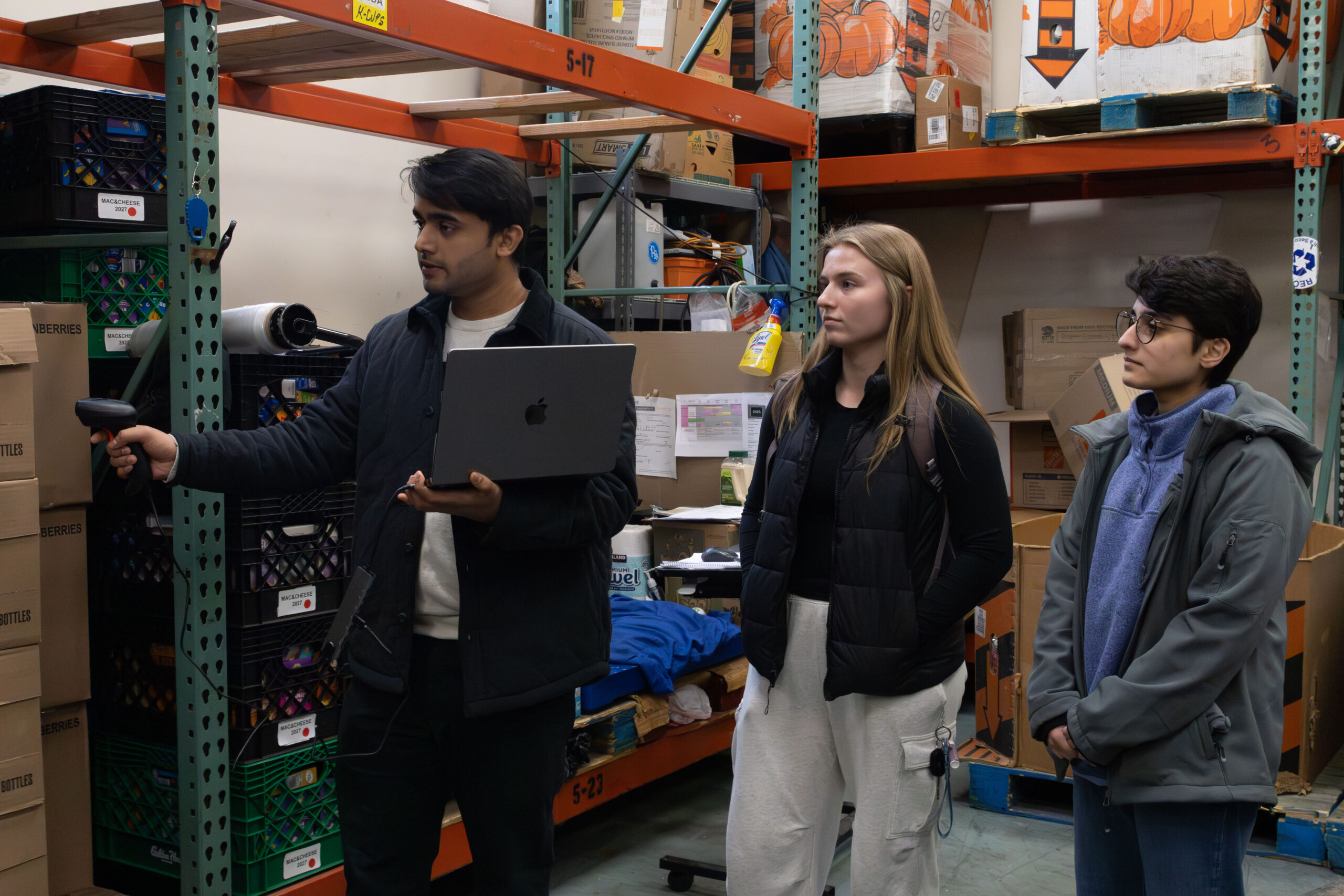
Interns Prashant Shah ‘26, Emily Morra ’26 and Tina Nosrati ’26 visit CFA’s Mahwah warehouse.
Nosrati called the experience “both educational and genuinely rewarding.”
“Experiences like this are valuable because they bring real-life community challenges into an academic setting, allowing students to contribute their skills to meaningful problems,” Nosrati said. “I believe this kind of collaboration creates one of the best opportunities for impact. It allows students to apply what they learn in school while supporting organizations in the community that are doing important work.”
Funding Internships for Good
The project was ultimately made possible by the Daffron Family Foundation. The foundation funded the internships, and will be funding a second-phase of interns who will turn the analytics platform that was created into an application that can be deployed to even more food pantry organizations in New Jersey and New York.
“We have been supporting the Center for Food Action for years, and it was really the juxtaposition of Ramapo College and its entrepreneurial approach to using data science for good that caused us to choose this project,” said Stephen C. Daffron.
Daffron said he believes the results of the project will have “a far greater and longer lasting impact” than any simple donation ever could.
“We could give the money supporting this project directly to the Center for Food Action and they could feed more people. Once. But this project will enable them to see where the food comes from, where the supply chain is effective, how to optimize what to do with it, and how to help the people who are being fed,” Daffron said.
The partnership between the Daffron Family Foundation, CFA and Ramapo is an example of the College’s strategic plan, Boldly Ascending, in action. The plan’s first goal, Academic Excellence and Student Success, outlines objectives to both “provide learning environments and opportunities that encourage the development of deep content knowledge that leads to discerning engagement in work and in the world” and “grow service opportunities and civic engagement … and make a positive societal impact locally, regionally, and internationally.”
The project is the first on what Ramapo College leaders hope will be a long list of donor-funded, faculty-supervised internships that address real challenges in the community.
Interns from the DMC Center are also developing an event management system for Mahwah Environmental Volunteer Organization (MEVO) to help the organization coordinate community cleanup and trail maintenance events, and generate reports showing volunteer contributions and the measurable results of cleanup efforts.
DMC Director Dr. Scott Frees, a professor of computer science at Ramapo, is hoping the success of the CFA project will motivate additional donors to fund internships through the Center.
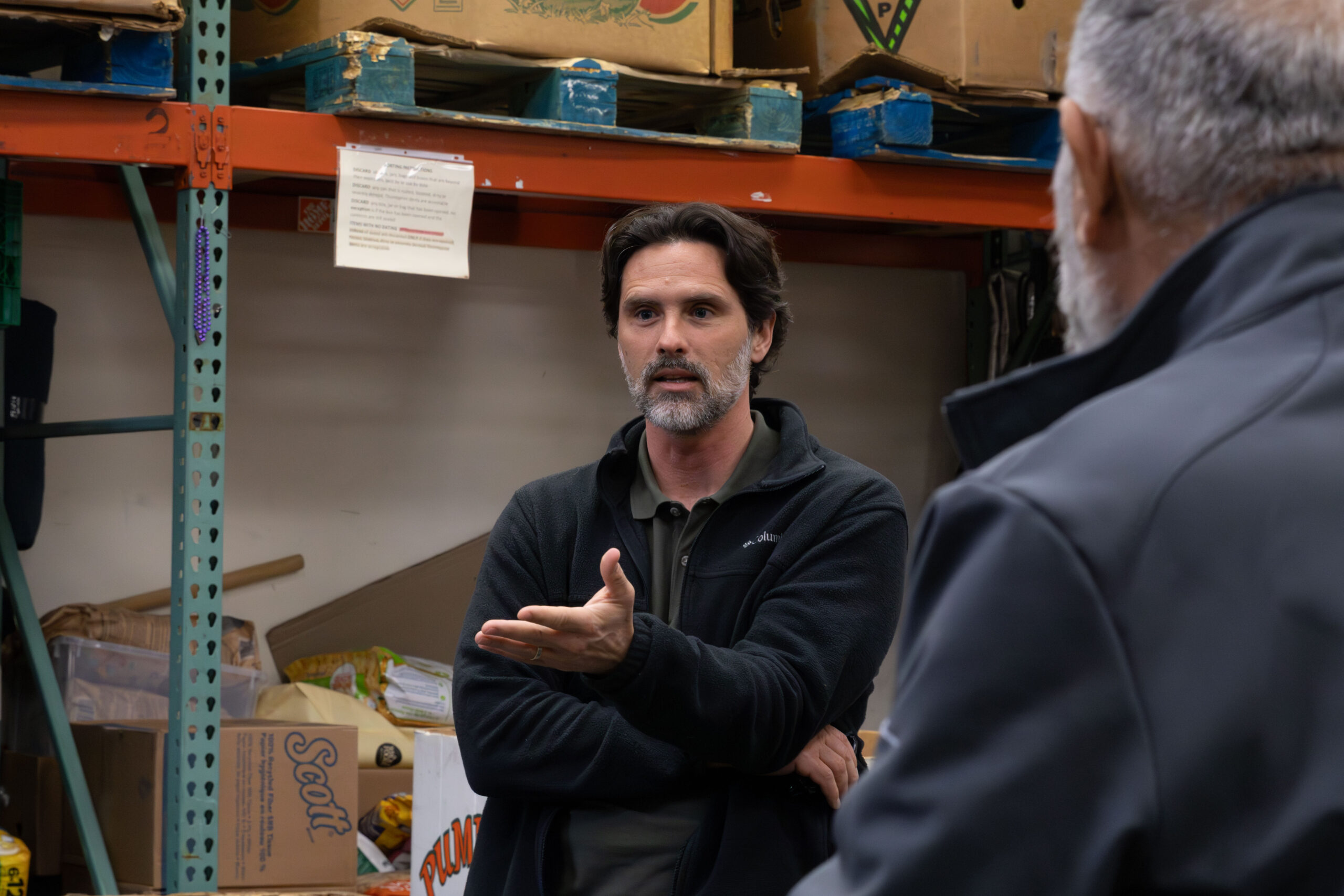
DMC Director Dr. Scott Frees, a professor of computer science, managed the interns on the project.
“Nonprofits often don’t have the resources to pay data science and computer science students to do what they need, but the students deliver a huge amount of value to them,” Frees said. “The nonprofits do not have to have technical staff. We go in, we figure out what they really need by engaging with them, we scope out the work, we manage the students. The donors basically have a dual impact – they are giving a huge amount of experience to our students and they are also helping the community.”
Empowering students to undertake mission-driven work that makes a real difference in the community is likely to be a catalyst for long, impactful careers.
“Knowing that the analytical work we do can help an organization operate more effectively – and that this may make someone’s life a little easier or better – keeps me motivated,” said Nosrati.
For more information visit the DMC Center Community Impact Projects webpage.
Follow Ramapo