- About Ramapo
- Academics
- Admissions & Aid
- Student Life
- Athletics
- Alumni
- Arts & Community
- Quick Links
- Apply
- Visit
- Give
Research Spotlights Renewable Energy’s Impact on Communities

This article is part of an ongoing Faculty Friday series, highlighting Ramapo College of New Jersey professors and their impact on students and the world.
January 23, 2025
by Lauren Ferguson
Nathaniel Otjen planned on becoming an environmental writer.
But after pursuing journalism as an undergraduate, his focus shifted – slightly.
“I had this really deep thirst for research and for digging deeper into stories,” explained Otjen, an assistant professor of sustainability and environmental studies at Ramapo College of New Jersey since 2024. “That’s what put me on the research trajectory.”
Otjen, who holds a PhD in Environmental Sciences, Studies and Policy, has spent years researching the impact of critical mineral mining and renewable energy development on communities, and both human and non-human lives. His thirst for research has yielded numerous peer-reviewed articles, book chapters, essays and even a podcast.
Now he is honing in on the debate around offshore wind, and the impact wind turbines may have on migratory whale species.
Since 2016, 126 dead humpback whales have been found along the East Coast, with 14 deceased humpbacks washing ashore in New Jersey since December 2022, he explained.
“Despite substantial evidence pointing to vessel strikes and entanglement in discarded fishing gear as the primary culprits, there remains significant controversy about what has caused the recent deaths and what should be done about it,” he stated. “Offshore wind farms, heat and toxin pollution, and increased shipping activity have all been blamed. While local residents, nonprofit organizations, industry groups, federal officials, and politicians disagree about the causes and next steps, they all agree that justice for the whales needs to be secured.”
Otjen’s research project, entitled Multispecies Justice on the Shore seeks to “understand how different groups along the Jersey Shore are articulating their own versions of justice for whales,” he stated. He and a Ramapo College student researcher will spend July and August visiting New Jersey shore communities such as Long Branch, Seaside Park, and Brigantine – which have experienced repeated whale strandings over the past five years.
During their research – funded by Ramapo’s Faculty Scholarship Fund – Otjen plans to conduct “semi-structured interviews, participant observation, and ethnography with community members, leaders of nonprofit organizations, and scientists at federal agencies,” he said.
He ultimately plans to propose solutions to support both whales and the shore communities impacted by their deaths, with the project resulting in a series of scholarly and public-facing outputs, he explained.
Building on Past Research
Otjen’s research into offshore wind is being informed by his extensive research into lithium mining, he said. “There are a lot of similarities there in terms of how renewable energy development projects can impact communities and can also impact ecologies,” he said.
Otjen wrote about lithium mining for his doctoral dissertation, then decided to explore the topic even further during his time as a postdoctoral fellow in the High Meadows Environmental Institute at Princeton University. With the United States increasingly relying on lithium for batteries, storing electricity and electric vehicles, “I was curious about the places where lithium was coming from and the impacts that was going to have,” he explained.
Together with other members of the Blue Lab group – an environmental research and storytelling group at Princeton University– he traveled the country, interviewing stakeholders near a proposed lithium mine in Gaston County, North Carolina and in northern Nevada, a desert area that is now the epicenter of lithium mining in the United States. Together they produced two seasons of the podcast Mining for the Climate.
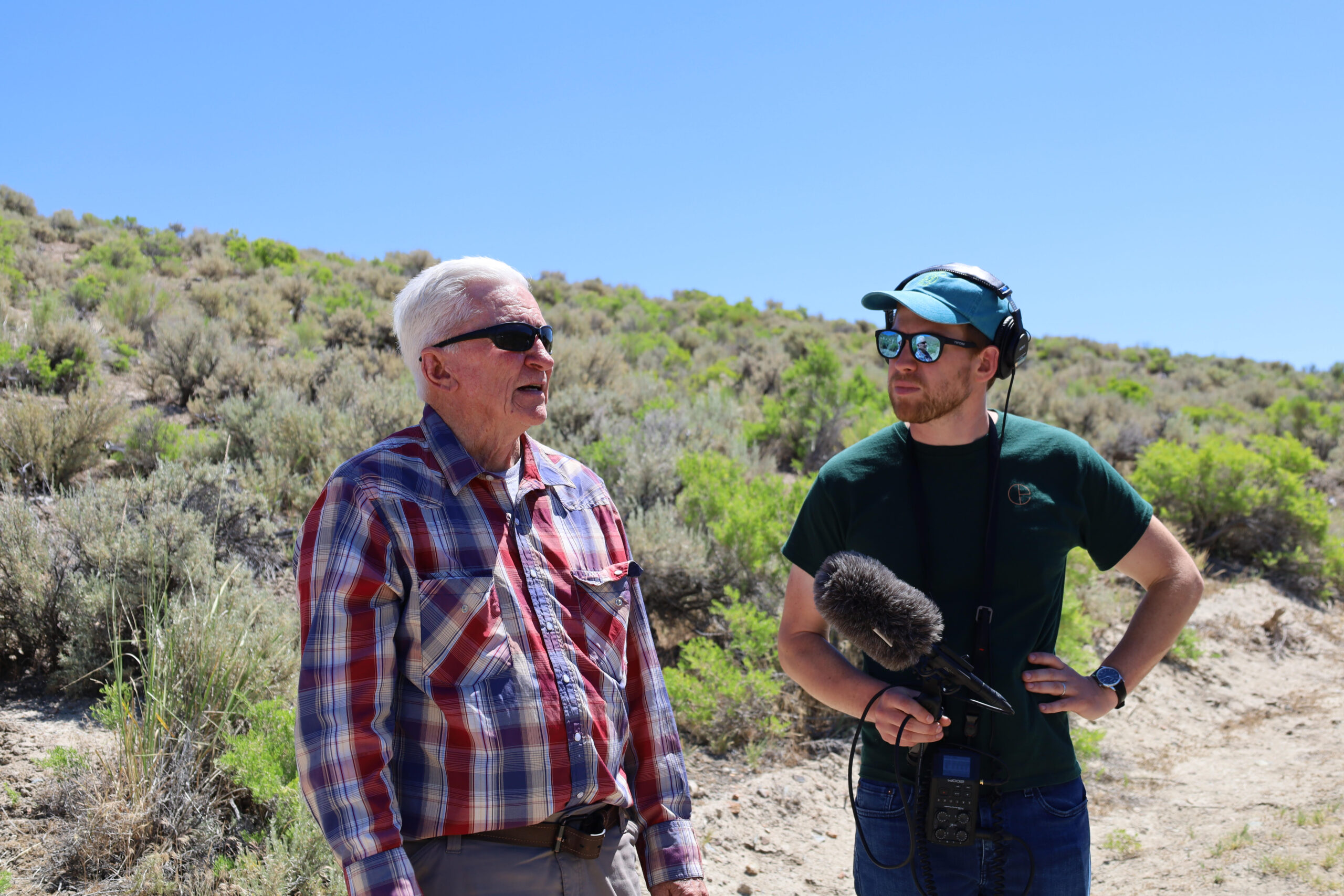
Dr. Nathaniel Otjen, right, conducts an interview for for the Mining for the Climate podcast.
Otjen said using audio storytelling served as a way to “talk to broader audiences and to reach beyond academia to a lot of everyday folks.”
They spoke with community members on the ground, mining executives and government officials. “We were interested in who is benefiting and who is suffering from the energy transition. A lot of my research looks into those types of questions, especially around energy development projects. So how do we think about justice, and is it possible to to think about decarbonizing in such a way that actually enables communities to not bear these burdens?” he explained.
From Farm to College
Otjen grew up on a small farm in Central Pennsylvania, selling pumpkins, and learning skills like welding, woodworking and caring for animals. “It was one of those places where we did so many things on our own. My dad was a stickler about it and really emphasized the importance of learning skills and being outside and all that really stayed with me,” he said.
Now as a professor at Ramapo, he shares his love for experiential learning with his students.
“We absolutely want every student to have the opportunity in each of their classes to engage in experiential learning, to do that hands-on work, to move the classroom outside of the college,” he said.
He’s taken his Environmental History class to the Meadowlands Environmental Center, his World Sustainability class to Mahwah Environmental Volunteers Organization (MEVO), and his Environmental Literacy class to the Ramapo Reservation to study how old signs play into the landscape.
After initially wanting to be an environmental writer, Otjen said his position at Ramapo College, nestled in the natural beauty of the Ramapo Mountains, and surrounded by so many opportunities for hands-on learning and environmental internships, turned out to be his “ideal job.”
“It combines teaching with research and writing. It allows me to do all of those things in a way that so few careers really allow you to do,” he said.
For more information on the Environmental Studies program at Ramapo, visit its website. For more information on the Sustainability program, visit its website.

505 Ramapo Valley Road
Mahwah, NJ 07430
p: 201-684-7500
e: information@ramapo.edu
Copyright ©2026 Ramapo College Of New Jersey | Statements And Policies | Accessibility | Contact Webmaster.
Follow Ramapo