- About Ramapo
- Academics
- Admissions & Aid
- Student Life
- Athletics
- Alumni
- Arts & Community
- Quick Links
- Apply
- Visit
- Give
NJ Supreme Court Justice’s Visit to Ramapo Inspires Pre-Law Students

New Jersey Supreme Court Justice Fabiana Pierre-Louis delivered the keynote address during Ramapo College of New Jersey’s 20th Annual Diversity Convocation.
February 17, 2026
by Lauren Ferguson
Ramapo College of New Jersey scholars interested in pursuing the legal profession gained invaluable insights from New Jersey Supreme Court Justice Fabiana Pierre-Louis last week.
Justice Pierre-Louis visited Ramapo’s Mahwah, NJ campus to give the keynote address during the college’s 20th Annual Diversity Convocation.
Prior to her speech, she hosted an intimate conversation with about 25 pre-law students. She shared her personal journey to becoming the first Black woman and first woman of color to serve on the Supreme Court of New Jersey, offered advice and answered questions from the aspiring attorneys.
“The best advice that I could give is to study hard, do as well as you can in college, and pick a law school that you think you will enjoy, a place that you see the environment would be supportive, and you would be able to grow,” she told the small group of students gathered around her in the historic York Room of the Birch Mansion on Ramapo’s picturesque Mahwah, NJ campus. She also told students to do their best to get as much practical experience as possible.
The daughter of Haitian immigrants, Justice Pierre-Louis was a first-generation student and an Educational Opportunity Fund scholar at Rutgers University. She went on to Rutgers Law School in Camden, then clerked for former New Jersey Supreme Court Justice John E. Wallace Jr., who became her mentor, and whose seat she now occupies.
“Everywhere I have been, I’ve taken some really, really valuable lessons and experiences and have built on that for every other position,” she told the interested students.
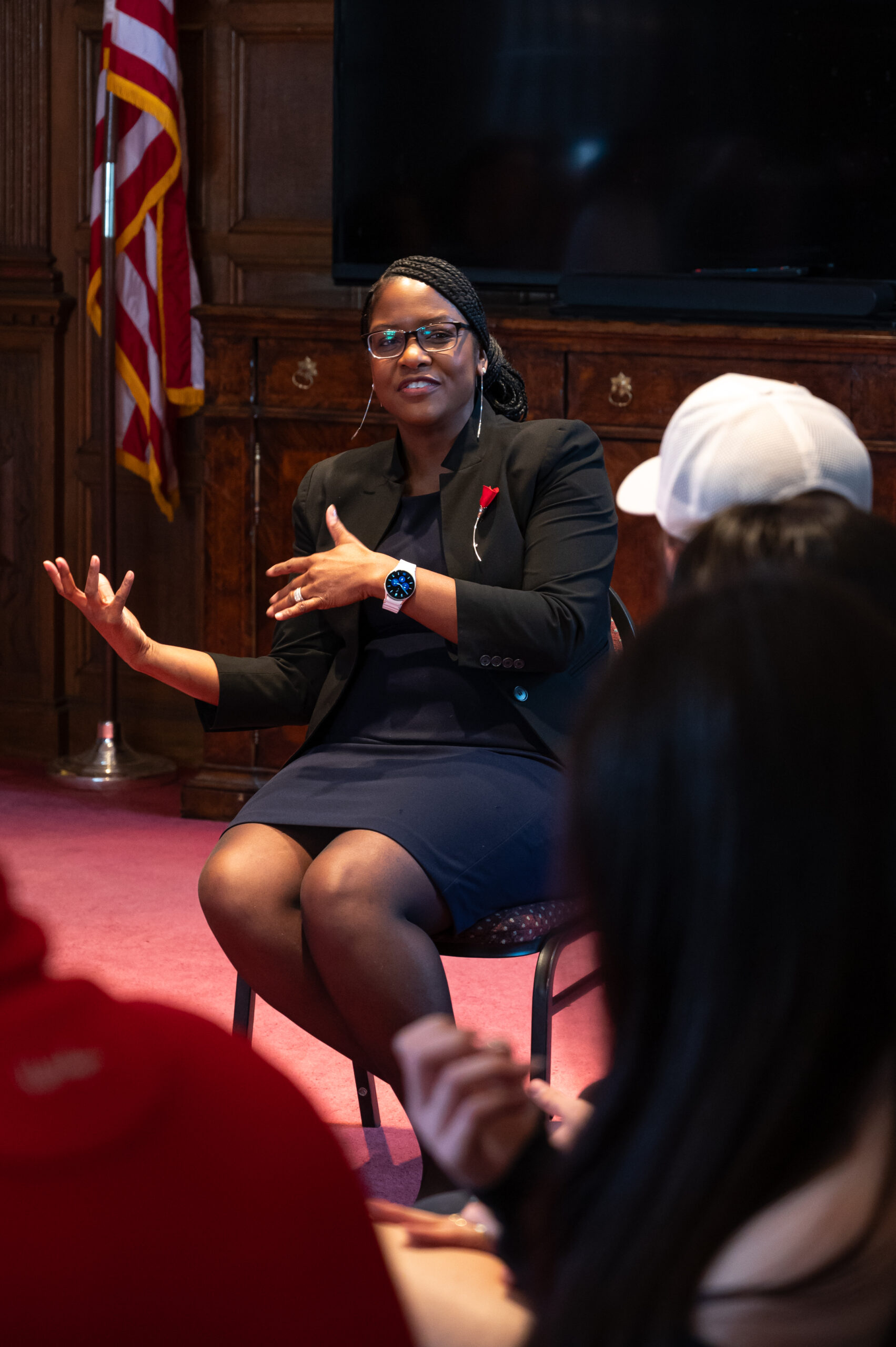
New Jersey Supreme Court Justice Fabiana Pierre-Louis answers a question from Law and Society major Mauricio Rodriguez ‘29.
She gained experience as a partner in a Cherry Hill, NJ law firm, focusing on complex commercial litigation, white collar crime, and government investigations. She was also a prosecutor in the U.S. Attorney’s Office’s Criminal Division, and was the first woman of color to serve as the Attorney-in-Charge of the Trenton office, and then the first woman of color to serve as the Attorney-in-Charge of the Camden office. In those positions, she supervised investigations and prosecutions of drug trafficking organizations, mail and wire fraud offenses, healthcare and government fraud matters, and violent crimes.
Former Gov. Phil Murphy nominated Pierre-Louis to the state’s highest court in June 2020. “It wasn’t something I was looking to get, but because of the different positions I had throughout my career, my reputation had preceded me, and folks were aware of the things that I had done,” she explained. She was sworn in as an associate justice in September 2020, about a week shy of her 40th birthday.
Sitting down and speaking with a New Jersey Supreme Court Justice was enlightening for Ramapo’s pre-law students.
“You can have so many different jobs involved with the law, but it was pretty cool to see somebody who had an experience in all,” said Law and Society major Mauricio Rodriguez ‘29, of Ridgefield Park, NJ, noting Pierre-Louis had been a law clerk, attorney and judge. “To see it first-person, rather than just an article is really awesome too, because you can ask more specific questions that you can’t really get from an article or just like general study.”
Fellow Law and Society major Elena Munirji ‘28 said having access to a New Jersey Supreme Court Justice was “unbelievable.”
“I think it’s very beneficial for us, and we get a deeper insight on the work, the foundation of her career, and how she got to where she is today. And I think that motivates a lot of the students here to keep going,” said Munirji, of Hawthorne, NJ. “She never thought she’d get to that position, and I’m hopeful, as well, that one day I could get there.”
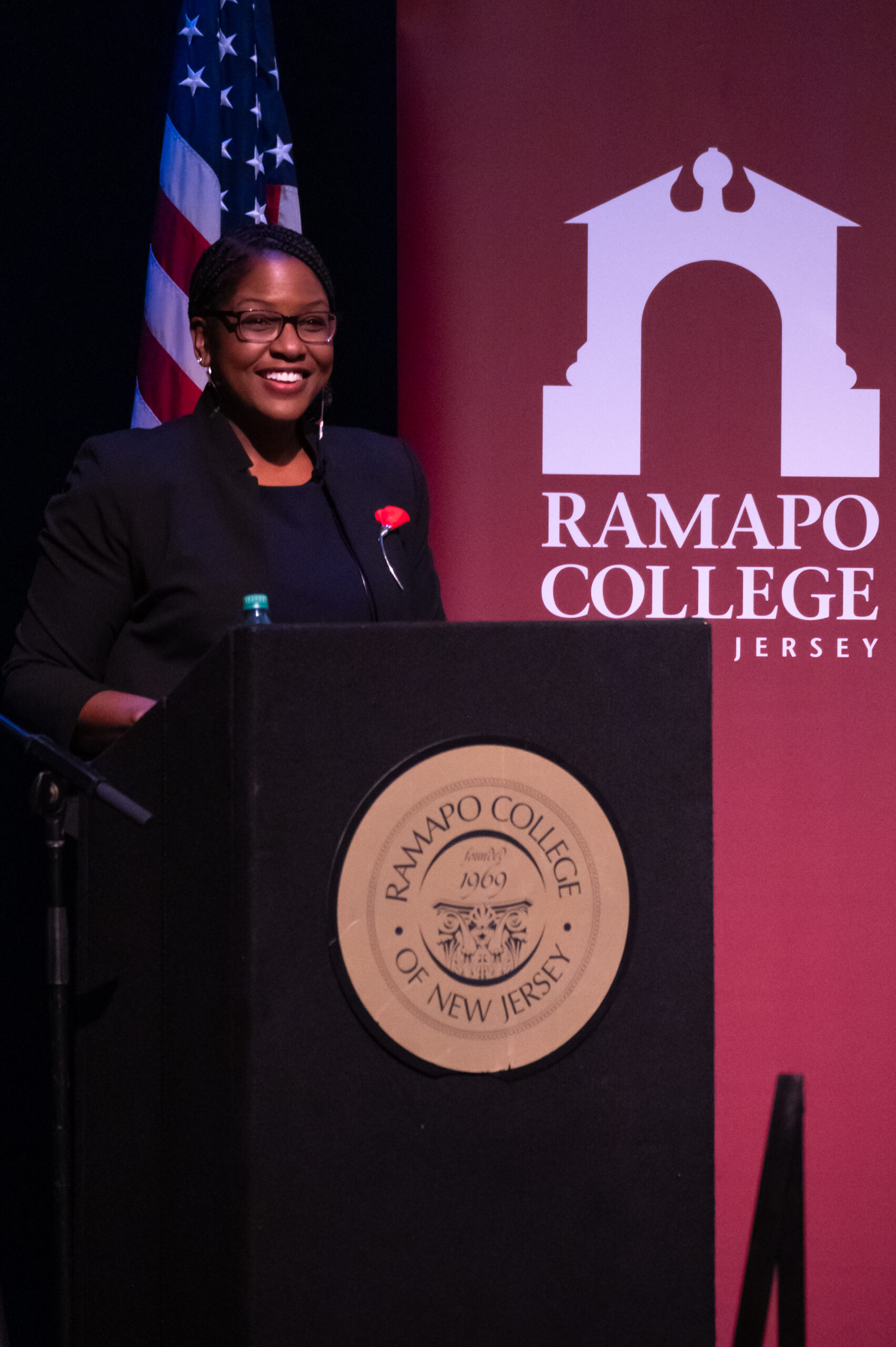
New Jersey Supreme Court Justice Fabiana Pierre-Louis spoke at Ramapo’s 20th Annual Diversity Convocation.
During Justice Pierre-Louis’ keynote speech for Ramapo’s 20th Annual Diversity Convocation, she spoke to a packed house of Ramapo students, staff, faculty, friends, and trustees at Ramapo’s Berrie Center.
In her speech, Justice Pierre-Louis shared decades of legal cases – and the people behind them – that ultimately led to the desegregation of schools in the United States.
“I think of the rich diversity here at Ramapo, and the students and the faculty, and I think it’s important that we never forget that it wasn’t that long ago, that this was not possible, this diversity,” she shared.
Later, she told the crowd: “Nothing in law and society happened overnight. And I am certainly well-aware that I am … just one of the beneficiaries of the hard work of Charles Hamilton Houston and all these very talented attorneys who put themselves in the line of fire for desegregation in this country.”
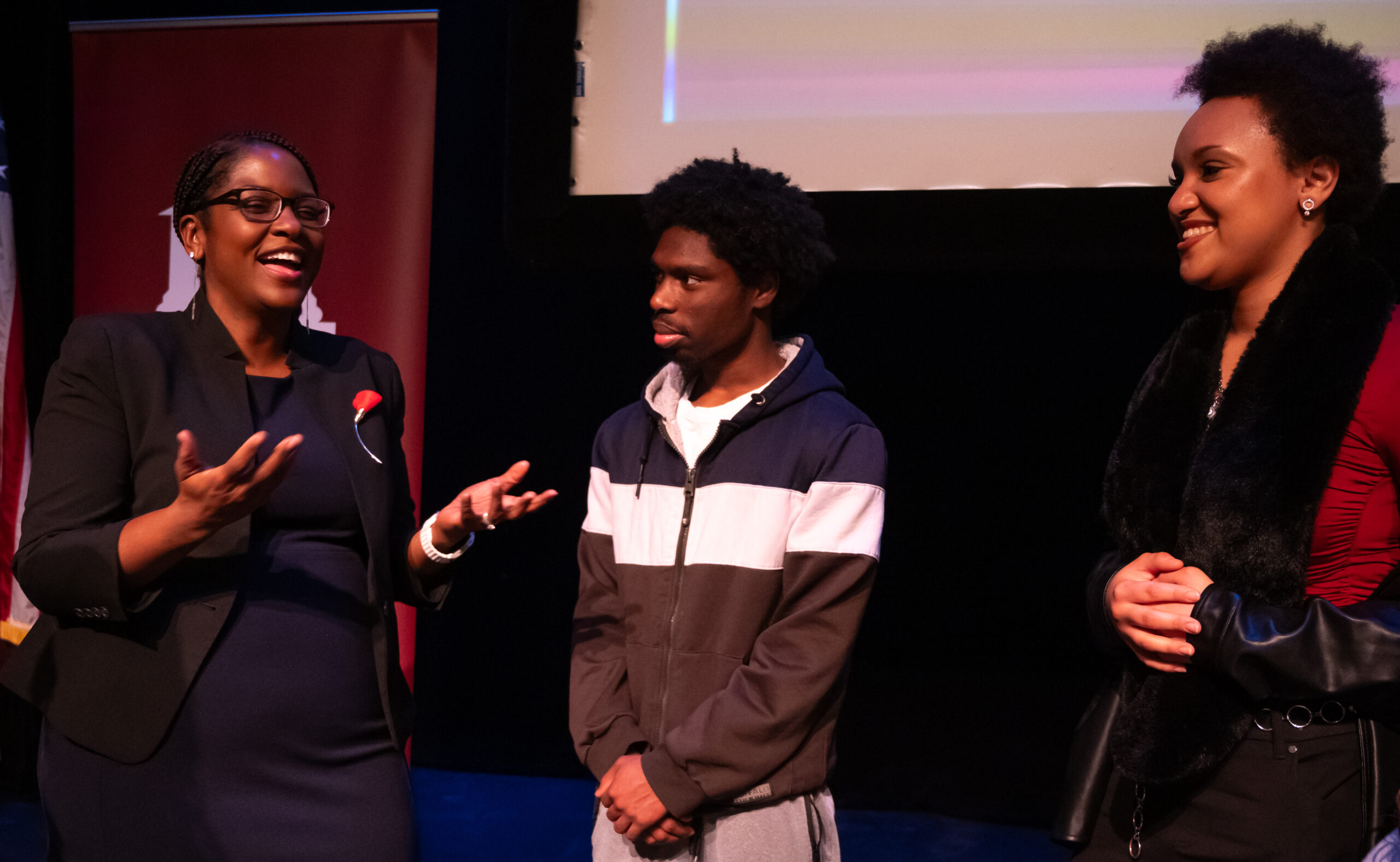
Ramapo College of New Jersey students had the opportunity to speak with New Jersey Supreme Court Justice Fabiana Pierre-Louis.
Ramapo’s annual diversity convocation is one of the ways the college spearheads initiatives and programs aimed at fostering an inclusive campus environment.
“Our values, our mission, our vision, and our strategic plan all guide us to be open, to respect one another, and to set the conditions such that a culture of belonging, access, and inclusion thrives,” said Ramapo College President Dr. Cindy Jebb. “In addition, we all share a responsibility to promote and cultivate an environment that fosters mutual respect, dignity, empathy, and understanding.”

505 Ramapo Valley Road
Mahwah, NJ 07430
p: 201-684-7500
e: information@ramapo.edu
Copyright ©2026 Ramapo College Of New Jersey | Statements And Policies | Accessibility | Contact Webmaster.
Follow Ramapo