August 20, 2026
by Lauren Ferguson
A Ramapo College of New Jersey professor and a pair of undergraduate researchers spent the summer diving into the issue of whale strandings at the Jersey Shore.
Nathaniel Otjen, PhD, an assistant professor of sustainability and environmental studies, Environmental Studies Major Meredith Ruland ’27 and Neuroscience Major Natalie Nguyen ’28, have spent July and August visiting shore spots like Long Branch and Brigantine which have experienced repeated whale strandings over the past five years.
Together, the trio has gathered information, and interviewed community members, leaders of nonprofit organizations and scientists at federal agencies – all for a culminating research project titled Multispecies Justice on the Shore.
The project seeks to understand how different groups along the shore are responding to recent strandings of deceased whales within the context of offshore wind development, according to Otjen.
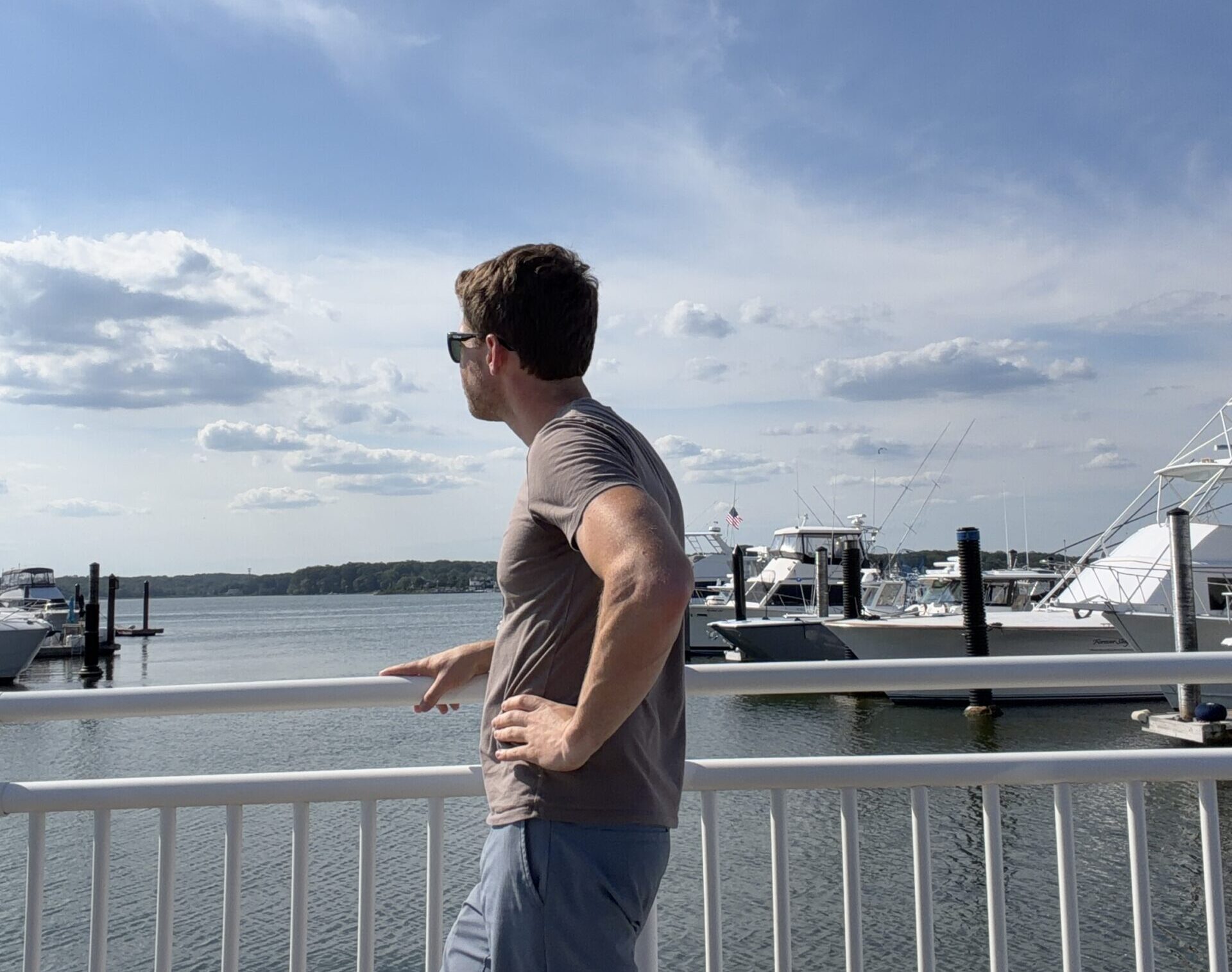
Assistant Professor of Sustainability and Environmental Studies Nathaniel Otjen visited Belmar, NJ, for research into whale strandings at the Jersey Shore.
In the midst of research this week, Otjen was in Barnegat Light where the body of a large, deceased female fin whale was spotted drifting in the surf. The species is endangered and federally protected. This fin whale – suspected to be nearing reproductive age – was the third to wash ashore in New Jersey in a year, Otjen said.
“That of course is always sad when you’re looking at an endangered species, then there is a female who is coming into reproductive age that just died,” Otjen said.
At the scene, Otjen met representatives of the Marine Mammal Stranding Center, monitoring the movement of the whale’s body and working on a recovery and examination plan. He also met concerned members of the public.
“I heard a whole variety of opinions and ideas about why the whale might be there. There’s a lot of speculation, always, anytime that this happens. And that’s very much connected to the research that I’m doing,” Otjen said. “I’m interested in how different groups, including nonprofit organizations, stranding organizations, and members from local communities, are responding to whale strandings. And, I’m interested in how they’re thinking about justice for whales and what that might look like.”
With the research and the help of Ramapo students, Otjen plans to produce a series of public-facing forms of media, such as online articles and short radio stories. Ultimately, he plans to propose solutions to support both whales and the shore communities impacted by their deaths.
Earlier this year, Otjen was named a 2026 Storymaker Fellow at the University of Southern California’s (USC) Wrigley Institute for Environment and Sustainability. The program trains environmental and sustainability researchers in storytelling, so they can reach people through compelling narratives that inspire change. Through the program, he spent a week building storytelling skills with other fellows at the Wrigley Marine Science Center on Santa Catalina Island.
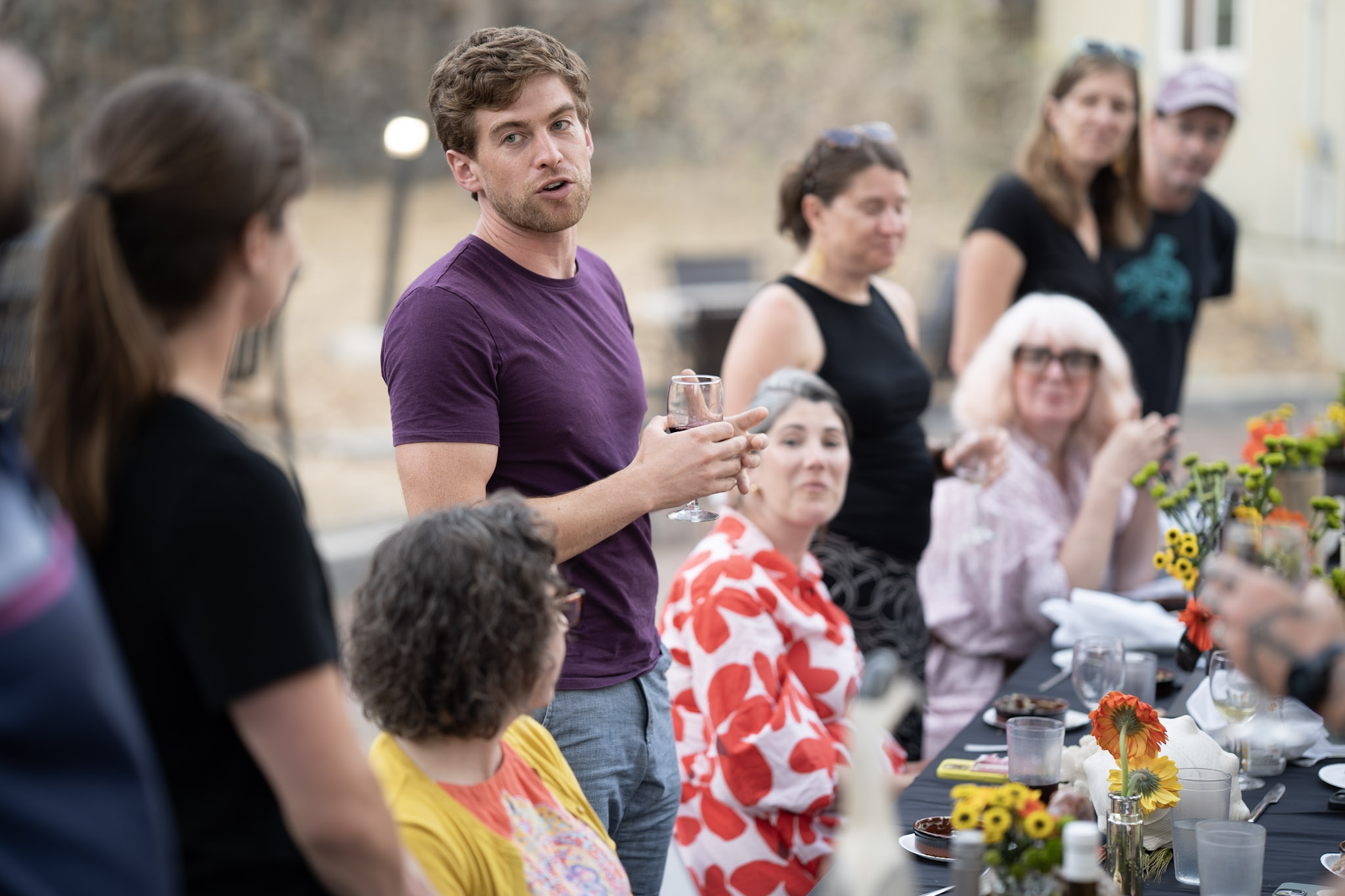
As a 2026 Storymaker Fellow, Assistant Professor of Sustainability and Environmental Studies Nathaniel Otjen spent a week building storytelling skills at the USC Wrigley Institute for Environment and Sustainability.
Otjen has been able to use his knowledge of storytelling, as well as sustainability and environmental studies, to train the Ramapo student researchers working alongside him on the Multispecies Justice on the Shore project.
The students, Ruland of Powell, Ohio, and Nguyen of Howell, NJ, created a contact list of people and organizations to reach out to, set up interviews and assisted with the interview process. They also learned how to conduct high-quality audio recordings, how to take field notes, and to brainstorm and storyboard ideas, Otjen said.
“The students have been really instrumental,” he shared.
For more on Otjen and his research, read: Research Spotlights Renewable Energy’s Impact on Communities.
Follow Ramapo