October 9, 2026
by Lauren Ferguson
Henry Williams went to the emergency room with worsening shortness of breath.
At 80 years old, he suffered from chronic conditions like heart disease and COPD, a serious, long-term lung condition. He also battled anxiety and depression. His only son died while serving in the military, and he was the sole caretaker for his wife with dementia.
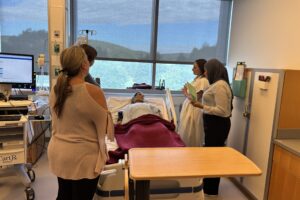
Williams is a computer-simulated patient in Ramapo College of New Jersey’s state-of-the-art nursing simulation lab. The mannequin’s chest rises and falls as he breathes. He speaks – an instructor in a control room just outside the mock hospital bay talks into a microphone to produce his voice. The machines around him beep and hum just like in an actual hospital.
“It’s surreal … It’s so realistic,” said Cardacia Davis, director of practicum education for Ramapo’s innovative social work program. In her role, Davis oversees hands-on learning experiences for aspiring social workers at Ramapo.
Since 2023, Bachelor of Social Work (BSW) students in their senior year as well as Master of Social Work (MSW) students interested in learning about practicing social work in a healthcare setting have been offered experiences in the high-tech simulation lab on Ramapo’s Mahwah, NJ campus. They work as part of a collaborative team, along with Ramapo nursing and nurse practitioner students who use what they are learning in their own programs to respond to and treat the mannequins during scenarios that mirror real life in a hospital.
“They’re all part of the healthcare team. That’s why we call it interprofessional, because we have social workers, but we also have nurse practitioners. We have the nurses. We have respiratory therapy,” said Nursing Simulation Lab Director Joan Richards.
The respiratory therapist who was called in, and ultimately provided high-flow oxygen therapy to the mannequin in the most-recent Ramapo-designed simulation scenario – was a Ramapo nursing staff member who is also a practicing respiratory therapist, she explained.
In the scenario, Williams, the patient, was admitted to the acute care unit of the hospital. He had a fever and was diagnosed with COVID. While he was in the hospital, his daughter-in-law cared for his wife, but the plan was not sustainable. His family was looking for help managing transitional care for him and long-term care for his wife.
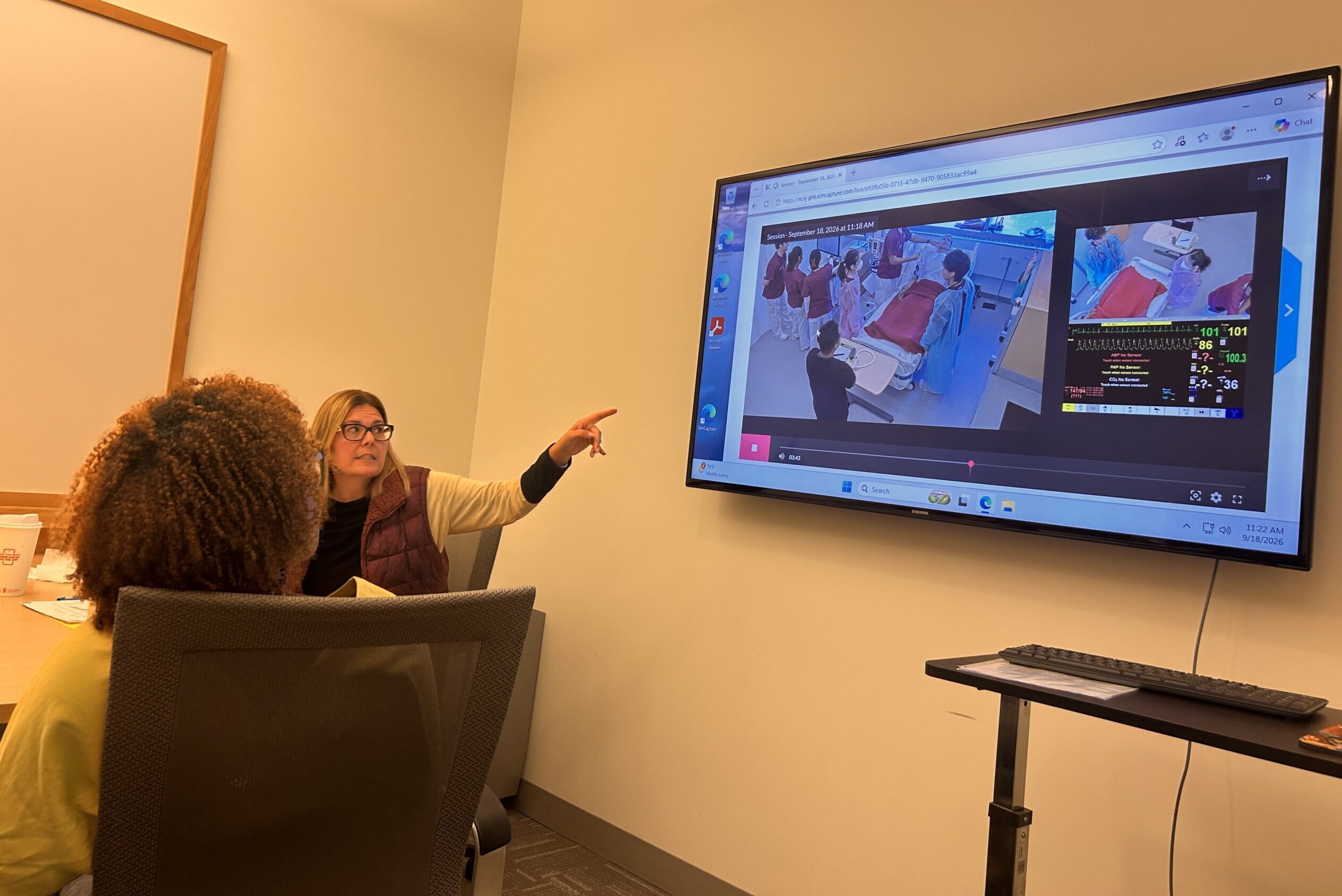
Social Work Practicum Coordinator Melinda Inzani talks with social work students about what is occurring on a live-feed of the nursing simulation lab, before they are called in to meet with a computer-simulated patient.
That is where the Ramapo social work students came in.
“There are some social workers here who are able to address your concerns about your family,” a nursing student told Williams, before telling him he would give him Metoprolol, a beta blocker to lower his blood pressure. Like in a real hospital, the nursing student requested the patient’s name and date of birth before administering the medication.
“Whatever the client is recognizing as the primary stressor is what you stay with,” Melinda Inzani, social work practicum coordinator, coached the social work students as they approached Williams’ hospital bed.
The students introduced themselves, then said they were there to talk to him about how comfortable he is returning home, and what he is most worried about. They asked how he felt about transitioning to have someone else help care for his wife, and if he was open to them helping him find resources for him and his wife. They asked how he has been handling the stress and if he would be open to talk therapy.
In the debriefing session following the simulation, MSW student Erica Mazon ’27 of Franklin Lakes in Bergen County, NJ, said the patient guided their process. “We did present options to him based on what he told us he was most interested in, and we told him we would return with the appropriate resources based on what his insurance would cover,” Mazon explained.
Mazon and her fellow social work students said the hands-on practice offered at Ramapo is a valuable training experience. “Anytime we get to practice, and receive feedback on that practice, we’re just going to become better coming out of this program,” Mazon said.
Likewise, BSW student Rania Mohamed ’28 of Palisades Park in Bergen County, NJ, said, “You can read as many textbooks and do as many lectures, but it’s not the same as really getting in it and having to do what you’ve been taught.”
When Keira Shannon ’28, who is also pursuing her BSW, first walked into the hospital bay, she said she felt “overwhelmed” by the different sounds and beeps, and tried to block them out and focus on the patient. “I found it really helpful, because I really want to go into the medical field and do an internship in a hospital, so it was nice to have a baseline experience,” said Shannon, of Collingswood in Camden County, NJ. “I became less nervous when I realized we are all just students working and learning together.”
Hands-on, experiential learning opportunities are built into both the nursing and social work curricula at Ramapo. In addition to simulations, nursing students complete a series of clinicals, where they learn alongside experienced nurses in hospitals and medical settings throughout New Jersey. Likewise, social work students complete hundreds of hours of practicum education, or internship time in settings such as hospitals, governmental agencies, non-profit organizations, school districts and mental health providers.
MSW student Carrie Slome ’13 ’27, who participated in the simulation, is currently interning at a long-term care facility. During her internship, the student from Stockholm in Sussex County, NJ, said she has seen how the director of nursing and director of social services work closely together – just like the social work and nursing students did in the simulation lab.
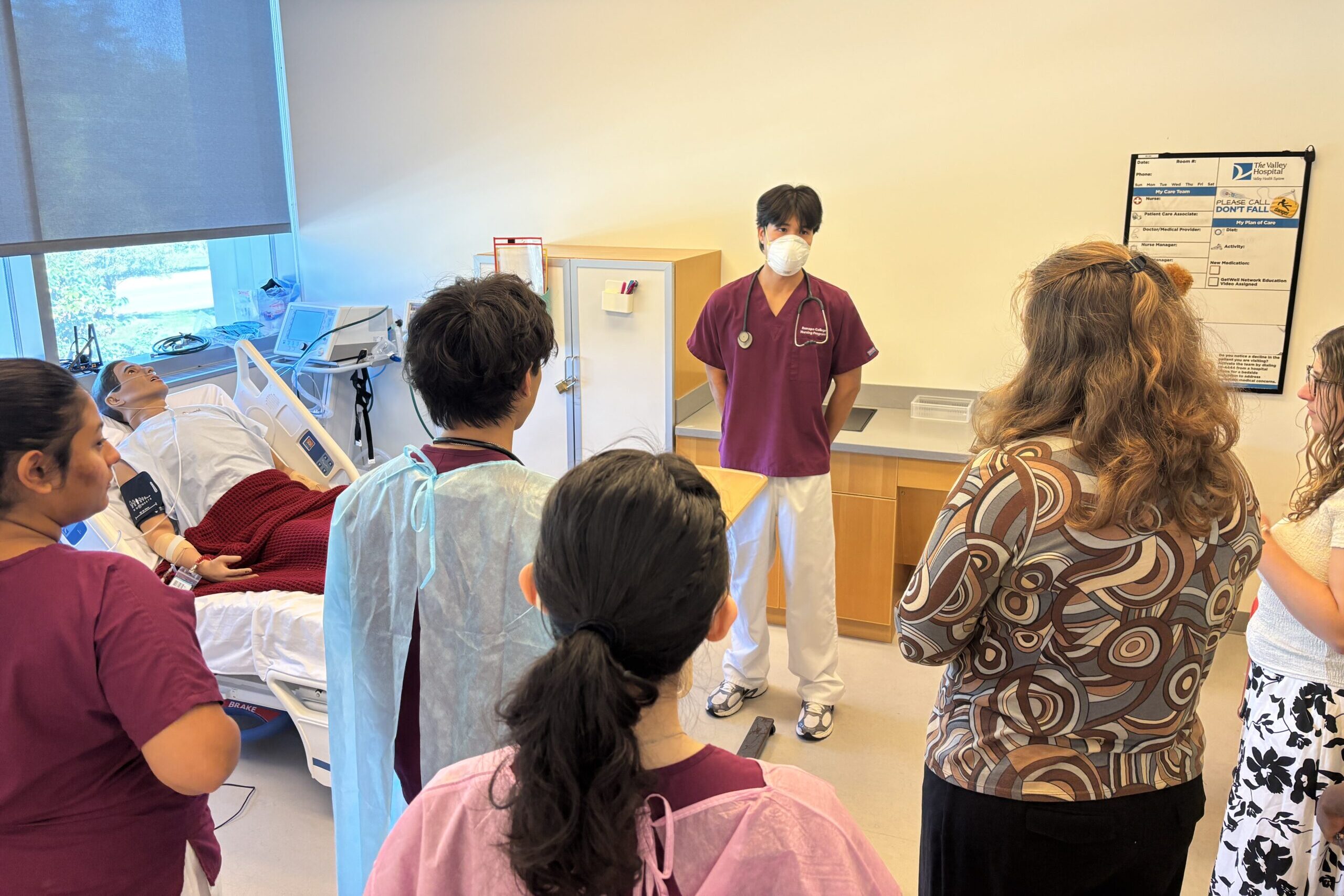
A Ramapo nursing student introduces social work students to a computer-simulated patient during a simulation that mirrored a real-life hosptial scenerio.
Following the simulation, the instructor who played the voice of the 80-year-old patient gave an assessment of how the patient felt during the exercise.
“From the patient’s perspective, it was very comforting to know that I had a group or a team of professionals caring for me. I had nurses at the bedside who were addressing my physiological needs. There was a medical team coming in and asking questions about my mental health. And it was also nice to have the social workers coming in asking about transitional care or asking about what’s going on at home to get a better understanding,” she shared. “It’s a little bit overwhelming at times, because I had breathing issues, but very, very comforting.”
To learn more about studying social work at Ramapo, visit the College’s Social Work webpage. For more on pursuing nursing at the College, visit Ramapo’s Nursing webpage.
Follow Ramapo