July 16, 2026
by Lauren Ferguson
Grace Martinez ’27 has always loved history, and has long been fascinated by how the objects people leave behind become connections to the past.
“Museums felt like a natural fit for me because they are a space dedicated to caring for and researching the art, artifacts, and stories that I find so impactful,” explained Martinez, a Ramapo College of New Jersey History major and Museum and Exhibition Studies minor.
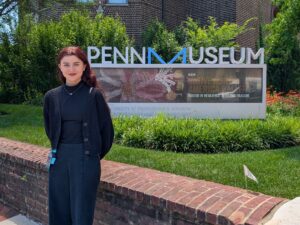
Martinez, who is in the Honors Program at Ramapo, is spending the summer interning as a collections management assistant at the University of Pennsylvania Museum of Archaeology and Anthropology, or the Penn Museum. She works with historical objects to safely inventory, photograph, and rehouse them, and uses the museum’s collections database to record bibliographic and archival data about the objects. This summer, she has worked with objects from around the world, from Babylonian clay tablets to Indonesian manuscripts. Last fall, she served as a collections management intern for the Morris County Historical Society.
The first-generation college student from Woodland Park, NJ chose to attend Ramapo in part because of its Museums and Exhibition Studies minor. “Very few schools offer similar programs at the undergraduate level, and I knew that it would give me the opportunity to learn more about the institutions that I am so passionate about,” she said.
Ultimately, Martinez dreams of working as a museum registrar, the person responsible for documenting and managing a museum’s collections. The hands-on experiences, dynamic curriculum, mentoring faculty and supportive community she has found as a Roadrunner are propelling her toward her goal.
Martinez sat down to answer questions about what she has learned through both her paid internship at the Penn Museum and her time at Ramapo.
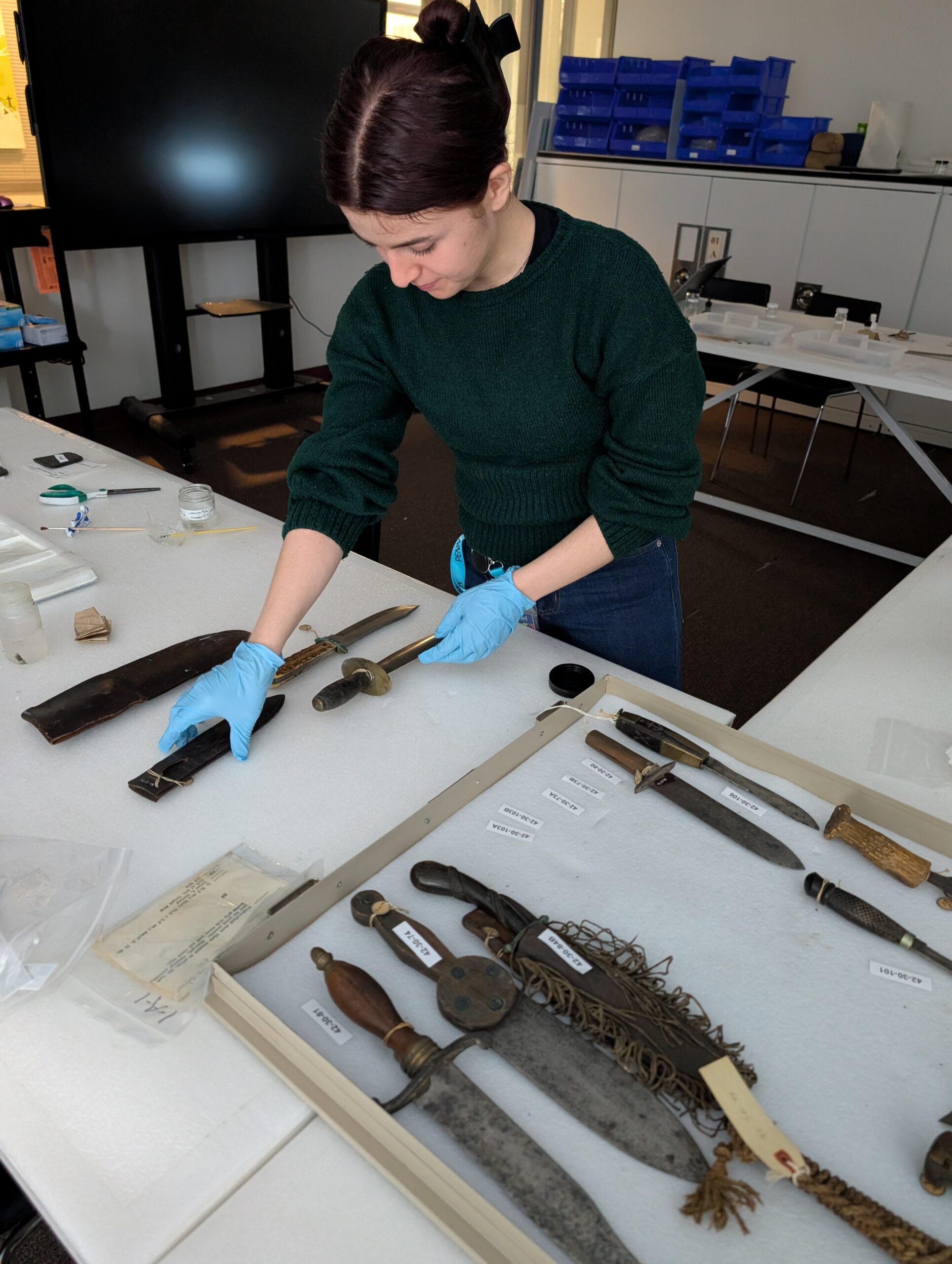
As an intern at the Penn Museum, Grace Martinez ’27 inventories, photographs and rehouses historical objects, and records information in the museum’s collections database.
How does the internship relate to your area of study?
My minor in Museum and Exhibition Studies has given me a unique perspective on the importance of safely housing historical objects in order to learn about the past and hold a more informed view of the present. Unlike many of my fellow interns, I do not specialize in archaeology or anthropology. However, my studies have taught me the importance and power of historical objects as well as the value of caring for them within cultural institutions such as the Penn Museum.
What have you learned so far?
The first two weeks of my internship have been referred to as ‘collections bootcamp.’ During that time I learned how to safely handle objects in order to number them, create safe storage boxes, and properly rehouse them. I also covered the basics of the Museum’s collections database. For the remainder of the internship, I’m circulating between eleven of the museum’s curatorial sections. There, I apply the skills I have learned to inventory objects, rehouse them, and enter information about them into the database.
Is there anything you are particularly grateful for from the internship?
I’m one of fifteen interns from around the world, and I love spending time with them and learning more about their specialties and experiences. We all have very different academic backgrounds, and I’m extremely grateful for the opportunity to learn more from my colleagues working as archaeologists, biological anthropologists, and cultural heritage researchers.
Have any of your Ramapo professors had a big impact on you?
There are almost too many to name! The entire Ramapo history department is phenomenal, and all of my professors have taught me lessons that I utilize in my internship every day. In particular, Dr. Stephen Rice, the co-convener of my minor, was incredibly supportive while I was working in my previous internship and while I was preparing to apply to the Penn Museum’s program. Additionally, his classes heavily influenced how I think about the role that cultural institutions play in people’s lives. Dr. Cathy Moran Hajo and Dr. Sarah Koenig both offer incredible classes where I was able to learn about technology’s role in history and museum studies. Dr. Pinar Kayaalp’s classes taught me to appreciate the political power of the objects that I’m working with this summer, and finally, the retired Dr. Alexander Urbiel’s classes focusing on public history made me consider how cultural institutions impact people’s understanding of the world we live in.
What do you like about the program you are in at Ramapo?
I really love the coursework that we have. In particular, classes like Public History and Museums in America give students a really unique perspective on how museums function both as repositories and as spaces dedicated to research and learning. I also appreciate that the minor requires an internship, and I think it pushes students to reach for experiences they might not consider otherwise.
Is there anything else you would like to add?
I was initially intimidated by the level of prestige that the UPenn name carries, as well as the fact that a lot of my fellow interns have more specific academic focuses than I do. I’m a first-generation student, and hearing about their college experiences made me realize how vastly different our backgrounds are. However, working at the Penn Museum has taught me that I’m capable of much more than I realize, and I think that’s something all Ramapo students would benefit to hear. Don’t let the possibility of rejection stop you from reaching for an opportunity; you never know what could happen if you just go for it.
To learn more about Ramapo’s Museum and Exhibition Studies program, visit the Museum and Exhibition Studies webpage.
Follow Ramapo