
March 31, 2026
By Lauren Ferguson
Research shows that gender bias exists in the workplace.
But how do you teach college students to recognize that bias and its cumulative effects – without triggering defensiveness – and ultimately motivate them to confront it?
The answer is sitting in a box in the office of Ramapo College of New Jersey Psychology Professor Dr. Leah Warner.
Warner, along with Dr. Jessica Cundiff, associate professor of psychological science at Missouri University of Science and Technology, developed an award-winning board game entitled Workshop Activity for Gender Equity-Classroom, or WAGES-Classroom for short.
“It teaches students about how gender bias in the workplace occurs through the process of the game. It is actually drawn from over one hundred research studies on how inequality occurs in the workplace,” Warner said.
The pair recently published a study on WAGES-Classroom in Psychology of Women Quarterly.
Some bias trainings are not empirically evaluated, so whether or not they are successful has not been determined, Warner said. “We are really trying to add to the literature to say, here is an empirically-validated way to teach people about how inequality works in a way that’s engaging, decreases defensiveness, and actually leads people to do things to change.”

Ramapo College Psychology Professor Dr. Leah Warner developed an award-winning game to teach students about gender bias in the workplace.
The pair – and their students – conducted longitudinal studies on the efficacy of the game, and asked participants if they did anything with the information they learned by playing. “Did you talk to someone about it? Did you learn more? Did you take any actions in your place of work to try to make things different?” Warner explained. “Those that played the game were actually more likely to do that, than those just simply reading the information.”
Warner hypothesizes that the experiential learning experience that gameplay provides is the reason. “Not only can people feel themselves more in it, but also one of the things that we really were thinking about is ways in which to decrease people’s defensiveness over learning about these topics … the gameplay itself kind of cuts through that,” Warner said.
Research-Backed Play
To play, players are split into two teams – a green team, representing females, and a white or yellow team, representing males – and are not told what the colors represent. Players are given dinosaur figurines as game pieces. “I just love taking something that is such a serious topic and making it fun,” Warner said.
Players start at entry-level positions and draw cards from piles correlating with their teams. The prompts on the cards describe realistic scenarios based on research findings on gender inequity, and tell players how many spaces they can move up the career ladder. The objective is to reach the top of the career ladder: an executive position with a top-floor corner office.
The scenarios on the cards touch on topics such as wage gap, sexual harassment, microaggressions, double standards and tokenism.
“You receive your paycheck for your first two weeks of work. $1,000 – way to go! Move forward one space,” reads a green team card. A similar yellow team card states: “You receive your paycheck for your first two weeks of work. $1,100 – way to go! Move forward one space.” The paychecks represent the actual documented wage gap between men and women aged 20-24 in the United States.
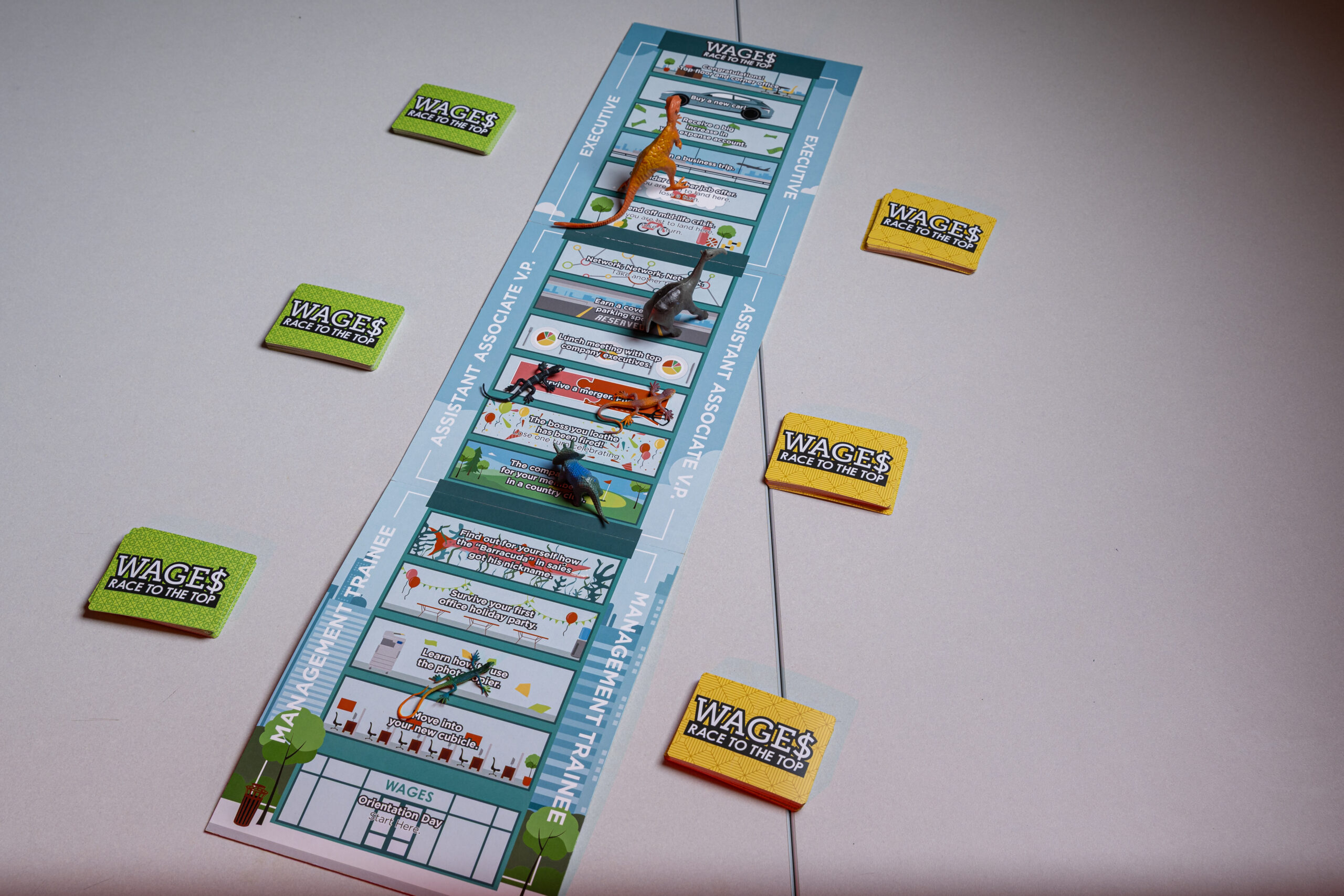
In WAGES-Classroom, players vie to reach the top of the career ladder.
“Advantages given to the white/yellow team are subtle and seemingly innocuous at first but accumulate to produce noticeable disparities as the game progresses through different career stages. Thus students come to discover knowledge about gender bias on their own as the game unfolds,” Warner and Cundiff wrote in Psychology of Women Quarterly.
Hands-On Experience
Warner has engaged Ramapo students not only in playing the game, but also in creating and evaluating it. Her students have gained valuable hands-on experiential learning experiences during the five years it took to research and develop the game. Roadrunners conducted literature reviews and helped to write the scenarios, and also ran the efficacy studies.
“Students not only got to run a study, they also had to learn how to teach, because this is accompanied with a structured discussion about the game, and PowerPoint presentations, so the students both conducted a study and taught other students about this phenomenon, and then presented the research,” Warner said. “It was really rewarding to be able to provide that for students.”
Warner said she loves taking such a serious topic and making it fun and engaging for her psychology students.
“I personally love playing games and I love injecting enthusiasm and play into my teaching,” she said.
There is a professional version of WAGES-Classroom in Warner’s office, which she makes available for Ramapo professors to borrow for their classes. She also offers free PDF copies of the game to anyone who wants to utilize it. The game has garnered support and recognition from both inside and outside of Ramapo.
Warner and Cundiff received a Society for the Psychological Study of Social Issues (SPSSI) Action Teaching Grant as well as an Association for Psychological Science (APS) Teaching Grant for WAGES-Classroom. Warner also earned the SPSSI Action Teaching Award and the SPSSI Teaching Innovation Award for social science inquiry.
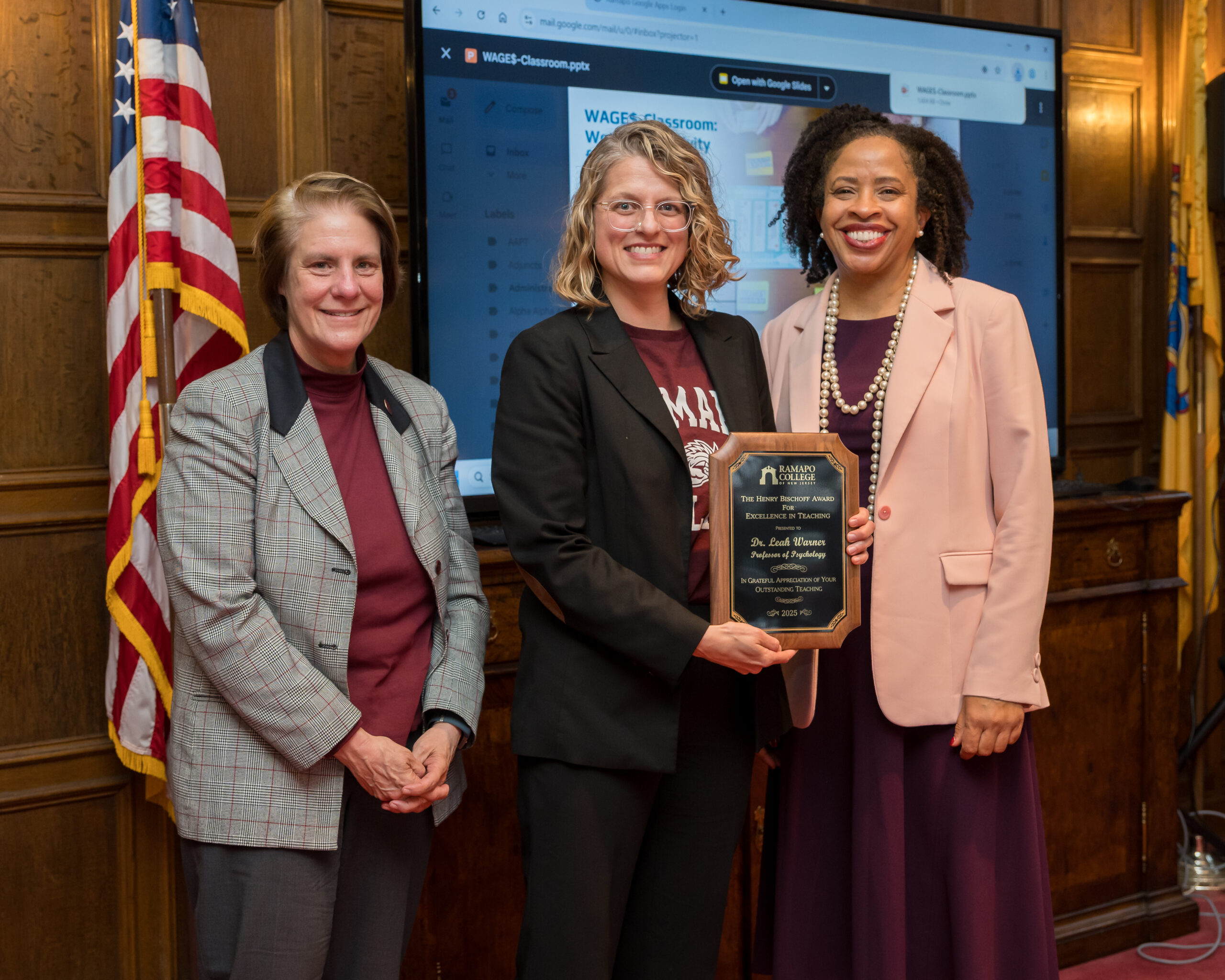
Dr. Leah Warner, center, was awarded the 2025 Henry Bischoff Excellence in Teaching Award. She is joined at the ceremony by Ramapo College President Dr. Cindy Jebb, left, and Associate Professor of Literacy Dr. Sharon Leathers, right.
The longtime psychology professor is also one of three Ramapo faculty members that were awarded the 2025 Henry Bischoff Excellence in Teaching Award. The award is given annually to faculty members whose work as teachers embody the best of Ramapo’s teaching culture. Other Ramapo professors honored in 2025 were Assistant Professor of African American Literature Indya Jackson and Associate Professor of Law and Society Sanghamitra Padhy.
Follow Ramapo