March 6, 2026
by Elizabeth Mendicino ‘26
To become an educator of any kind requires a special empathy and care for the world around you. It is often the most exceptional educators that regard this empathy as one of the most important parts of their work.
Dr. Satarupa Dasgupta, associate professor of communication arts at Ramapo College of New Jersey, has proven to be a phenomenal example of this; her care for her students and the world around her sets her apart as a phenomenal educator. And as a health communication researcher, she has quickly become a leader in academic circles.
Since joining the faculty at Ramapo in 2018, Dasgupta has won multitude of awards, authored countless peer-reviewed articles, book chapters, and other academic works, and served as leadership on multiple National Communication Association caucuses. However, when asked what brings her the most pride regarding her work, none of this came to mind.
Much of Dasgupta’s work is centered around marginalized groups, particularly women of color, transgender individuals, sex workers, and neurodiverse groups. “It’s very rewarding that this kind of work is getting noticed, because the work that I do, a lot of it has been defunded,” Dasgupta said. “There has been a lot of defunding, especially in the area of culture specific programs … This is a huge problem. And then I work with these people who are vulnerable, and sometimes they are voiceless. They are invisible.”
Despite extensive federal defunding of her work, Dasgupta persists because she knows how important it is. Not only this, but she encourages her students to do the same; to engage their curiosity and conduct research on the topics most important to them.
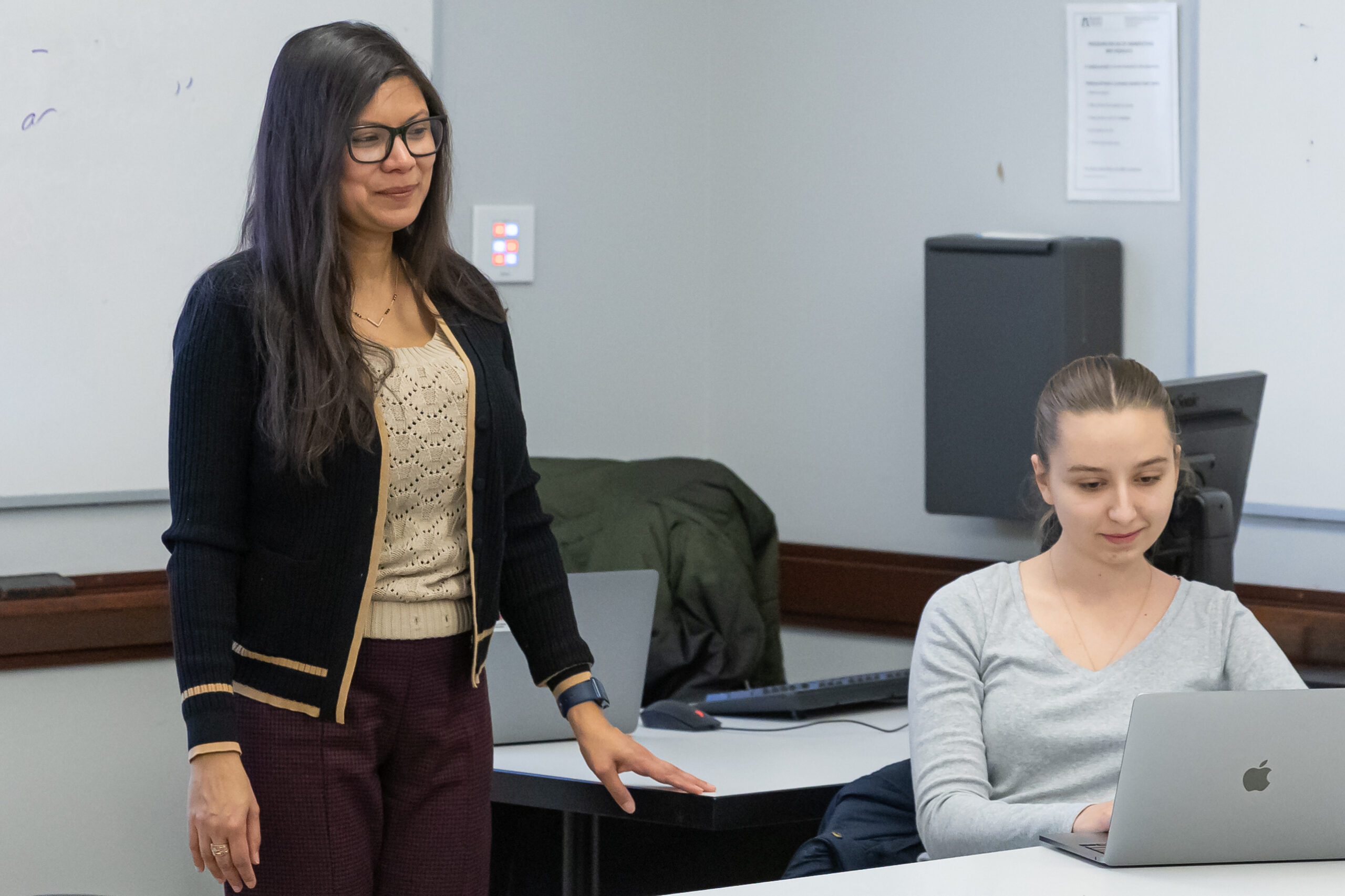
Dr. Satarupa Dasgupta encourages students to pursue research.
As advisor to Ramapo’s award-winning Lambda Pi Eta Communication Honor Society, empowering students and challenging them to succeed is essential. Dasgupta frequently works with students on research, eventually bringing their collaborated works to various communications conferences where the papers have become peer-reviewed and won awards.
Dasgupta’s support of her students is what changes the game for them, giving them the opportunity to conduct research they did not think was possible. Her students have written and presented papers on topics that are personal to them – ranging from the complex link between ADHD and substance abuse disorders to the impact of social stigmatization on people with cleft lips and palates.
“She has given me so much knowledge and confidence,” said Alyssa Curto ‘25, who presented her project on the impact of social stigmatization on people with cleft lips and palates at the Council of Public Liberal Arts Colleges (COPLAC) Northeast Regional Conference at the Massachusetts College of Liberal Arts, as well as Ramapo’s 13th Annual Scholars’ Day. Her project was also put on display at the 116th Annual Eastern Communication Association Convention in Buffalo, NY, which Dasgupta described as “one of the most competitive conferences with a low acceptance rate.”
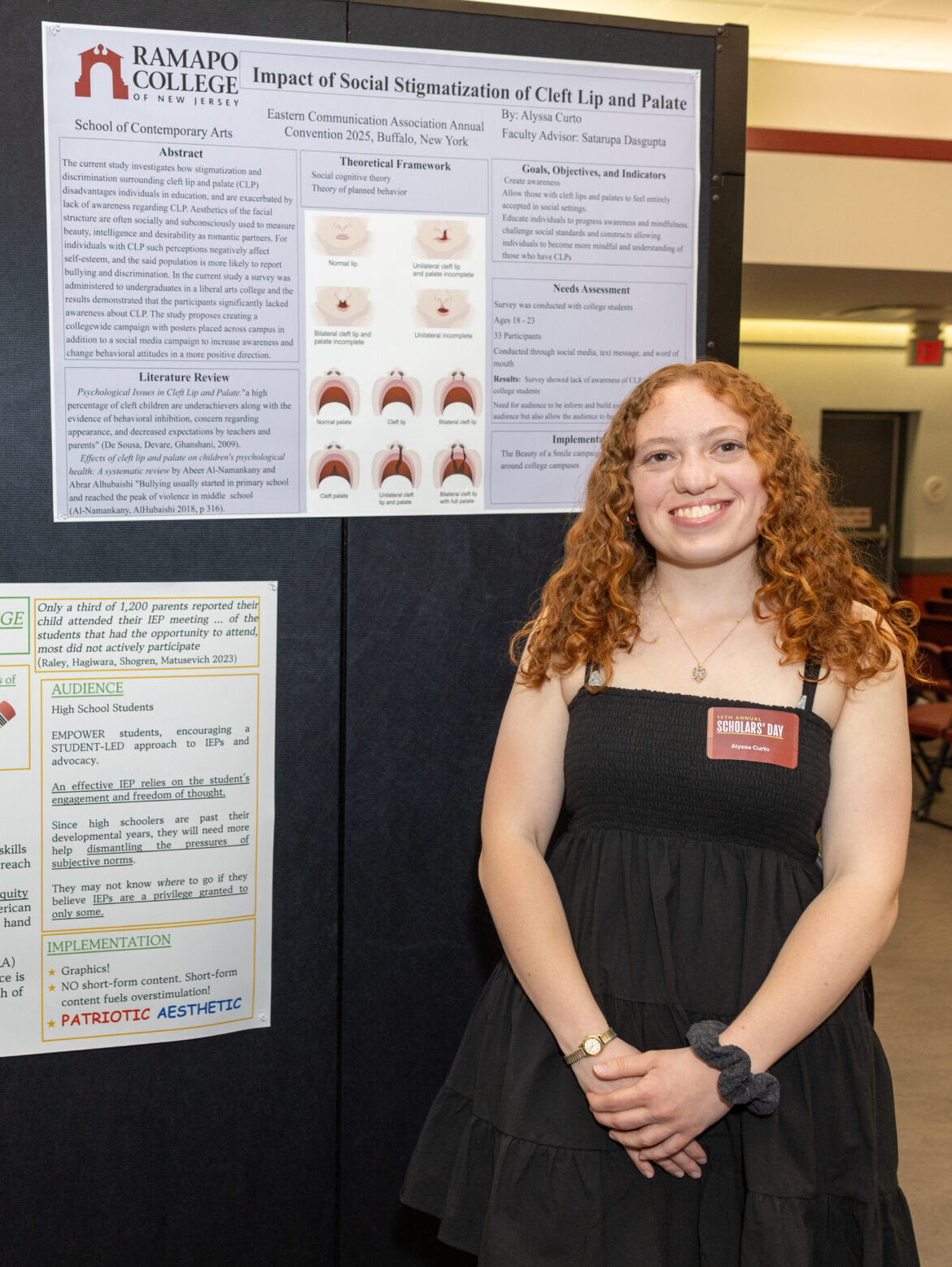
Dr. Satarupa Dasgupta encouraged Alyssa Curto ’25 to pursue research on the impact of social stigmatazation on people with cleft lips and pallats.
Dasgupta’s students have praised her for being an accessible, engaging mentor.
“She doesn’t just read off of slides. She has a discussion for every one of her classes so that the students can better understand the material,” said Uma Advani ‘27, Global Communication and Media Major, International Business Minor. “She makes all of her material very relatable to students, especially in today’s generation. She also teaches us how she is also human and that life happens and I am eternally grateful to be taught by such an inspiring woman!”
“Professor Dasgupta has been very helpful in and outside of class, between answering questions regarding her course as well as my research project,” said Rachel Kobelski ‘26, a Psychology major and Women’s, Gender and Sexuality Studies minor. “She really cares about her students and wants to help! She’s always accessible.”
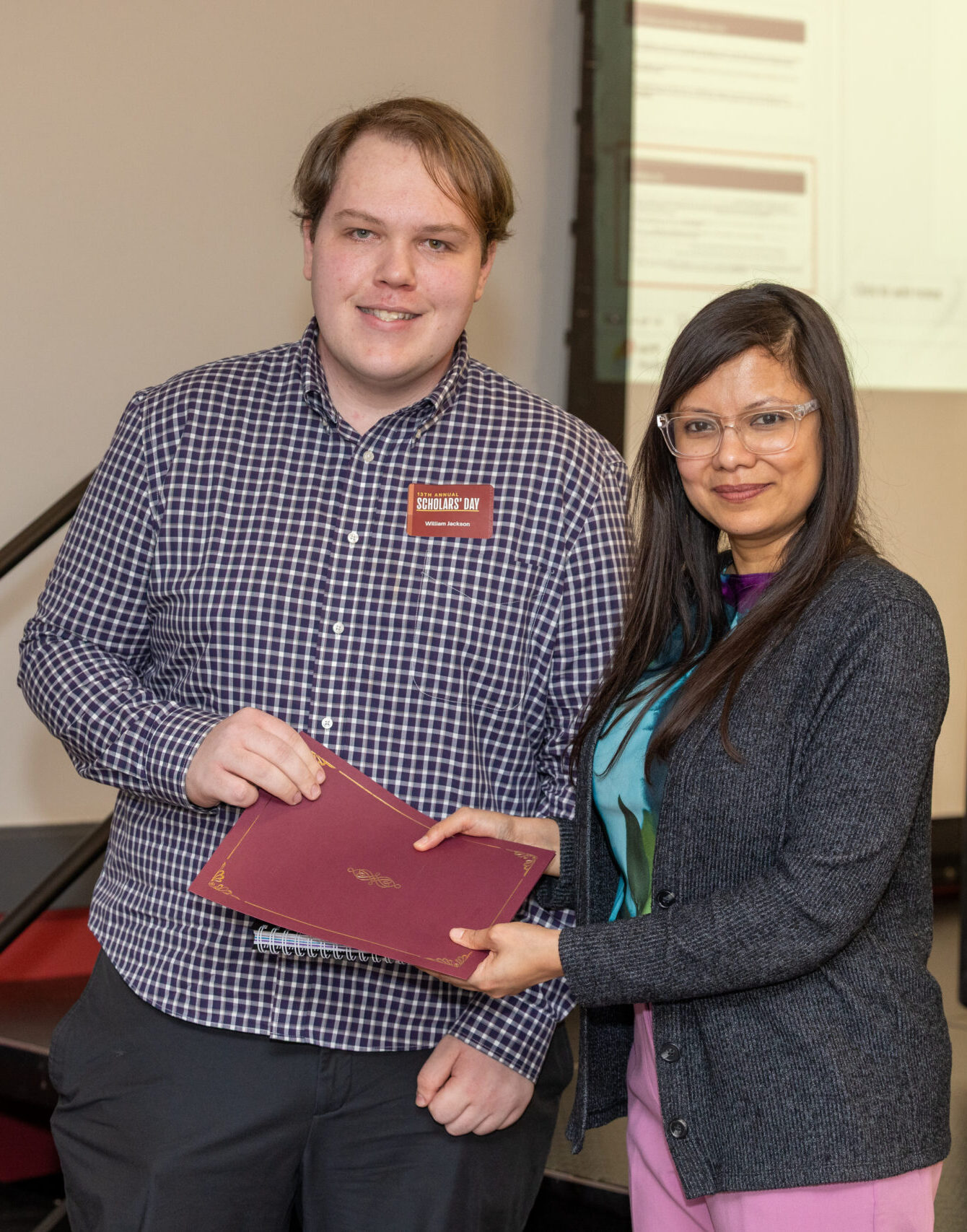
William Jackson ’25, a student of Dr. Satarupa Dasgupta, conducted award-winning research and presented at multiple conferences.
Now, Dasgupta is preparing to bring a mix of alumni and current students to the 117th Annual Eastern Communication Association Convention in Pittsburg, PA in April.
Dasgupta will present her paper entitled Transnational Feminism in Practice: Rethinking Intimate Partner Violence Response and Mitigation Services across Borders. She will also co-present two papers she co-authored with her students. Alumna Emily Melvin ‘23 co-authored the paper Patterns of Control: A Narrative Review Exploring Nature and Scope of Technologically Mediated Intimate Partner Violence Among Generation Z Individuals, while Sara Hosbach ‘24 and Melissa Glasson ‘24 co-authored the paper Reimagining Diversity and Inclusion in Postsecondary Education: Critical Communication Pedagogy for the Neurodiverse Students..
In addition, Roadrunners Miranda Frisbee ‘26 will present her paper Brains in All Shapes: Building Better Classrooms for Neurodiverse Learners, Rachel Nicole Kobelski ‘26 will present her paper Victims of Incel Culture & the Effect of Manosphere Engagement, and Maryellen Kane ‘27 will present her paper Creating engaged citizens: A proposed campaign for the development and implementation of a curricular framework for civic education.
“I hope that I managed to create that kind of voice among the students, sometimes you need to advocate for yourself,” said Dasgupta on empowering students to pursue advocacy and research. “A lot of diverse students, sometimes they’re hesitant. There are structural deficits everywhere … but we need to change that … I hope that my work is helping to usher in a bit of a change. Even if it can create a bit of an awareness, consciousness, about what is lacking, that is important.”
Follow Ramapo