October 27, 2026
by Lauren Ferguson
As autumn sets in on the Ramapo Mountains, students at Ramapo College of New Jersey have access to some of the brightest, most colorful trees in the state.
But for Roadrunners, the trees and mountains offer more than just breathtaking leaf-peeping views. They provide opportunities for hands-on research.
“It’s just so wonderful that we are at the base of the New Jersey Highlands and have the Ramapo Mountains right across the street,” said Associate Professor of Environmental Science Eric Wiener, PhD.
For more than 20 years, Wiener has spent his days not just teaching in Ramapo classrooms, but mentoring and immersing Roadrunners in hands-on learning and research experiences in the forests surrounding the College’s picturesque 300-acre Mahwah, NJ campus.
The experiences Roadrunners have gained by conducting research in the forests, and analyzing and working with large data sets, has been a catalyst for countless careers. Environmental Science alumni have gone onto prestigious graduate programs, environmental education positions, and roles in organizations such as the U.S. Environmental Protection Agency, New Jersey Department of Environmental Protection, and environmental consulting firms.
Wiener said the location of Ramapo’s campus affords students “amazing” access to forests.
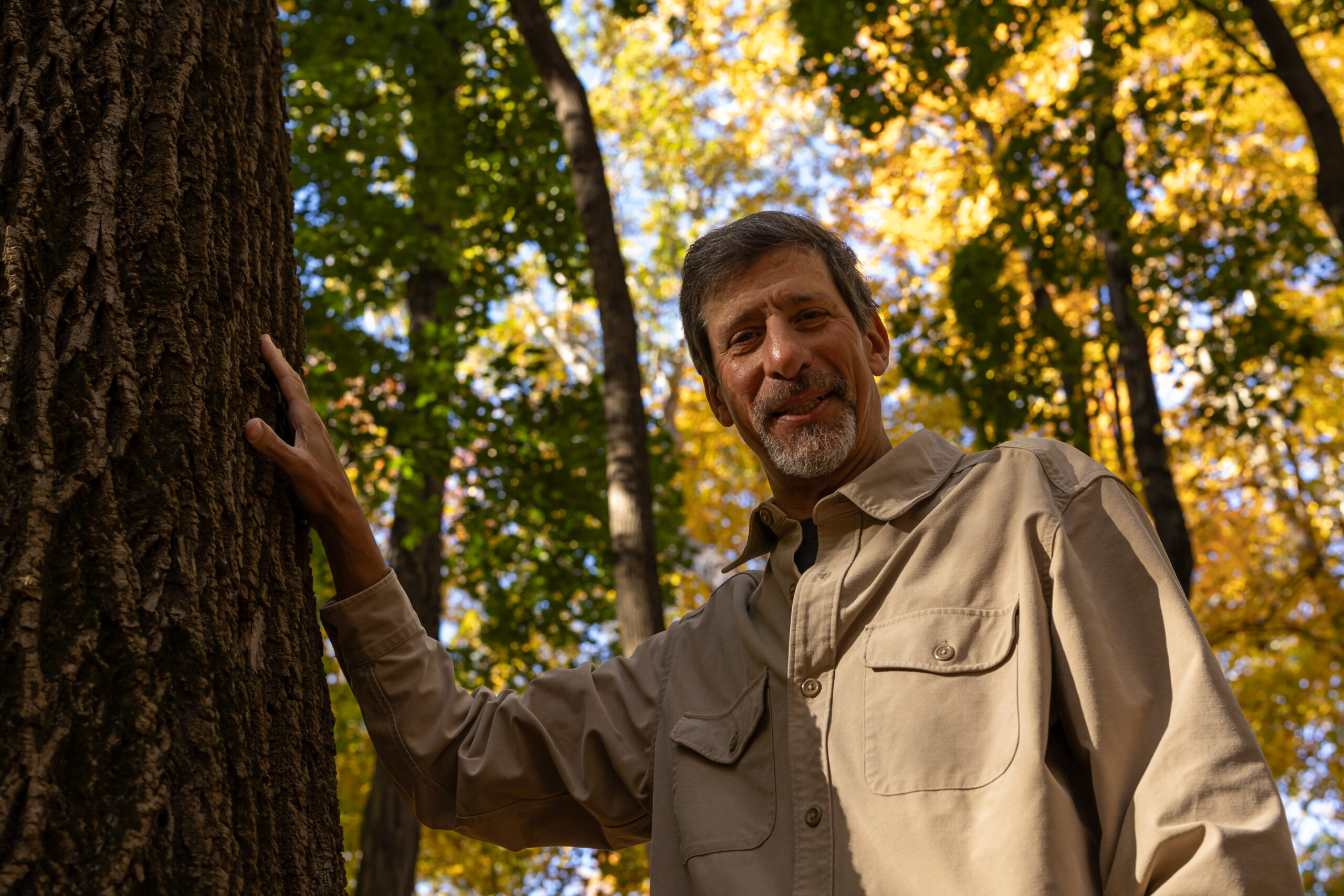
Associate Professor of Environmental Science Eric Wiener, PhD, mentors Roadrunners through hands-on learning and research experiences in the forests surrounding Ramapo College.
“If you look at a map, you’ll see that right across the street starting with the Ramapo Reservation, it’s connected to Ringwood State Park which is connected to Sterling Forest, and then Harriman State Park over in New York across the border. And going in the other direction, there is Ramapo Mountain State Forest, and then Norvin Green State Forest, and more,” Wiener explained. “There’s over 100,000 acres of protected forests in the immediate region.”
Fertile Ground for Research
The forests surrounding Ramapo College are fertile ground for all sorts of research opportunities.
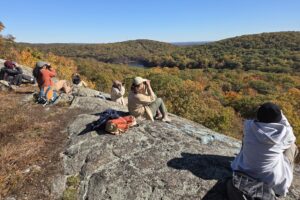
During the College’s Spring 2026 Scholars’ Day, student scholars presented their research on topics such as: The Timing and Patterns of Autumn Migration of Blue Jays through the Ramapo Mountains; Oak Leaf Defoliation Following a Spongy Moth Outbreak in the New Jersey Highlands; and Aggressive Interactions Among Migrating Raptors Over the Ramapo Mountains. In the spring, students also presented their work at the Mid-Atlantic Chapter of the Ecological Society of America’s annual conference at Towson University in Maryland.

During Ramapo’s 2026 Scholars’ Day, Julien Roche ‘26 (left) and Josephine Mitchell ’27 (right) presented research they conducted into aggressive interactions of raptors migrating over the Ramapo Mountains.
Currently, Wiener and students in the environmental science capstone course are immersed in research for two long-term studies about the region. One focuses on tree ecology in the forest. “We’re looking at how different tree species are in decline and how that impacts the overall forest ecosystem,” he said.
Students survey large areas of forests, and take data on each dead tree that they find – measuring their sizes, identifying the species and trying to figure out how they may have died. They also look at which tree species are most likely to replace the ones in decline to better understand what the changes mean for the future species composition of the forest. The research is done and mapped every four years, so students can tell which trees died in the last few years and how patterns of tree mortality change over time.
In recent years, ash trees have been killed due to invasive insects, beech trees are now dying from a new disease, and oak trees are in gradual decline due to a variety of problems, Wiener explained. “The forests are changing, and this is a really unique study documenting those changes and how it affects the whole forest community, including everything from other plants to mammals and insects and birds,” he said. Through the project, Roadrunners learn field methods, and good habits for being field scientists, he said.
Roadrunners are also learning valuable field-science habits by participating in a project led by Wiener, which focuses on how studying raptor migration over the Ramapo Mountains can help people better understand raptor migration in Eastern North America. Students are learning to find and identify raptors – such as hawks, falcons, eagles and vultures.
“During migration, you can see them in large concentrations. We recorded data on over 16,000 migrating raptors so far this fall, and over 7,000 in just one day. So in addition to being involved in meaningful field research, students get to have such amazing sightings and experiences,” Wiener said.
Learning in the Field
Environmental Science Major Hannah Smith ’29, a student working on the raptor migration project, said “One of the reasons I chose to come to Ramapo was because of the natural areas surrounding the school. Who doesn’t want to be studying environmental science surrounded by forests and mountains?”
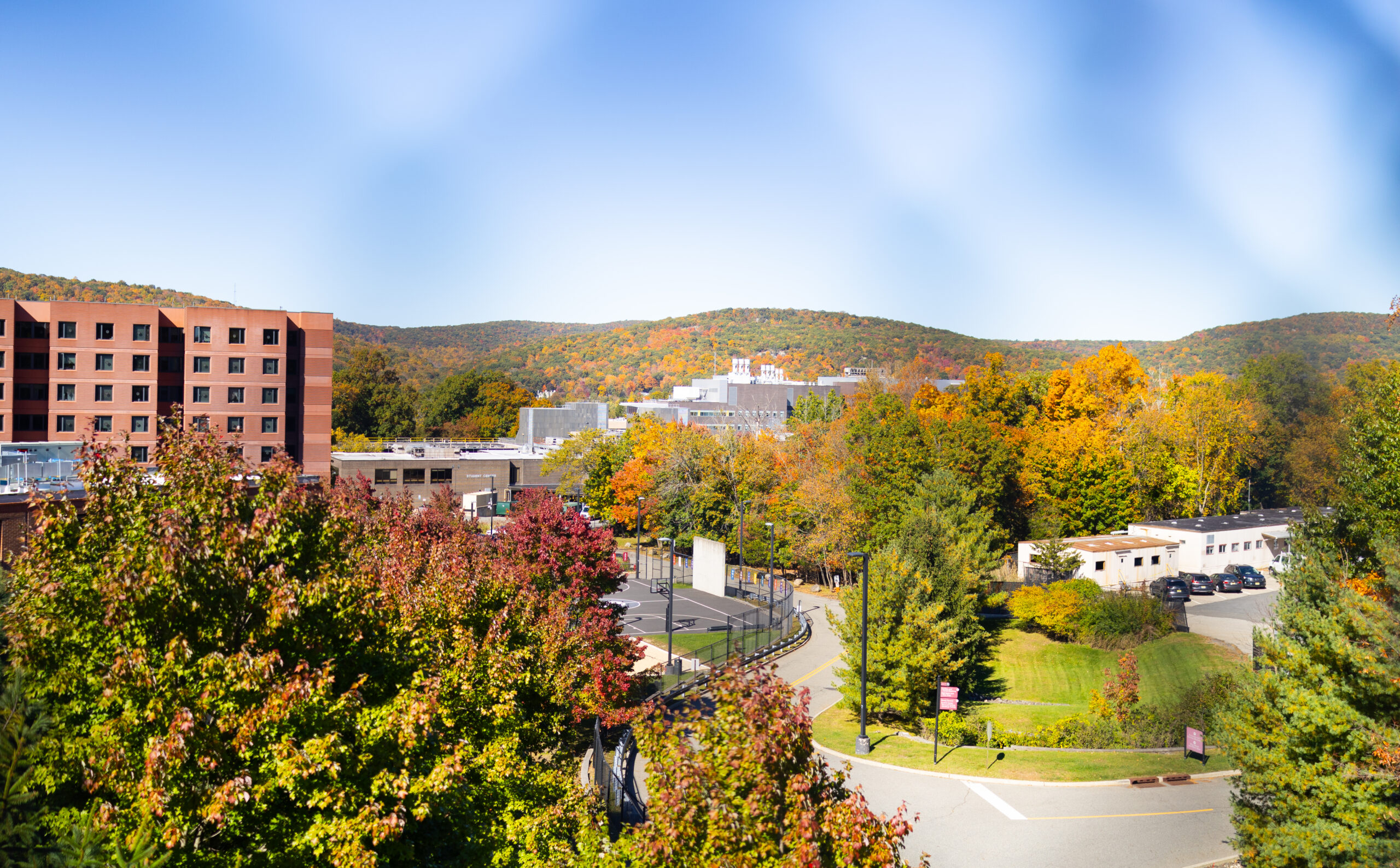
Ramapo College of New Jersey’s picturesque campus is set in the foothills of the Ramapo Mountains, with access to over 100,000 acres of protected forests in the immediate region.
Besides working on the raptor project within the Ramapo Reservation, Smith, of Ledgewood in Morris County, NJ, said her professors have taught classes in the Reservation, and “we have learned about the geological history of the reservation, tested the water quality along its lakes and streams, and studied the forests that reside within it.”
Likewise, fellow Environmental Science Major Collin Suojanen ’28 called it “a rare opportunity” to have the Ramapo Reservation “be an alternative to a classroom or lab.”
“I’ve learned water chemistry, ornithology, plant and wildlife ecology, and now I’m conducting my capstone research on forest dynamics, all right across the street from campus,” said Suojanen, of Jackson, in Ocean County, NJ.
For Suojanen, doing work in the field has made a world of difference in learning about the environment. “I’ve looked at data and statistics on a computer, and I’ve learned about many ecology ideas in lectures. However, nothing comes close to standing in the forest and seeing with your own eyes the nuance and complexity of nature,” he said.
Benefits of Nature
While conducting their research, Wiener and his students – as well as others in Ramapo’s Hiking Club, Birding Club and other outdoors-oriented clubs – have taken in the fall colors that have blanketed the Ramapo Mountains.
“This year, you could really see the colors come out for some of the tree species better than the past few years. Especially the hickories, they have this really rich yellow color this year,” Wiener said. “I can’t believe the sassafras trees, they’re just gorgeous this year. Many of them have really deep red and orange leaves.” Wiener has also been awed by the dark red of some of the red maple trees and the beautiful orange of many of the sugar maples.
After more than two decades teaching at Ramapo, Wiener knows the Ramapo community is fortunate for the College’s location at the base of the New Jersey Highlands, surrounded by nature.
“It is so great for students to get out into the forest for fresh air and exercise. It’s great for physical health and studies show it’s also great for psychological well-being,” Wiener said. “Students should take a friend and help them enjoy nature, because the more people who enjoy nature, the more people will want to support it.”
To learn more about studying Environmental Science at Ramapo, visit the Environmental Science program webpage.
Follow Ramapo