Contact
Virtual Tour

July 9, 2026Bootcamp Down Under: Our Experience In Australia
By Cairenn Binder
In May of 2026, I had the incredible opportunity to head “down under” to Sydney, Australia with my colleague Tracie Boyle. Together with the Centre for Forensic Science at the University of Technology Sydney (UTS) and the New South Wales Police Force (NSWPF), we were to host a weeklong bootcamp event intended as hands-on training for law enforcement and undergraduate students seeking to enhance their IGG skills.
Little did we know that cross-cultural collaboration with our colleagues in Australia would leave us with as much of a learning experience as a teaching experience! Here’s a breakdown of how we spent our week in Sydney:
Sunday
After departing from New Jersey on Friday afternoon and suffering the grueling 24-hour trip to Sydney, we emerged from Sydney Airport on Sunday morning. One of our NSWPF colleagues graciously picked us up and transported us to our hotel which was located just across the street from our workplace for the week, the UTS.
Jet-lagged and exhausted, we knew we had no choice but to stay awake as long as possible in order to hit “reset” on our sleep schedules and adjust to Australian time ahead of our workweek. Thus, we set out to the Taronga Zoo where we spent hours walking around, checking out every animal enclosure, and enjoying the beautiful Australian “winter” weather (70s and sunny!).
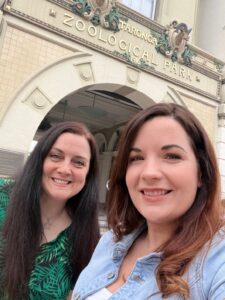
Tracie + me at the entrance of Taronga Zoo.
In the afternoon, we briefly met with colleagues for a meal and then headed back to our hotel to get plenty of rest for the busy week ahead.
Monday
Fairly well rested, we headed to campus for the first time on Monday morning to begin casework with our Aussie colleagues. Upon our arrival to campus, we were introduced to the bootcamp participants including undergraduate forensic science students from UTS as well as members of law enforcement and forensic agencies from across Australia and New Zealand! After some minor housekeeping and admin work, our students were introduced to their case: an unidentified human remains case from New Jersey.
Tracie and I provided some cultural context regarding the location where the unidentified person was found, and then introduced the various software tools we would use for tree-building and genealogy. Then, they were off! Adjunct Associate Professor Nathan Scudder (UTS and Australian Army) had taken the time to divide the students into small cross-agency workgroups, which was a brilliant way to facilitate collaborative learning. We were immediately impressed with the UTS students’ knowledge of IGG as well as their dogged research skills. While the law enforcement participants had varying degrees of genealogical research experience, each brought valuable perspectives to the investigation and were quick learners when it came to IGG research.
In the afternoon, I provided two lectures to facilitate learning about IGG subjects relating to the case the students were tasked with. The group also took the opportunity for a photo op next to the double helix staircase – did I mention that the UTS campus is phenomenally gorgeous?
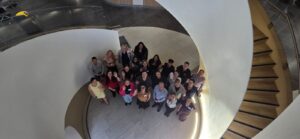
Our bootcamp group at the base of the double helix staircase.
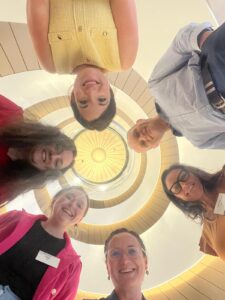
Looking up towards the top of the staircase!
By the end of the day, we had covered a lot of ground! That evening, we joined our new colleagues for a quiz night at a dungeons-and-dragons themed restaurant – right up my alley! While the days at UTS were filled with learning on both sides of the equation, the networking events in the evening were wonderful opportunities to learn more about Australian culture.
Tuesday
On Tuesday, the team started with a review of the casework so far and then dove into a lecture and demonstration on segment analysis. This provided our bootcamp team members with specific areas of focus to search for and identify potential most-recent-common-ancestors (MRCAs). On this day, the bootcampers were able to identify the likely area of origin of the decedent through their genealogical findings.
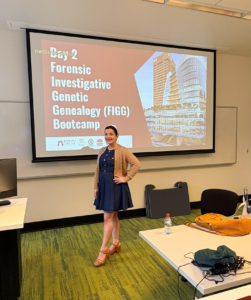
Preparing to teach Day 2 of Bootcamp!
In the evening, we were joined by our colleagues for a pan-Asian feast at Sydney’s Spice Alley. Delicious!
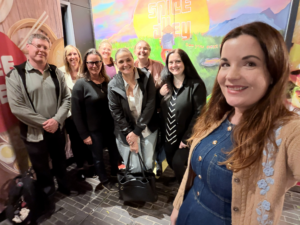
Happy and full after our meal at Spice Alley!
Wednesday
During day three of bootcamp, the team really turned up the heat! Multiple most-recent-common-ancestor (MRCA) couples were identified, but as occurs in many cases, we found some complicating factors which impacted our ability to build the trees of some of the DNA matches for the case. However, our bootcampers were not deterred – if anything, they became more determined in the face of adversity!
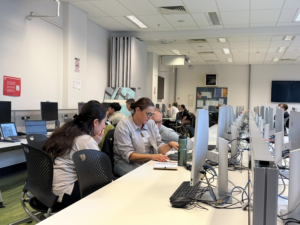
A moment of intense research during bootcamp.
In addition to casework, the bootcampers were provided with lectures from Professors David Gurney and Nathan Scudder on law and ethics, as well as from Tracie Boyle on OSINT tools.
Although we were exhausted by midweek, we couldn’t pass up the opportunity to attend a lecture hosted by the Australian and New Zealand Forensic Science Society at Western Sydney University. This was an important networking opportunity and we were delighted to meet a fellow New Jersey native – a student conducting her postdoctoral studies in Sydney!
Thursday
After a breakthrough with a difficult DNA match, the bootcamp team became refocused on several families of interest and began the painstaking process of descendancy research. Endogamy complicated the research process at this stage, and together we commiserated about the difficulties of this case.
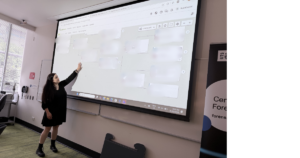
Tracie pointing out an area of focus in a family tree.
Learning that we have more commonalities than differences, I provided a lecture on special populations and provided case examples involving breakthroughs achieved through outside-the-box research methods.
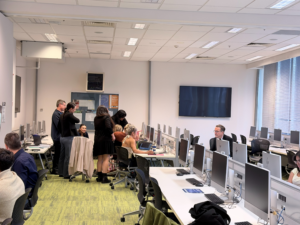
Hubbub around a computer after a critical finding is made.
That evening, we had our biggest night out yet, enjoying a meal and meaningful conversation at Darling Harbour.
Friday
I can’t lie – on Friday, I was stressed as I was beginning to think that the team might not solve the case! We had only until noon to work with the bootcampers, and although we knew what families the decedent was descended from, we seemed to be no closer to uncovering their identity. Having encountered adoptions and other family tree complications in the past, Tracie and I wondered if this was the complicating factor for our selected case. We ended the day without resolving the case, although we had a delightful morning presenting the participants with certificates and exchanging goodbyes with our newfound friends.
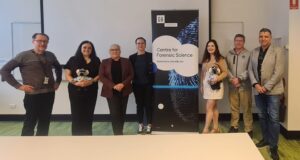
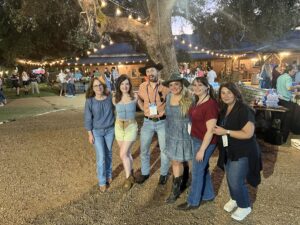
Tracie and I with our colleagues from UTS and NSWPF after a great week.
That evening – our last in Sydney – Tracie and I enjoyed the Vivid Sydney festival of lights. It was the perfect way to end the (almost) perfect trip – and could have only been improved by news of a solve…!
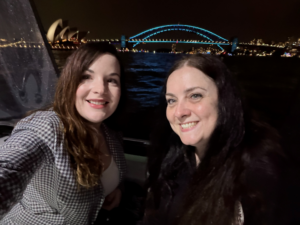
Me + Tracie on our boat tour in front of Sydney Opera House.

Beautiful Sydney during the Vivid festival!
Saturday and Beyond
On Saturday morning, we sadly headed back to the United States, determined to reevaluate the case and see if we could find something that had not been discovered at bootcamp. However, as we adjusted our sleep schedules again and I headed out for another conference in Indiana, we found we didn’t need to take a second look!
While we were traveling, one of the bootcampers found the missing piece of the puzzle – and found a candidate for the UHR we’d all tried to identify all week! Days later, we met with the bootcampers once more – this time via an online meeting – to present their candidate to the investigating agency.
We couldn’t be prouder of the bootcampers and our co-facilitators who spent a week with us in Sydney. They are tenacious researchers, dynamic thinkers, and bright, friendly, lovely individuals. Before we even left Sydney, we were already anxious to return – and I remain hopeful that we will be back to hold another bootcamp event in the future.
Our Takeaways:
- During our trip, I learned so much about the differences in policing between the United States and Australia. There are some privacy laws in Australia that are more restrictive than the US, but also some areas where law enforcement is less restricted in investigating or arresting individuals.
- There are also many similarities between our countries. One that was particularly notable to me is that Australia, New Zealand and the United States are all homes to Indigenous populations who have been deeply affected by European colonization. This interacts with IGG in many ways, including how cases are investigated, how DNA drives may be viewed, and how difficult it is to identify DNA contributors – and leads to challenges for IGG practitioners both in the US and in Australia and New Zealand.
- The vibes are immaculate! Sydney is a wonderful city filled with friendly people. The UTS Centre for Forensic Science is a world class center for forensic science research and education and we were delighted to collaborate with their faculty and staff to host this once in a lifetime event.
We look forward to future collaborations with our colleagues in Australia and New Zealand, including further bootcamp events. Until next time… G’day and cheers to our mates in Australia!
Categories: Uncategorized
June 26, 2026The End of an Era
By Cairenn Binder
This RIGG marks the end of an era.
On a sunny summer day in 2022, I met Professor David Gurney for the first time at the Runcible Spoon Bakery & Cafe in Nyack, New York. We had been introduced online by a mutual friend and business colleague, Margaret Press, who had been my supervisor at DNA Doe Project and had worked closely with David to form the Investigative Genetic Genealogy Accreditation Board (IGGAB). Margaret noted that we lived close to one another and might enjoy working together on investigative genetic genealogy projects.
Little did we know, at the time, that our conversations over iced coffee and pastries would develop into dozens of solved cases and answers for waiting families. Our scribblings about potential programs would foreshadow memorable summer conferences and hundreds of alumni from novel educational experiences we developed together. Discussions of our passions – his, miscarriages of justice and mine, Latin American unidentified remains cases – would unfold into long-term research projects and collaborations with positive effects that have rippled through the field of IGG.
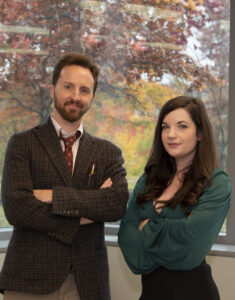
David and I shortly after we started the Ramapo College IGG Center in 2022. At this time, there was no IGG lab, no IGG certificate program, and no RIGG Conference!
Over the years of our work together, I have noted David’s apparent inability to “coast”. As a team, we have never sat back to enjoy the fruits of our labor, accepting the status quo. As our programs have grown, we have hired more people, taken on more cases, and raised more funds to ensure that the power of investigative genetic genealogy can reach as many cases as possible.
To that end, David has never said “no” to a good idea, even when it is difficult to implement. Our Latin American DNA Project, our participation in conferences around the world, our pioneering education programs, and a lot of other very hard work – have happened thanks to David’s leadership and advocacy for our IGG team.
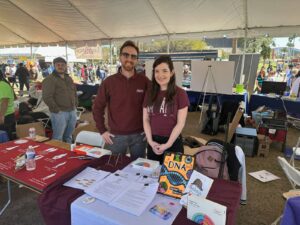
Our first DNA Drive in Tucson, 2023.
Investigative genetic genealogy leadership can be a thankless job. During his tenure as the Director of the Ramapo College IGG Center, David has been at the helm as we received backlash from critics worldwide. We have repeatedly been on the receiving end of articles and social media posts disparaging our work and questioning our intentions while we strove to provide justice for victims of violent crime and overturn wrongful convictions. Aside from that, our working relationships in The Center are not always peaceful and harmonious – we have experienced disagreements that threatened our partnership and divested us of our morale. However, David’s ability to push through even the most challenging situations and smooth over disputes is admirable, if not positively transcendent.
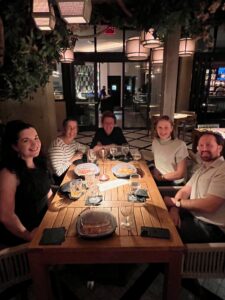
With colleagues in West Palm Beach days after a ToS change rocked our world in 2025.
Outside of his work in IGG, David’s passion for Law, Justice, and Morality – which is also the name of the class he has taught every semester at Ramapo – is apparent. Walking by his office, students are guaranteed to find printed copies of the United States Constitution and Bill of Rights perched on the dado rails on either side of his door. As a professor, David has strived to ensure that the young adults in our society are educated about their rights and freedoms as well as ethical and moral dilemmas we are bound to encounter as humans. The shelves of his office include not only works by Thomas Paine and Franz Kafka, but also religious texts and American literature he may use to illustrate ethics and morality in our modern world. For his innovative methods and his dedication to teaching, David was awarded the Henry Bischoff Excellence in Teaching Award in 2023.
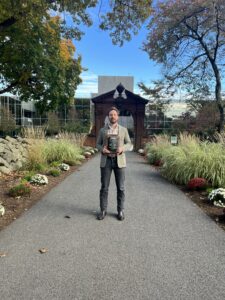
David after being awarded the Bischoff Award in 2023
As a leader, an advocate, and as a friend – David Gurney will be sorely missed when he steps away from his role from the IGG Center this summer to relocate to the southwest. I have no doubt that his impact on the field of investigative genetic genealogy will continue. As I said, the man cannot “coast” and we can’t wait to see what he does next.
Thank you, David, from all of us.
Categories: Uncategorized
June 26, 2026Past is Prologue
By David Gurney
Tantae molis erat Romanam condere gentem. (OK, OK, but see the note below on hubris.)
Leading the IGG Center at Ramapo College for the past four years has been the greatest honor of my professional life. The people and experiences (the good, the bad, and the ugly) have inspired and re-shaped me in ways I could never have predicted. I am proud of every team member and the work that we have done together. Thanks to the dedication of the team, the IGG Center rests on a solid foundation. As my wife and I make the move back to Arizona with our family, I leave my role with gratitude and confidence. The field of IGG has as its goal to provide justice and answers to victims and families, and the IGG Center is now a leading light in that effort. The center’s missions of providing proven casework, expert education, and imaginative research are well-established. With these accomplishments in mind, innovation and expansion benefit from the temporary turmoil of restructuring, and so I believe that the impact of the IGG Center will only increase in the years to come.
Beginnings
When I came to Ramapo College as a professor in the fall of 2019, I had an idea—more a dim flickering, really—to start a clinical program that combined my earlier work on wrongful convictions with the new investigative method that had identified the Golden State Killer and already led to one exoneration, Christopher Tapp. The problem was time. As a new professor teaching a full load of classes, time was in short supply. Then, in the spring of 2020, as COVID-19 brought turmoil and uncertainty to the world, one of the many odd and unexpected outcomes of that awful event presented itself: time. For someone who did not yet have kids to take care of and was fortunate enough to have family that avoided the worst of the disease, the most sudden impact of COVID was a surplus of that previously scarce resource. It was in those long, strange months that I had the time to blow oxygen onto the idea of creating an investigative genetic genealogy program at Ramapo.
The need was clear. A relatively small number of practitioners were solving cases with IGG at that time. And there were potentially hundreds of thousands of cases—including unsolved violent crimes, unidentified remains, and wrongful convictions—that could benefit from the method. To work those cases, an army of well-trained practitioners would be needed. After an intensive course in genealogy in the summer of 2020, mentoring from IGG pioneers such as Lori Napolitano and Margret Press, and innumerable fits and starts, I began to put the pieces together for a program at Ramapo. What I didn’t know then was that my most significant IGG education was ahead of me.
To convince Ramapo—and myself—that the idea was viable, I created a stand-alone class for undergraduate students where they would learn how to do IGG using simulated cases with DNA helpfully provided by several of my friends (thanks Paul, Sam, and Katy). The students were enthralled and rose to the challenge mightily (one of them, Emma Brennan, later graduated from the IGG Certificate Program).
There was still the problem of convincing Ramapo. An avenue opened when Ramapo took on a new president in the summer of 2021. With the encouragement of my ever-supportive dean, Aaron Lorenz, I submitted a proposal under the president’s call for innovative ideas for new centers at the college. In the early summer of 2022, I formally presented the idea, where I emphasized the public good of IGG and the potential for Ramapo to become a hub for IGG education, practice, and research. To my delight, the proposal was approved. Now . . . to build an IGG Center.
(A note on hubris: in the initial thoughts about the center, I imagined doing the work largely on my own. Thankfully, Nemesis arrived sooner rather than later, and slapped sense into me.)
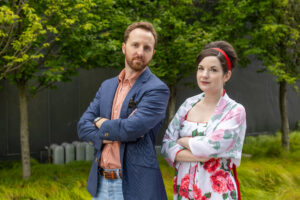
What happened next is one of the innumerable moments of serendipity that have accompanied the birth and growth of the IGG Center. Margaret Press of the DNA Doe Project suggested that I meet up with an early DDP volunteer who by then was the director of education and development at that organization. Her name was Cairenn Binder, and she happened to live right across the Hudson River from my home in Nyack, NY. We met at a coffee shop (Runcible Spoon, for the curious) to talk shop, with no agenda but sharing notes: Cairenn picking my legal brain and me picking her IGG brain. I can’t recall if it was at our first or second meeting that I rashly, and half-jokingly, suggested that she give up her nursing job and come work at Ramapo. I had no authority to offer anyone a job at that point, and I knew that adding another paid, full-time position to an already-speculative idea would be a hard sell to Ramapo. But suggest it I did, with all of the concomitant disclaimers about unlikelihood and uncertainty. The idea landed and took root, and within a month I’d emailed Cairenn an outline of how the center would operate and a proposed job description.
Foundations
Looking back now after four years, I am amazed at how nearly every speculative goal laid out in that email has been realized—and exceeded. Cairenn and I were, from the start, eerily united in our visions for the center and have remained so through the ups and downs of the past four years. With Cairenn at the helm of the certificate program, what began as the upstart education program in the field quickly became the go-to destination for practical, hands-on IGG training. Skeptical initial receptions to our outreach to law enforcement, medical examiners, and wrongful conviction organizations has, through a record of reliable communication and successful leads, turned into a steady stream of referrals from our, now, trusted partners and new contacts alike.
Building the center has not been without challenge. We have faced many moments of struggle and stress, along with long days and nights. Each member of our team has made sacrifices of time and energy that I am astounded by and endlessly grateful for.
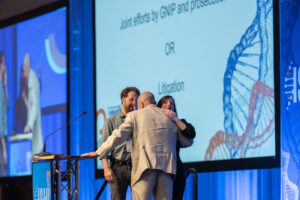
Today, the IGG Center is a recognized leader in the field. Our team has provided leads in nearly fifty cases, one of which led to the exoneration of two brothers, Robert and David Bintz. Over 350 individuals have graduated from the IGG Certificate Program and are collectively responsible for helping to solve sixteen cases during their training. Four cohorts of our IGG Bootcamp (from where I write this post as a new lead is quickly developing around me) have spent an intensive week solving cases in person at Ramapo. Our annual RIGG conference, now in its fourth year, hosts IGG luminaries and neophytes alike with expert presentations, topped off with what we lovingly call Ramapo’s “escalated” BBQ. Research at the center has produced thirteen scholarly articles and book chapters and helped influence legislation. Our Latin American DNA Project has filled the databases with hundreds of new testers. We have helped train international colleagues in the United Kingdom through our partnership with Sheffield Hallam University, and recently Cairenn and Tracie held the first overseas bootcamp in Australia. The number of conferences where we have presented is nearly uncountable, from ISHI to the Innocence Network to IHIA and more. Media has covered the work of the center with a plethora of news articles, interviews, and features throughout the United States, and the world.
All of this has been a team effort. What began with myself and the quick addition of Cairenn has grown to a team that is the apogee of the IGG world. Tracie Boyle, our case manager expertly shepherds cases from intake to lead generation, providing regular updates to agencies along the way. Julian Rebelo, our staff IGG practitioner, works doggedly on cases and oversees our teams of volunteers that put the long, strenuous hours into casework. Our four certificate program assistants, Marianne Hess, Christine Fiechter, Tiffany Sowell, and Diane Bates provide practical and patient mentoring to our cohorts of students. Traci Onders and Monique Platt, our first assistants, were instrumental in building a successful program.
Promotion of Cairenn and Restructuring
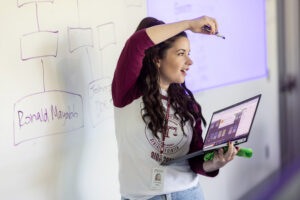
And Cairenn Binder. From the earliest days of the center’s formation all the way to the present day, Cairenn has been the beating heart of the IGG Center. Her drive and resilience are unmatched in anyone I have encountered in my professional career. As a mentor to students, she is professional, approachable, and patient. As an IGG practitioner, she is nonpareil in her quick wits and ability to spot trends in the tree—indeed, she is, without doubt, the most impressive practitioner I have witnessed at work. Watching her work cases in the first months of meeting her was an education in IGG beyond what I had considered possible up to that time (her facility with Millennial and Gen-Z slang alike has been another education in its own right!) As a presenter and communicator, she is clear, conscious of her audience, and never put off by tough questions. As a colleague, she is a fount of inspiration, and I am privileged to call her a friend.
It is because of Cairenn that I feel enormous confidence and optimism in leaving the IGG Center. Over four years, I have witnessed Cairenn develop as a leader at the center and in the field as a whole. And so it is with boundless confidence that I announce the promotion of Cairenn Binder, MS, AIGG, to the role of director of the IGG Center at Ramapo College. Cairenn’s relentless passion for the power of IGG to do real good in the world is a testament to her character and a cynosure for the entire field.
Along with Cairenn’s promotion comes additional restructuring. Tracie Boyle will rise to director of case management. Tracie’s dedication to cases is manifest every day, and her shining optimism has been a beacon for me in hard times. To lead the certificate program, a newly hired director—to be announced—will come on board soon. And Marianne Hess and Christine Fiechter will step up as senior program assistants.
As I leave the center, many of the projects we’ve been working towards for years are finally coming to fruition. I know that each one of those projects will be carried forward with aplomb under Cairenn’s leadership.
Thank You
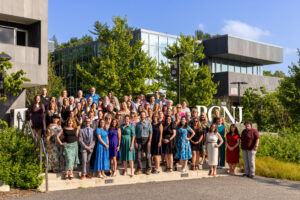
There are many more people to thank, more than I can possibly list here. Nick and Susan Vallario, whose generous donation launched the IGG Center in 2022. Nick passed away earlier this year, and I miss him greatly, but I know he would be proud of where the center is today and where it is headed. Stan Richmond, who has supported the center in a variety of ways since its founding. Aaron Lorenz, my dean, who has since moved on to a well-deserved vice provost position at Salve Regina University. I could not have navigated the early years of the IGG Center without his unwavering support and steadying advice. Susan Gaulden, Ramapo’s previous provost, who saw the early potential in bringing IGG to Ramapo. Kathy Stasis and Chris Tredici, from the budget office, who have graciously fielded my many inquiries about the byzantine budget systems of the college. Chris Romano, a Ramapo VP who has never missed an opportunity to trumpet the mission and success of the IGG Center to audiences of alumni and Ramapo boosters. President Jebb, who took a risk in approving a new and untested idea from a fresh and then-untenured junior professor. Provost Middleton, who helped remove barriers to the center’s growth.
All of the Ramapo staff from housing, dining, IT, and communications who have provided the unseen and too-often unsung foundations that make the IGG Center function.
My colleagues in the law and society program at Ramapo—Jeff Ellsworth, Mia Serban, Sangha Padhy, and Atieh Babakhani—who stood behind my unconventional path (not something, I imagine, they anticipated when they hired me as a professor in 2019). Naseem Choudhury, from the faculty union, who was always willing to listen and offer advice.
Thank you to Margaret Press, CeCe Moore, and Lori Napolitano for supporting and mentoring me when I was a complete unknown. Thanks to Greg Hampikian for providing sage advice on building a practical program within an academic setting. To Kelly Harkins Kincaid, thank you for providing a steady stream of patient responses to my lab questions.
To our agency partners, and the families and victims you represent: you are the reason that we do what we do. It has truly been an honor to assist you in providing answers to the families of the missing and justice to victims of violent crime. Thank you for trusting us with your cases, and thank you for the work that you do.
To Jim Mayer from the Great North Innocence Project: thank you for helping me to fulfill one of the initial goals of the IGG Center in helping to free two wrongfully convicted men from prison, and for giving me a full circle moment working on a case from the organization that first put me on the path that has led me here.
Our students and volunteers who have dedicated thousands of collective hours in the service of justice: thank you, thank you, thank you. Never forget the significance of the work you do.
Tracie, Julian, Monique, Tiffany, Marianne, Diane, Traci, and Christine: thank you for who you are. I am fortunate to know you and to have had the opportunity to lead such a team of remarkable people. Thank you especially to Cairenn, who came like a shooting star over a battlefield when I met her in 2022, and to whom I am forever grateful.
And, most of all, thank you to my wife, Arthi, for standing by me through the long nights and weekends when I was busy with the center, and the frequent travel that took me away from home.
To every IGG practitioner, law enforcement officer, medical examiner, forensic scientist, and attorney, named here and otherwise, who has recognized the power of IGG as a tool for justice and works on behalf of the nameless, those who have been swept by violence, and the wrongfully convicted, draw strength from the good work that you do. There is much more noble work to be done, thousands of cases representing victims and families in search of justice and answers, and you are needed. Take heart. I leave you with these words:
that which we are, we are;
One equal temper of heroic hearts,
Made weak by time and fate, but strong in will
To strive, to seek, to find, and not to yield.
Categories: Uncategorized
December 19, 2025Wrapping Up 2025: Highlights of a Rollercoaster Year
Circling back to our end-of-year blog post from 2024, I see we had a resolution post more in 2025. It looks like we fell extremely short of that goal! With that said, it was an extremely busy and productive year for us at the IGG center and we had plenty to do! Here are a few bright spots in what was most certainly an incredible year.
Marianne Hess, IGG Program Assistant:
“My favorite moment of the year was when our team was able to provide a lead for a recently found, unknown Jane Doe. This case took over 18 months, and the team spent 3000+ hours working on the case. It is especially close to my heart because it was the very first case that I worked on as a volunteer after I completed the Ramapo IGG Certificate Program.”
(Note: The case Marianne is speaking of is one yet to be announced.)
David Gurney, IGG Center Director:
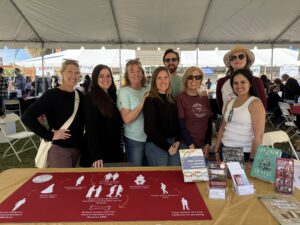
David Gurney (center, rear) with Ramapo Volunteers at the Tucson Festival of Books.
“Watching the continued success of Ramapo’s Latin American Project was one of my favorite moments from 2025. Latin American Does are people who deserve to have their names back, and their families deserve to know what happened to their loved ones. In the project’s third year, six of our hardworking volunteers put their sweat (literally!) into handing out 100 FamilyTreeDNA Tests at the Tucson Festival of Books, helping to ensure that Latin American Does are given a better chance of having their names finally returned to them.”
Cairenn Binder, IGG Center Assistant Director:
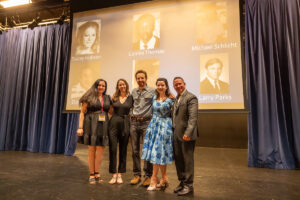
Ramapo Staff Members Tracie Boyle (left), David Gurney (center), and Cairenn Binder (right of center) sharing a moment with Lauren Felix (left of center) and Bob Taft (right) after the RIGG 2025 Keynote Speech.
“The keynote speech at our conference, RIGG, this year was given by two of my favorite people in the world — Lauren Felix and Bob Taft. Lauren was one of the first students in the IGG Certificate Program, and Bob was present at the launch of the IGG Center in 2022 — I’ve worked with him on cases since 2018! Seeing these two talk about their journey in IGG and the impact of their work on families who needed them felt like a full-circle moment. That happy memory will be one that keeps me content through all of the tumultuous times in the field of investigative genetic genealogy.”
Categories: Uncategorized
April 23, 2025A Week at Ramapo College: Preparing for IGG Bootcamp
By Cairenn Binder
This year, we will have the highest number of bootcampers ever on Ramapo’s campus for a full week of casework and collaboration. Bootcamp is one of the most fun weeks of the year for us as staff, but it’s not just fun – it’s a lot of work, and can be overstimulating and exhausting, too!
In this blog post, I will share my top 5 tips for having a great time at IGG bootcamp on Ramapo’s beautiful campus in Mahwah, NJ:
- Prepare for your stay on campus. You’ll be staying in Bischoff Hall, where you’ll have a private room with your own bathroom. While our dorms were voted the best in New Jersey, remember that it’s not a hotel and may be lacking in some of the things you would expect from a hotel stay. This blog by our staff member Tracie Boyle lists some of the items you might need to bring to make yourself more comfortable. Additionally, here are a few more item recommendations from our staff members:
- Staff member Traci Onders states, “I drove, so I had room to pack an electric kettle, a mug, some instant coffee and tea. I also packed some snacks. I liked having a nice towel and my pillow, and packed some walking clothes and shoes as well as my yoga mat.”
- Staff member Marianne Hess advises a few comfort items: “A towel is a good thing to bring – it was nice having a fridge. If you are picky about your pillow, I would bring a pillow, but it isn’t necessary. I brought one of those $3 mini fleece blankets that are from Walmart. When you fold it is the size of a shirt or pants, but it’s cozy to sleep with.”
- Staff member Monique Platt adds that bootcampers may want to bring “…comfy shoes if they might want to go walk on the trails in the evenings.”
- Give yourself a break. Bootcamp is an intense experience! We work up to eight hours of the day during bootcamp, often on violent crime cases which can be emotionally impactful. The IGG lab can be noisy, crowded and overstimulating when findings are made in a case.
Taking frequent breaks is a form of self care. I recommend bringing noise-canceling headphones if you are overstimulated by noise, and taking walks as needed outside of the IGG lab to get some rest for your mind between periods of intense work. Don’t forget to learn more about self care at Tiffany Sowell’s presentation during the weekend of RIGG! - Bond with your teammates. Friendships have been forged at bootcamp which may last a lifetime. In the evenings, our bootcampers are known to play games and converse in the Bischoff Hall lounges. Additionally, you may want to organize a morning hike at the nearby Ramapo Valley Reservation ahead of the day’s work to refresh your mind and body for casework. Make it an all-day experience and something to remember!
- Practice makes perfect! Do you remember the skills you learned when you attended the IGG certificate program? You’ll want to check in with yourself ahead of bootcamp to ensure you remember what you learned in class about selecting genetic matches, building and sourcing family trees, and documenting to ensure you are ready to work both UHR and violent crime cases at bootcamp! If there are some things you need a refresher on, we will have all six of our staff members on hand to help out.
Don’t forget to communicate with your teammates during bootcamp – the whole point of having a collaborative, in person environment is to have the opportunity to talk in person with others working on the same case. This helps our work progress faster and increases the chance of solving a case in less than one week! You can get a feel of what the room will be like by viewing the photo album from 2024’s bootcamp here.
- Attend the alumni party. Our 2025 bootcampers are all graduates of our IGG certificate program – which means they are eligible to attend our alumni party! If you’ve got your ticket already, you can look forward to a fantastic evening of bonding with those from your certificate program cohort as well as others who have graduated from Ramapo’s IGG programs. It’s a great way to close out the bootcamp experience and settle into RIGG weekend… and we are counting down the days!
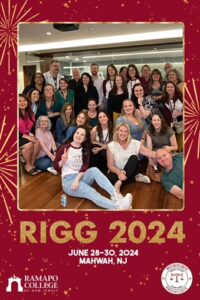
Ramapo IGG Alumni at the 2024 alumni party
Categories: Uncategorized
December 18, 2024Wrapping Up 2024: Our Favorite Moments
Although we’ve been neglecting the blog lately (our New Year’s Resolution is to post more), we have had a busy and fruitful year at the Ramapo College IGG Center. Our staff spent this week reflecting on our favorite moments, which we’ve compiled here to share.
Marianne Hess, IGG Program Assistant:
“My favorite moment for the the IGG Center this year was when the Bintz brothers were exonerated. On a personal note, when I first learned about IGG I thought that it could be a great use of IGG. I was so excited the first time I heard someone mention IGG in that context – it was David Gurney at ISHI in 2022!”
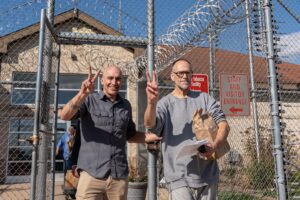
Jim Mayer, Managing Attorney at the Great North Innocence Project, with Robert Bintz, exoneree, walking out of prison after 25 years of wrongful incarceration. Photo Courtesy of the Great North Innocence Project.
David Gurney, IGG Center Director:
“Seeing the Bintz brothers exonerated a result of the work of IGG Center staff and students was an incredible moment in 2024. Representing only the third and fourth individuals exonerated through IGG, their cases demonstrate the power of IGG as a tool of justice writ large. The exonerations also exemplify the value of Ramapo IGG Center’s collaborative approach to casework. I am so proud of our students and staff for helping to give Robert and David Bintz their freedom and finally achieve justice for Sandra Lison after 37 years.”
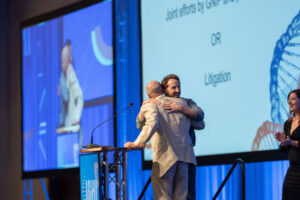
David Gurney and Cairenn Binder being surprised on stage by Jim Mayer, who just announced that the Bintz brothers had been found innocent of the murder of Sandra Lison. Photo courtesy of the International Symposium on Human Identification.
Monique Platt, IGG Program Assistant:
“My favorite moment of 2024 was the first day of Boot Camp. There’s a unique energy that you feel right before any case launch, but it’s wholly different when there are so many of you in the same room ready to dig in on the same case. Anything can happen. You don’t know yet whose lives could be impacted by the work you’re about to do, but there’s something very special about knowing you’re all working towards a shared outcome.”
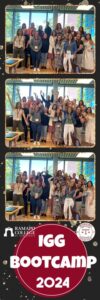
Boot campers at the 2024 IGG Summer Bootcamp
Traci Onders, IGG Program Assistant:
“One of my favorite moments was meeting Allen Grasser, the brother of Norm Grasser, and learning about what it was like for him to have a brother missing for over four decades, and what it meant to finally have some answers as to what happened to his brother. Rhinelander John Doe was identified as Norm Grasser by Ramapo IGG’s first cohort and it was a special honor for our cohort to be able to hang out with Allen during RIGG and a special privilege for me to call him my friend.”
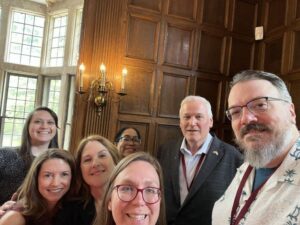
Traci Onders (bottom left) with students from the Spring 2023 IGG Certificate Program and Allen Grasser (right of center) at RIGG 2024.
Tracie Boyle, IGG Center Case Manager and Administrative Assistant:
“There were so many great moments this year, but if I had to choose one that stands out, it’s definitely CrimeCon. We worked hard, but we had a lot of fun too! We met some wonderful (and inspiring) people, created new partnerships, reconnected with familiar faces we hadn’t seen in a while, and enjoyed some really great conversations.”
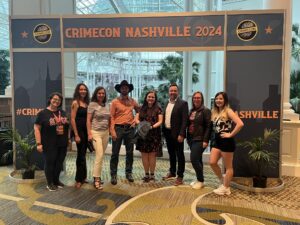
IGG Center Staff with friends, alumni and collaborators at CrimeCon in Nashville.
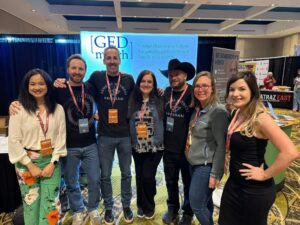
Promoting uploads to IGG databases at CrimeCon 2024.
Cairenn Binder, IGG Center Assistant Director:
“I am cheating, because I update the website so I get to pick more than one favorite moment. Apologies to my coworkers! My favorite moments were those where we got to meet with our alumni and our colleagues in the field for in person meetups and collaborations. I4GG in San Diego stands out as a highlight, as do the alumni party and keynote nights at RIGG. Aside from that, quiet moments on campus and enjoying the beautiful scenery are little pleasures we can’t take for granted.”
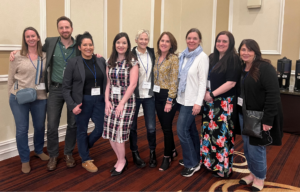
IGG Center Staff and alumni at I4GG in San Diego
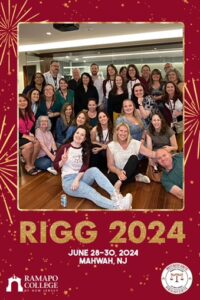
Ramapo IGG Center Alumni kicking off RIGG 2024
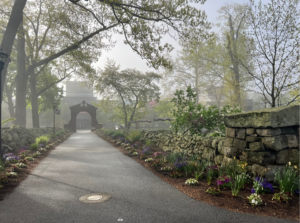
A peaceful morning on campus
Our team looks forward to more moments like these in 2025. From our team to you – we wish you a very Happy New Year!
Categories: Uncategorized
September 25, 2024Justice Delayed but not Denied: Bintz Brothers Exonerated After 24 Years with the Help of IGG
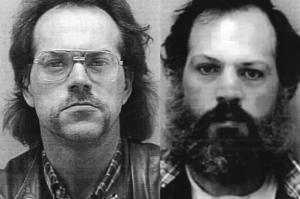
Robert Bintz and David Bintz
This blog is an update to David Gurney’s previous blog post: New lead in 1987 Wisconsin murder of Sandra Lison could produce third IGG exoneration
In June of 2023, the Ramapo College Investigative Genetic Genealogy Center was tasked with identifying the contributor of a DNA profile developed from blood and semen found on the dress of Sandra Lison. Ms. Lison had been kidnapped, sexually assaulted and murdered while working at the Good Times Bar in Green Bay, Wisconsin in 1987.
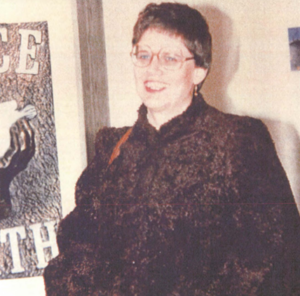
Sandra Lison
When our IGG bootcamp students produced a new lead in the case in July of 2023 and identified William Hendricks as the possible suspect, we knew there might still be a long road ahead. The State of Wisconsin would need to agree the lead was significant, exhume William Hendricks’ remains, compare Hendricks’ DNA directly to the crime-scene DNA, and, if he was a DNA match – agree to vacate the convictions of Robert and David Bintz.
Thankfully, the state was cooperative, and the remains of William Hendricks were exhumed in May of 2024. Due to the age and condition of the remains, there was some difficulty in developing a suitable DNA profile. To expedite the process, one of our generous donors covered the cost of testing at a private lab, who developed a full profile. An analysis by the Wisconsin State Lab demonstrated overwhelming statistical evidence that the previously unidentified crime-scene DNA came from Hendricks.
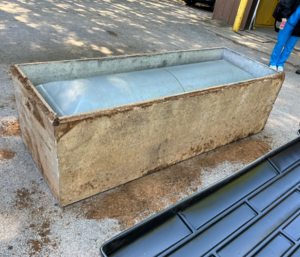
The exhumation scene
Recognizing the significance of the DNA result, the State of Wisconsin conducted a renewed investigation of the case.

DNA report comparing Hendricks’ DNA to crime scene DNA
On September 24th, we were scheduled to present this case at the International Symposium on Human Identification with Jim Mayer of the Great North Innocence Project. Although we had hoped for a conclusion prior to our presentation, the case remained in limbo with a hearing scheduled in October and the Bintz brothers still in prison for a crime they did not commit.
Unbeknownst to us, just hours before our presentation, Jim had received a phone call that changed the course of the case entirely. On stage, he shocked everyone in the room (including his co-presenters) by sharing that the state’s investigation revealed additional evidence of Hendricks’ guilt. All parties now agree that two innocent men have been sitting in prison for twenty-five years. An expedited hearing was called, and the next day, the State of Wisconsin formally acknowledged the Bintz brothers’ innocence, and a judge granted relief. They will be released shortly.
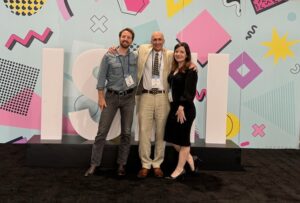
David Gurney, Jim Mayer and Cairenn Binder at ISHI 2024 shortly after it was revealed that the Bintz Brothers’ exoneration was imminently forthcoming.
When Jim Mayer of the Great North Innocence Project initially broke the news of Hendricks’ identification through IGG to his client, Robert Bintz’s first reaction was relief that his daughter would finally know that he did not commit this horrible crime. After twenty-five years, and with the help of IGG, the truth has finally been revealed, and a measure of justice has been given to all of the victims in this case.
Categories: Uncategorized
Follow Ramapo