- About Ramapo
- Academics
- Admissions & Aid
- Student Life
- Athletics
- Alumni
- Arts & Community
- Quick Links
- Apply
- Visit
- Give
CHGS Events
Notes on our Announcements
All times given in Eastern Standard Time
All events are free and open to the public
For more info and parking, email: holgen@ramapo.edu.
CHGS Events, Spring 2026
National Socialists in our Backyard: The German-American Bund in New Jersey
Dr. Angela West, Drew University
Thursday, February 12 at 1:10 in SC-156
(in the student center)
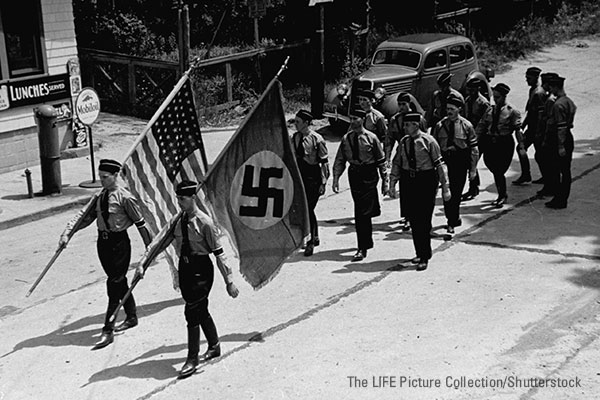
The German-American Bund was a pro-Nazi group that operated in the USA from 1936-1941. Chapters and social camps flourished in NJ, even in Bergen County. Dr. Angela West will lead a discussion of Nazism in our regional past—a topic of enduring resonance and consequence. Her research focuses attention on the roles of women in hate groups, which is all too often overlooked.
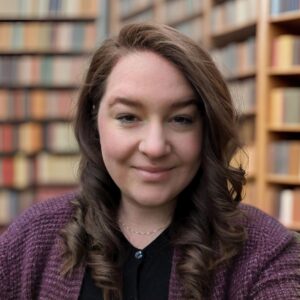
Dr. Angela West is a historian of Holocaust/Genocide Studies, Extremism, and Gender in the USA. She earned her Ph.D. from Drew University, where her dissertation, “The Keepers and Caretakers of Hate: American White Women in Organized Racist and Antisemitic Movements, 1930-2020,” earned the highest distinction. In her groundbreaking work, Dr. West examined decades of women’s involvement in extremist organizations, arguing that they served as crucial ‘bridge leaders’ who bolstered the effectiveness and influence of hate groups in the United States. Dr. West serves as the Coordinator for Programming and Fundraising for Drew University’s Center for Holocaust/Genocide Study. In addition to her role as an adjunct professor, Dr. West also works as a consulting historian and museum curator for Temple Sinai’s Holocaust Remembrance Center in Summit. Dr. West is dedicated to advancing understanding of the Holocaust, far right extremism, and its implications for contemporary society.
Rescheduled Commemoration of
International Holocaust Remembrance Day
How to Talk to Your Son about Fascism
Dr. Craig A. Johnson, UC Berkeley
Monday, March 9 at 7:30pm in the Ridgewood Public Library
Part of our collaborative “Paths to Understanding Series”
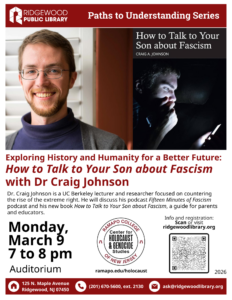
Dr. Craig A. Johnson will speak about his recent and timely book, How to Talk to Your Son about Fascism. The book is a guide for parents, carers, and others with young men in their lives on how to talk with those young men about fascism and the extreme right, which specifically and particularly preys on them for requirement. It offers research and analysis, for anyone with a young person in their lives, about how and why the far right recruits young men. The book covers the history of far-right recruitment, explaining why the extremists focus on recruiting men. The book then offers suggestions for how to counter recruitment today.
Craig A. Johnson is an independent journalist and an academic who hosts the podcast, Fifteen Minutes of Fascism.
Theater that Matters with Ramapo Students
Reserve Tickets Here
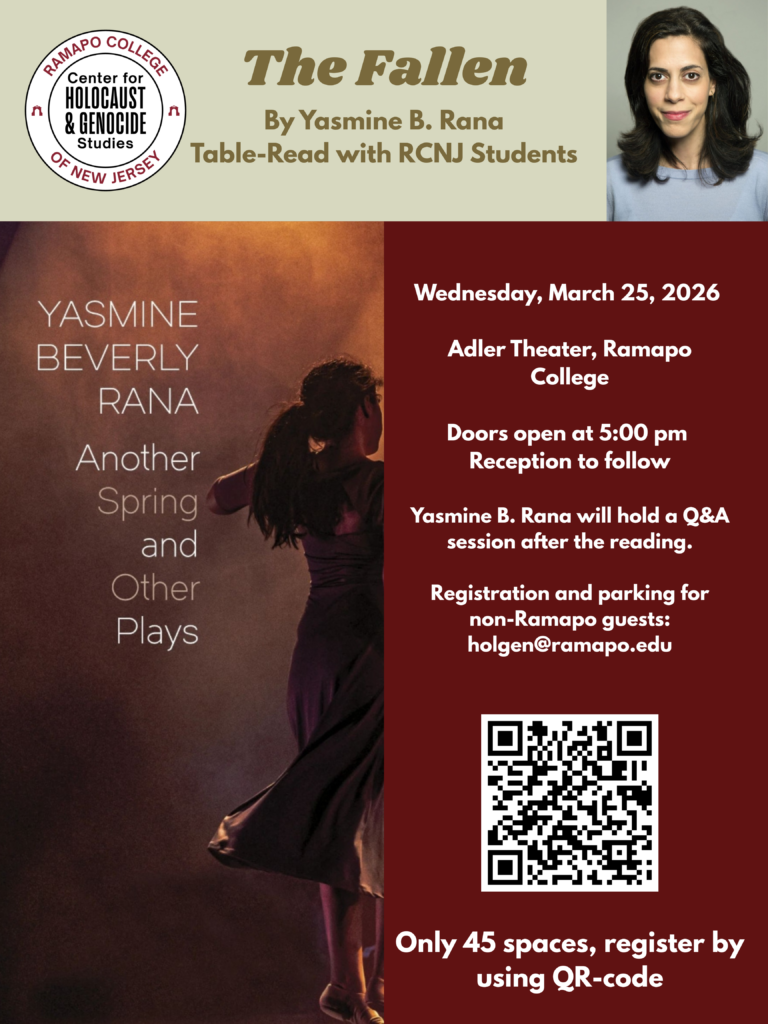
Part of Yasmine B. Rana’s latest collection of plays, The Fallen explores the painfully complex legacies of sexual and gendered violence perpetrated in the Bosnian War (1992-1995).
Yasmine Beverly Rana visited Ramapo College twice in Fall 2025 to discuss her work as a genocide educator and playwright. In October, she read from one of her new plays about sexual and gendered violence in Bosnia during the Yugoslav Wars and the Srebrenica Genocide.
Ms. Rana will hold a Q&A session after the performance.
A “table read” is an organized reading of a script in which the speaking parts, stage directions, and scene headings are read out loud. The actors typically do not wear costumes and the stage tends not to have any scenery.
What an honor to commemorate together.
Register Here
Hidden in Plain Sight: The World Jewish Relief Archives and the Untold Stories of Survival
Wednesday, April 15, 2026 – 7:00 pm eastern
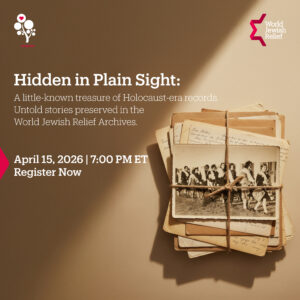
CHGS is proud to cosponsor this exciting program.
Join World Jewish Relief USA for a national webinar uncovering one of the most significant — yet little-known — collections of Holocaust-era records. The World Jewish Relief Archives preserve extraordinary documents that illuminate rescue, relief, and survival — stories that continue to resonate across generations.
Register here or by clicking on the graphic.
Paul Anticoni
Chief Executive of World Jewish Relief, global Jewish humanitarian leader
Mona Golabek
Concert pianist, author, actress: The Children of Willesden Lane
Arthur Kurzweil
Author and Jewish genealogist: From Generation to Generation
Deborah Oppenheimer
Academy Award–winning filmmaker of Into the Arms of Strangers: Stories of the Kindertransport
Hosted by David Weisberg
Executive Director, World Jewish Relief USA
Cosponsoring organizations: CHGS_RCNJ, Dallas Jewish Historical Society, Defiant Requiem Foundation, Generations of the Shoah International, Holocaust and Genocide Education Network, Holocaust Documentation and Education Center, Holocaust Museum Orange County, Institute for Holocaust and Genocide Studies, Jewish Genealogical Societies of Colorado, Greater Miami, Greater Washington, Oregon, and Souther Nevada, Kinder Transport Association, New Cracow Friendship Society, Ray Wolpow Institute for the Study of the Holocaust, Genocide and Crimes Against Humanity, WWU, San Francisco Bay Area Jewish Genealogical Society, Six Million Voices, South Carolina Council on the Holocaust, Vermont Holocaust Memorial, Zekelman Holocaust Center.
Medical Care and the 1994 Genocide against Tutsi in Rwanda
Tuesday, April 21 at 1:50 PM in ASB-136
(Zoom option available)
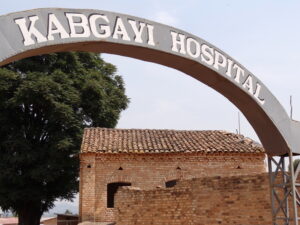
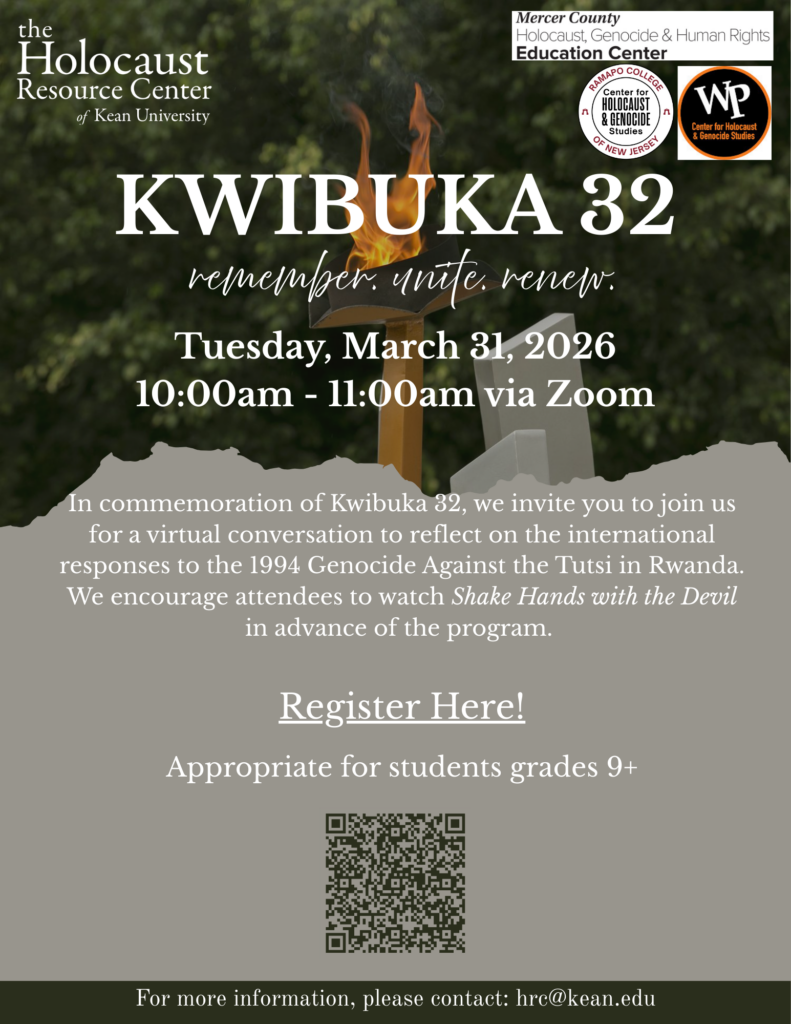
We begin with a point of tension: Medical professionals take oaths to save human lives without distinction and to avoid causing harm. Genocide occurs at the terminus of a politics of division; a politics that removes individual communities and peoples from the circle of moral obligation, rendering them available for mass violence and death. Despite our faith in healthcare sciences and its practitioners, we must confront the role that doctors and researchers have played (and continue to play) in genocide and its justification for over a century. This should not overshadow the tremendous risks and sacrifices made by innumerable medical professionals to intervene into genocide, to care for the wounded, and to offer shelter whenever possible.
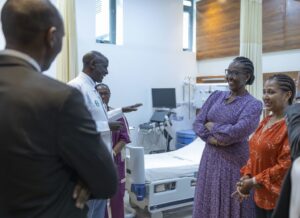
Jeannette Kagame, the First Lady of Rwanda, visits the new maternity ward in King Faisal Hospital (2023)
With a singular focus on the 1994 Genocide against Tutsi in Rwanda, we will explore the difficult questions faced by doctors and healthcare professionals in times of genocide. How can one act ethically in such conditions? By what measure should one judge their own choices and those of others? What happens when doctors belong (or are assigned) to the persecuted community or, for that matter, the persecuting society? Can we identify structures that existed before genocide that may have helped make it possible? What, on the other hand, may have helped mitigate its horrors? How have Rwandans rebuilt their healthcare system and what may we learn from them? How were they able to move forward meaningfully and with dignity? What challenges remain today?
Featuring: Dr. Odette Nyiramilimo and Dr. Emmanuel Kayibanda
Moderator: Providence Umugwaneza, founder of Kabeho Neza Initiative
Co-Sponsored by CHGS and the Pre-Med/Pre-Health Club, Pre-Dental Club, United Asian Association, American Women’s Medical Association, Pre-Physician Assistant, and Project Arch. Special thanks to Keya Naik.
***Register Here***
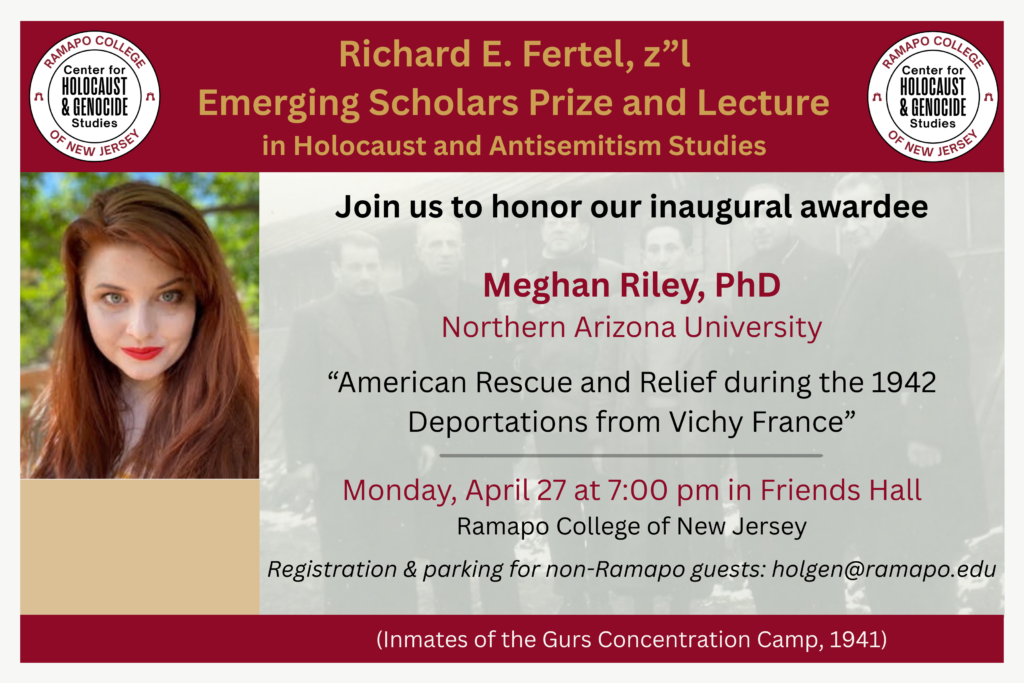
Click for more information on the Fertel Prize and Dr. Meghan Riley
Visit this site often, as we will be adding additional events and opportunities to the Spring 2026 schedule.
CHGS Events, Fall 2025
Remembering Genocide: German Memory Politics from Namibia to Israel/Palestine
Dr. Zoé Samudzi, The Ohio State University
Wednesday, September 17 at 7:30 pm via Zoom Webinar
This talk engages the afterlife of German colonialism, namely Germany’s genocide of the Ovaherero and Nama peoples at the beginning of the 20th century in South West Africa (present-day Namibia). In particular, it contends with the contestations in memory between the communities and the Namibian state, between German denialism and qualified recognition, and between attitudes towards the Nama and Ovaherero genocide and the politics and history of Israel/Palestine.
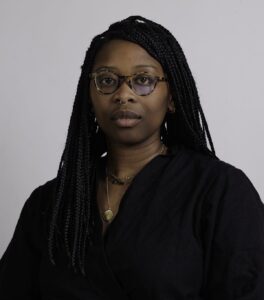
Zoé Samudzi is a Postdoctoral Scholar in the Department of African-American and Africana Studies at The Ohio State University. She is also a Global Blackness Fellow with the Johannesburg Institute for Advanced Studies at the University of Johannesburg, and a fellow with African Museums and Heritage Restitution (AFRIMUHERE). Her work engages visuality, genocide memory, and African postcoloniality. As well as a writer, Samudzi is an associate editor with Parapraxis Magazine, a popular magazine dedicated to psychoanalytic thinking.
Part of our Open Classroom Series, which invites members of the public to join Ramapo students in their courses for guest lectures. Students have priority in asking questions.
Foundational Concepts: Holocaust Trauma and Postmemory
Dr. Marianne Hirsch, Columbia University
“From Trauma to Repair: Rethinking Postmemory at a Time of Crisis”
Thursday, September 18, 2025 at 5:30 pm
Trustees Pavilion I (in person)
Zoom with advanced registration
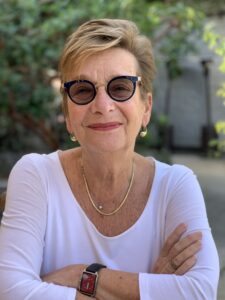
In this lecture, Marianne Hirsch will discuss how her thinking about the intergenerational transmission of memories of violent histories has shifted, particularly after October 7, 2023. Hirsch’s conceptualization of what she has called “postmemory”—based on family memories of surviving the Holocaust– initially focused on the inheritance and perpetuation of trauma. In this talk, she will explore the reparative potentials of memory through the work of several artists who open-up the past and reframe its debilitating legacies. Memory art, Hirsch will suggest, can become a transformative practice of communal repair and a platform of social solidarity.
This is part of our Foundational Concept Series, which re-introduces the foundational terms and concepts of Holocaust and Genocide Studies with specific attention to new trends and emerging perspectives.
Reflections on our Study-Trip to Prague in 2025
“The Holocaust, Genocide, and Human Rights in Central Europe”
Hear from students about their experiences studying in the Czech Republic with CHGS Director Jacob Ari Labendz.
We will be running the trip again in Summer 2026 (May 24 – June 4). Interested students are encouraged to attend, as are members of the public who would like to help us raise scholarships for participants.
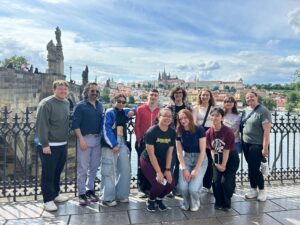
Ramapo Students with Prague Castle and Charles Bridge
Tuesday, September 30 at 5:30 pm
Alumni Lounge 156 in the Student Center (in person)
Join Us on Zoom (click for Advance Registration)
Ramapo students spent ten days in one of Europe’s most beautiful cities studying the region’s history of genocide and the echoes of that violence in contemporary approaches to human rights and multicultural belonging. The study-trip included visits to sites of mass atrocity; reflections on the histories and cultures of minority groups before, during, and after the Second World War; meetings with non-governmental organizations working in the field of human rights and representing marginalized communities; discussions with locals; and an impressive array of expert-led tours and museum visits. (Students also had ample free time to explore Prague on their own.) Most days began with a lecture from trip director Dr. Jacob Ari Labendz, who is an expert in Czech and Jewish history, or from fascinating local scholars. While this course focused significantly upon the Holocaust and Jewish life, it will delve with nuance and depth into the histories and contemporary conditions of Roma, the LGBTQ community, and refugees. We enjoyed an incredible program with an exceptional local partner.
Foundational Concepts: Concentration Camps
Andrea Pitzer, Journalist and Author
Tuesday, October 21, 2025 at 5:30 pm
Trustees Pavilion 1
What is a concentration camp? What is at stake when one labels an institution a “concentration camp”? What implications and associations does the term carry? How has it been used and contested over time? These are neither simple nor merely theoretical questions. In 2017 and again today, Americans (and the entire world) are debating whether or not the “concentration camp” label may be applied to US institutions. Similar debates raged about the Gaza strip before 2023. Andrea Pitzer, a published and well-regarded expert in concentration camps, will help us make sense of these issues.
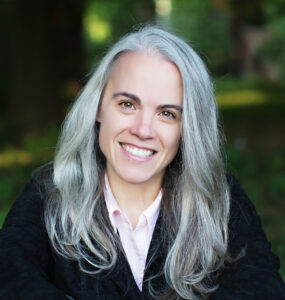 Andrea Pitzer writes the Degenerate Art newsletter and is the author of three books. One Long Night: A Global History of Concentration Camps was named a “best history book” of 2017 by Smithsonian magazine. Icebound: Shipwrecked at the Edge of the World narrates the three Arctic voyages of Dutch navigator William Barents in the 1500s. The Secret History of Vladimir Nabokov recasts the life and works of the celebrated Russian American novelist through the geopolitics of his time.
Andrea has written for The Washington Post, The Atlantic, The NY Review of Books, Outside, GQ, Vox, Slate, and many other outlets. In 2009, she founded Nieman Storyboard, a narrative nonfiction project of the Nieman Foundation for Journalism at Harvard University. Her reporting has taken her to former or current concentration-camp sites on four continents, as well as multiple expeditions to the Arctic. You can find out more about her current and past writing at www.andreapitzer.com.
This is part of our Foundational Concept Series, which re-introduces the foundational terms and concepts of Holocaust and Genocide Studies with specific attention to new trends and emerging perspectives.
War, Genocide, and Sexual Violence in Bosnia
History and Theater
Laura B. Cohen, PhD and Yasmine Beverly Rana
Thursday, October 30 from 1:15 – 2:15 pm
Friends Hall (SC-219)
Join us for part one of an incredible program through which we will explore the role and legacies of sexual violence in the Yugoslav Wars, with specific attention to Bosnian victims and survivors. Dr. Laura Cohen will provide a short lecture about these topics, after which she will join in discussion with internationally celebrated playwright Yasmine Beverly Rana and CHGS Director Jacob Ari Labendz. We intend to stage a table read with Ramapo students of one of Ms. Rana’s plays in the Spring semester in commemoration of Women’s History Month. Students interested in participating in the table read should contact Dr. Labendz (jlabendz@ramapo.edu). We look forward to collaborating with Dr. Lori Myers (Ramapo College).
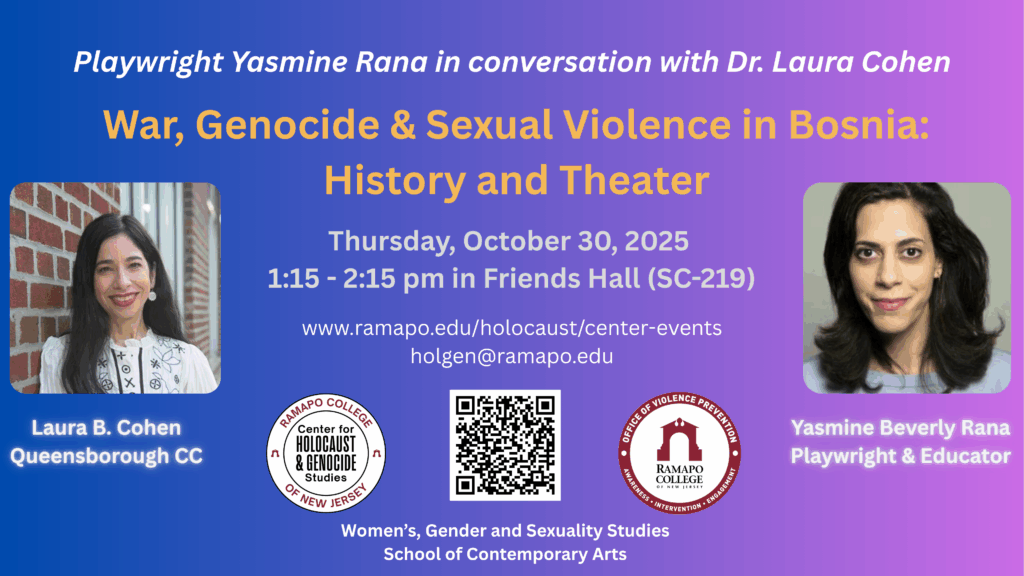
Laura B. Cohen, Ph.D., is the Executive Director of the Harriet and Kenneth Kupferberg Holocaust Center (KHC) at Queensborough Community College—CUNY. Dr. Cohen received her doctorate from Rutgers University’s Division of Global Affairs where she researched the intersection of transitional justice and contested narratives at the Srebrenica Genocide Memorial in Bosnia and Herzegovina. Her analysis builds upon her extensive fieldwork in the Balkans and at atrocity site memorials in Germany, Poland, Cambodia, and Rwanda. She has lectured widely—including at Ramapo College!—about memorialization, transitional justice, and genocide education. Dr. Cohen also holds an M.S. from New York University’s Center of Global Affairs and an M.A. in Media Studies from The New School.
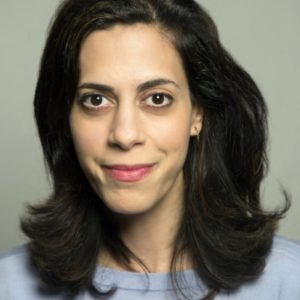
Visit Yasmine Beverly Rana’s website to learn more about her career as a playwright and dramatist. In addition to being a playwright, Yasmine is a local educator (teacher of ESL, English, Social Studies and Theater), mentor to new playwrights (Northeastern University) and drama therapist (Registered Drama Therapist and New York State Licensed Creative Arts Therapist). She has worked in Bosnia, the Republic of Georgia, and Switzerland. Yasmine received her BFA and MFA in Dramatic Writing from New York University’s Tisch School of the Arts and her Master of Art in Teaching from Fairleigh Dickinson University. She is a member of the Dramatists Guild of America and represented by Susan Gurman in New York.
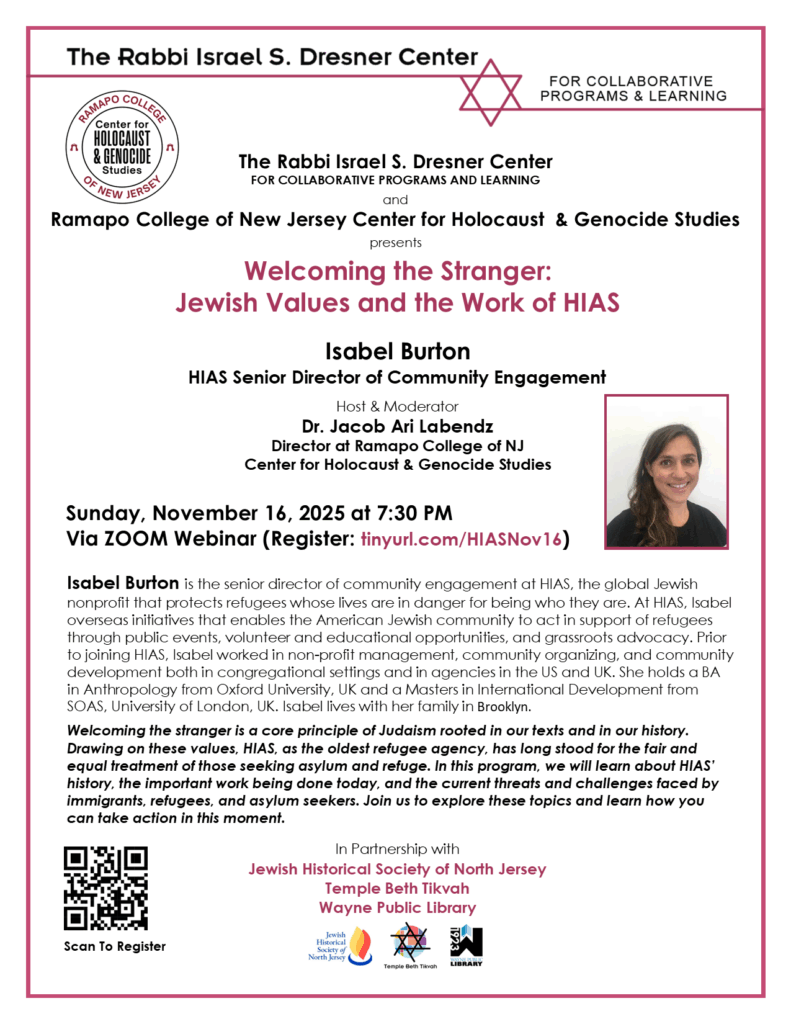
Holocaust and Genocide Education Today: Challenges and Opportunities
November 17 at 5:30 PM in Friends Hall (SC-219)
You may also join us via Zoom with advanced registration.
Panel discussion featuring:
Colleen Tambuscio, CHGS Pedagogy Programs Administrator
Brianna Doherty, NJ Commission on Holocaust Education
Yasmine Beverly Rana, Local Teacher and Playwright
Moderated by CHGS Director Jacob Ari Labendz
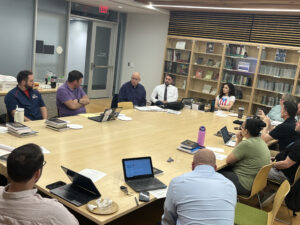
Teacher roundtable led by Colleen Tambusio. Recent Ramapo grad, Stefanie Viera, presented her research on transitional justice after the Guatemalan Genocide, which she wrote under the guidance of Dr. Labendz.
Holocaust and genocide education are at a crossroads. CHGS has gathered three expert practitioners to discuss the challenges, opportunities, and future of Holocaust and genocide education in our region. We face multiple issues, including the inevitable passing of the survivor generation, a recent spike in antisemitism, the deployment of the Holocaust as a symbol in contests and debates over Israel, Palestine, and Gaza, and longstanding tensions regarding the status and legacies of the Holocaust as a singular, unique event of Jewish history or as human event with universal implications. CHGS continues to expand the services we offer to educators and schools in and beyond our region to help them navigate these waters. Please bring your questions!!!
Previous Years’ Programs
Lectures and Programs, 2024-2025

505 Ramapo Valley Road
Mahwah, NJ 07430
p: 201-684-7500
e: information@ramapo.edu
Copyright ©2026 Ramapo College Of New Jersey | Statements And Policies | Accessibility | Contact Webmaster.
Follow Us!