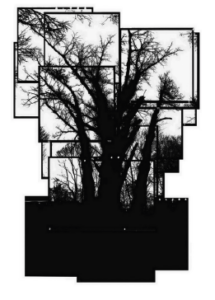
Witness and Living Memorial Tree
The Landscape of our Memory
Gabriela Bulišová and Mark Isaac
Kresge Gallery, Berrie Center, Ramapo College
September 16 – December 4, 2026
Tue., Thu. & Fri.: 1:00 – 5:00 p.m. • Wed.: 1:00 – 7:00 p.m.
Closed Thanksgiving week
More info: Ramapo College Art Galleries
Read Glowing Coverage by Deb Breslow in the Jewish Standard
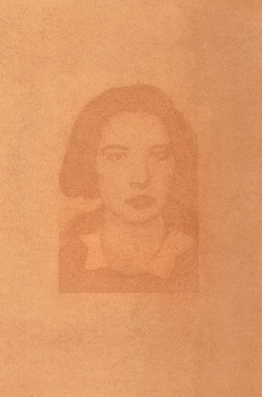
Anthotype Portrait
The Landscape of our Memory is a haunting and original exhibition by Prague artists Gabriela Bulisova and Mark Isaac. It is part of a long-term project that addresses the “Holocaust by bullets” by commemorating the more than 2 million people who were murdered in or near their hometowns rather than in death camps. As every technique is rooted in the landscape, the project has an environmental sensibility that suggests a relationship between genocide and ecocide. (More on the artists’ website).
* * *
Gabriela Bulišová and Mark Isaac are multidisciplinary artists who collaborate on intimate projects designed to bridge the gap between fine art and documentary practices.
With Gratitude to our Co-Sponsors
- Center for Holocaust and Genocide Studies, Ramapo College
- Ramapo College Art Galleries and the Berrie Center
- Sam & Sara Schoffer Holocaust Resource Center, Stockton University
- Stockton University Art Gallery
Supported by a generous gift from a private family foundation.
Video of Artists' Remarks at the Opening
Review the Exhibition Catalogue
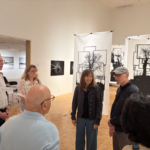
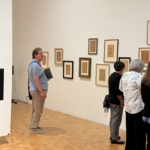
Pictures from Our Opening Events
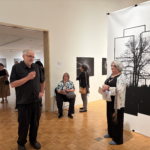
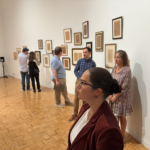
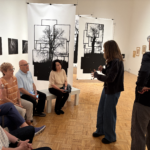
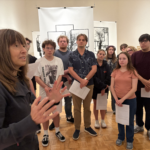
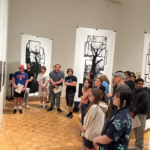
Remarks from Jacob Ari Labendz, CHGS Director
“… Cursed be the ground because of you; By toil shall you eat of it all the days of your life… until you return to the ground—for from it you were taken. For dust you are, and to dust you shall return.” – Genesis 3:17-19
“What have you done? Hark, your brother’s blood cries out to Me from the ground! Therefore, you shall be more cursed than the ground, which opened its mouth to receive your brother’s blood from your hand. If you till the soil, it shall no longer yield its strength to you. You shall become a ceaseless wanderer on earth.” – Genesis 4:10-12*
The Landscape of our Memory questions the artificial separation of blood and soil. So too do the Edenic allegories, which open in divine harmony. We meet the earth as the material source of human life and the physical locus of its oblivion. The first humans—the parents of us all—achieve discernment, against their creator’s will. Humanity thus learns to distinguish (and therefore must choose) between good and evil, and between the necessity of life and inevitability of death. No longer in balance with nature, much less each other, we sweat against the land, suffer for new life, and fear for our earthen bodies. Terror leads Cain, the first human child, to murder his younger sibling. The latter’s blood—his lifeforce, in biblical terms—calls to the heavens from the very earth into which it should have naturally returned. Human hands rent the vestiges of prelapsarian harmony, and so we carry the curse of alienation from the earth and each other.
One by one, the Nazis and their collaborators shot to death over two-million Jews and members of other targeted minorities, notably Roma, as they built an empire of blood and soil across Eastern Europe. They sought to resolve existential fear by rendering humanity into distinct races arranged along a hierarchy of moral worth. The intimacy of these murders scarred the earth, like the mass graves they left behind. Generations later, they reveal Cain’s lasting mark upon us.
With The Landscape of our Memory, Gabriela Bulišová and Mark Isaac offer stunning glimpses of reharmonization. They help us sense the blood that still calls out from the killing fields of the Holocaust, flows through nearby rivers, and whistles among trees that witness but cannot see. Anthotype victim portraits, created with flora from sites of mass murder, reterritorialize the dead and imbue earthen materials with lives cut short. Through the artists’ edenic lens, genocide and ecocide appear almost indistinguishable. The Landscape of our Memory points to the fundamental wholeness of our world and humanity, at a moment of profound rupture—a reminder of the responsibility we collectively assumed when we endeavored, in our imperfection, to tell good from evil.
The Center for Holocaust and Genocide Studies at Ramapo College of New Jersey (CHGS) is committed to helping its students and patrons approach humanity’s greatest horrors through the arts. As the preeminent Holocaust scholar and survivor Yehuda Bauer (1926-2024) indicated in Rethinking the Holocaust, a handful of academic disciplines cannot fully satisfy our need to understand and work through the Holocaust (along with other genocides and mass atrocities). We also depend, he explains, upon the vision of the artist, the wisdom of the philosopher, and the care of the therapist. It is an honor to have worked with so many talented organizations and individuals to bring this exhibit to life. On behalf of CHGS, I would like to thank Gabriela Bulišová and Mark Isaac for their kindness, generosity, and cooperation, not to mention their artistry. We are grateful to Sydney Jenkins, Robert Modafferi, and the Ramapo College Galleries. CHGS also owes special thanks to Irvin O. Moreno-Rodriguez and our colleagues at the Sara & Sam Schoffer Holocaust Resource Center at Stockton University.
* Translation from the Revised JPS Edition (2023).
Follow CHGS