Philip M. Anderson*
Stephen Anderson*
Eta Rena Bacon
Paramjeet Bagga*
Marion S. Berger
Daniela Buna
Angela C. Cristini
Joseph Dallon, Jr.*
Lawrence D’Antonio
Frank Farrell
Arthur M. Felix*
Gary Fisk
Carol Frishberg
Maxim J. Goldberg-Rugalev
|
Roger N. Johnson
John Kalbacher
Eric Karlin*
Amruth Kumar*
Bernard Langer
Richard Lowell
William Makofske *
Marjorie McConnell
Robert Mentore*
Victor J. Miller*
William Mitchell*
William Olsen
Kenneth Peterson |
Katarzyna Potocka*
Avram Primack
Roberta Rosty*
Edward I. Saiff*
Mary Shiffman
Robert J. Shine*
Ash Stuart*
Giovanni Viglino*
Eric M. Wiener
About the School
The School of Theoretical and Applied Science
(TAS) offers an interdisciplinary approach to the sciences.
Without the restricting boundaries of traditional science departments,
TAS faculty creatively interact across disciplines on a day
to day basis; a biologist
and a computer scientist develop one of the first undergraduate
programs in the exciting new field of bioinformatics; mathematicians
work with biologists, chemists, and physicists to craft a sequence
of integrated math/science courses for elementary education
students; and an Environmental Institute is envisioned,
realized, and vibrantly active for over 15 years. Such interdisciplinarity
is the norm for TAS, not the exception.
The school offers 12 majors: Allied Health Technologies (jointly
offered with the University of Medicine and Dentistry of New
Jersey – UMDNJ), Biochemistry, Bioinformatics, Biology,
Chemistry, Clinical Laboratory Science (jointly offered with
UMDNJ), Computer Science, Environmental Science, Mathematics, Nursing (jointly offered with UMDNJ and
Englewood Hospital), and Physics. Minors are available
in Biology, Chemistry, Computer Science, Environmental Science, and
Physics. Two graduate programs are associated
with TAS: Master of Science in Educational Technology and Master
of Science in Nursing - Education Track (jointly offered with
UMDNJ). In addition, TAS co-sponsors combined BS/graduate degrees
in conjunction with the several science departments of Rutgers
University, New Brunswick. Further descriptions of these programs
appear in the Majors section of this Catalog.
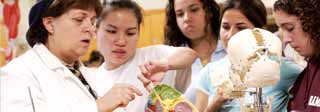
TAS’s resources include a diverse array of modern, well-equipped
teaching laboratories. Entry-level laboratories in biology,
chemistry, and physics are computerized, allowing students to
gain lab based computing skills at the very beginning of their
college career. In addition, TAS has several dedicated computer
laboratories, including one for Geographical Information Systems
(GIS). Plans for an innovative Environmental Center (which will
house a lecture room and a laboratory) and a new greenhouse are well underway.
TAS faculty members excel at teaching and are also internationally
recognized for their scholarship and participation in scientific
organizations. Many have received awards, fellowships, and grants
from private, international, and government agencies including
the American Chemical Society, Fulbright Foundation, Guggenheim
Foundation, National Institute of Health NIH), National Oceanographic
and Atmospheric Administration (NOAA), National Science Foundation
NSF), New Jersey Commission on Higher Education, New Jersey
Department of Environmental Protection, and the US Department
of Education. Many faculty have research programs that actively
involve students, and in many cases the students co-present
the findings of this research at conferences and/or in published
papers.
All TAS students supplement their major with a two courses School
Core requirement – Science in Cultural Perspective (SCP)
– that fosters an appreciation of the historical, philosophical,
environmental, ethical, and social issues related to scientific
and technological development.
Ramapo’s cooperative education program provides opportunities
for working in a "real life environment". Under the
joint supervision of a scientist at the work-place and a TAS
faculty member, co-op students earn degree credits while earning
money. A strong internship program (where students earn degree
credits for work done on a volunteer basis) is also available.
Student organizations such as the Biology, Chemistry, Math,
Pre-Med, Physics Clubs and the Environmental Alliance sponsor
lectures, trips, and social activities. Each club elects officers
who gain leadership experience in planning programs such as
the annual Earth Day celebration. Ramapo’s chapter of the
Society of the Sigma Xi, a national organization for faculty,
fosters research and schedules lectures by national and international
authorities.
| Ramapo
College of New Jersey recognizes the value of
publishing on the Internet and encourages the
campus community to produce personal World Wide
Web pages to enhance communications. The College
does not preview, review, censor, or control the
content of these pages in any way as a matter
of course. Personal Web pages are those of the
authors, and do not in any way constitute official
Ramapo College of New Jersey content. |
[ return to top ]
|