
Roadrunner Alumni
From First Responder
to Future Clinician:
Emily Nappi’s ’25 Journey of Advocacy and Resilience
By Anastasia Bamberg | Spring 2026
When Emily Nappi enrolled as a student at Ramapo College in fall 2017, she could not have imagined the journey she would take between that day and the day she graduated in May 2025.
“When I first entered Ramapo, I walked through the Arch and when I completed my degree eight years later, I didn’t expect to be so different, to have grown so much in life as a person,” Nappi said. “I didn’t expect to participate in my Arching ceremony in a wheelchair after experiencing the life-changing event of working as a first responder during COVID. It all hit me at that moment, how different my life was from each Arching ceremony.”
Nappi’s interest in health care began at a young age. When she started at Ramapo, she had been working in her hometown in Bergen County for several years as an EMT. During the COVID-19 pandemic, her dedication to helping others fueled her decision to take a break from college and work full time as a first responder.
Nappi faced her own set of health care challenges and had to put her aspirations on hold because of mobility issues, which eventually required her to use a wheelchair. She returned to Ramapo in the adult Degree Completion Program in 2023 and graduated in 2025 with a degree in social science. She currently is enrolled in Rutgers School of Health Professions in the occupational therapy doctorate program. Nappi is a strong advocate of disability rights and has found adaptive sports to be a vital part of her rehabilitation.
Questions & Answers
with Emily Nappi ’25
Who at Ramapo had the greatest influence on you, and what did you learn from them?
Trish Laprey had the greatest influence on me. When I returned to Ramapo through the adult Degree Completion Program, I was scared and unsure. I was still weak and even struggled to push my own wheelchair on campus during those first few months. Trish sat down with me when I couldn’t even imagine what my life could look like. I truly didn’t see what my future was, but I knew Ramapo was my first step in rebuilding my professional life. She helped me discover occupational therapy as a path forward and ensured that I met my requirements. Trish watched me reclaim my identity as a health care worker and made sure I had what I needed along the way.
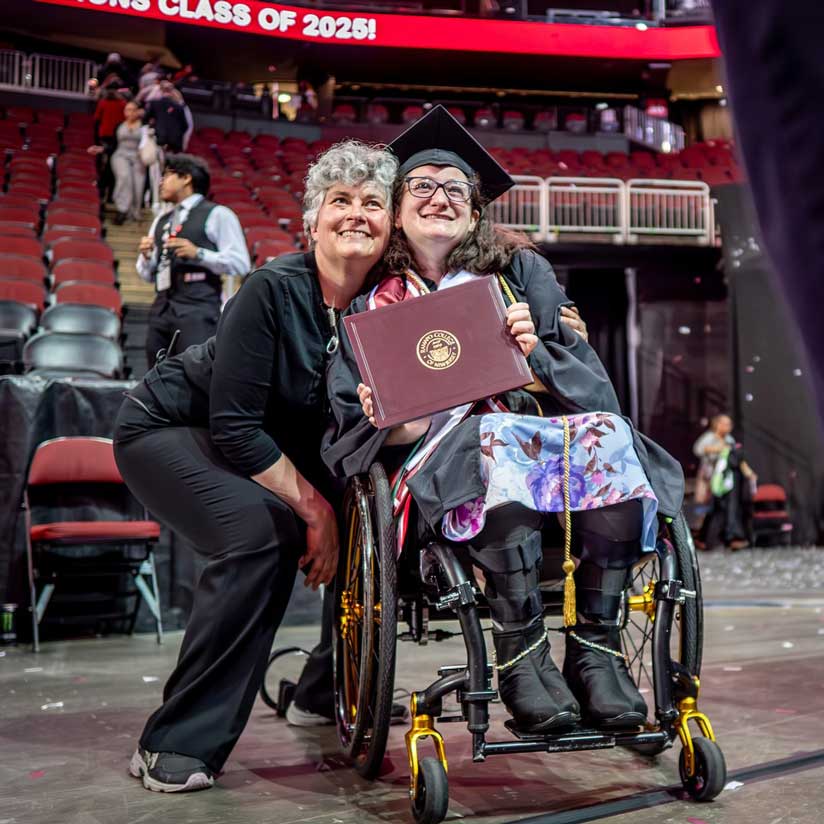
Nappi and Trish Laprey at Ramapo’s 2025 Commencement ceremony.
What skills that you learned at Ramapo do you still use today?
Ramapo taught me advocacy skills that I use every day. My professors taught me the history of disability rights, how I can attend college and navigate public spaces. They taught me how to ask for what I need and to stand up for myself as a person with a disability. Those skills I gained and the confidence to advocate for myself helped me develop as a clinician with a disability, apply those skills to working with people like me and help them build their lives back. Those skills are essential in my program, where I serve as the American Occupational Therapy Association representative for my cohort and continue to advocate accessible education. They also will be foundational in my future clinical work, especially as I pursue my goal of working in inpatient rehabilitation.
What made you decide to pursue adaptive sports?
Growing up, I was always athletic. I was a ski racer, ballet dancer, ski instructor and eventually worked as a ski patroller. Adaptive sports became a crucial part of my rehabilitation. When I started adaptive sports, it felt like coming home. I had felt for a long time like I was just trying to survive rather than challenge myself, and even my doctors put me in a bubble, saying “gentle swimming” was the best way to preserve my function. The challenge of learning new skills and pushing myself to my limits gave me something to work toward during recovery. Eventually, adaptive sports felt less like “rec therapy” and more just like doing sports and I just happened to be disabled.
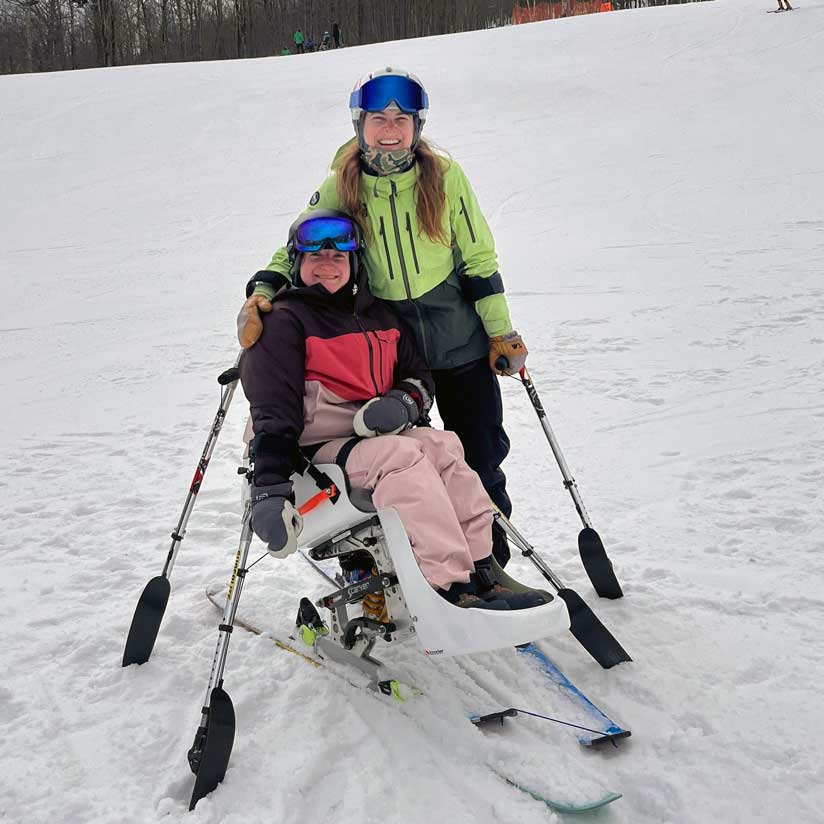
Nappi with Paralympic skier Kelsey O’Driscoll at Vermont Adaptive-Sugarbush Resort at Mt. Ellen.
What are one or two accomplishments you are really proud of?
I’m really proud to have returned to Ramapo after becoming disabled. It would have been easier to give up on higher education, but I chose to come back. I’m also proud of accepting the support of my community. As someone who worked in emergency medical services and was used to being the helper, learning to receive help was its own kind of strength. Now I’m proud to be pursuing my Occupational Therapy Doctorate at Rutgers School of Health Professions, where many faculty members have built their careers and continue to collaborate with Kessler Institute. Learning from the clinicians connected to one of the places that helped me rebuild my life feels like a full-circle moment.
What advice would you give to students or anyone looking to follow your path?
Sometimes the pivot you’re forced to make becomes the best thing that ever happened to you. When I had to leave EMS behind, I thought my health care career was over. Instead, I found occupational therapy, a field that lets me combine my clinical knowledge, my love of adaptive sports and my lived experience with disability. Don’t be afraid to reimagine what your path could look like. The detour might lead somewhere better than you originally planned.
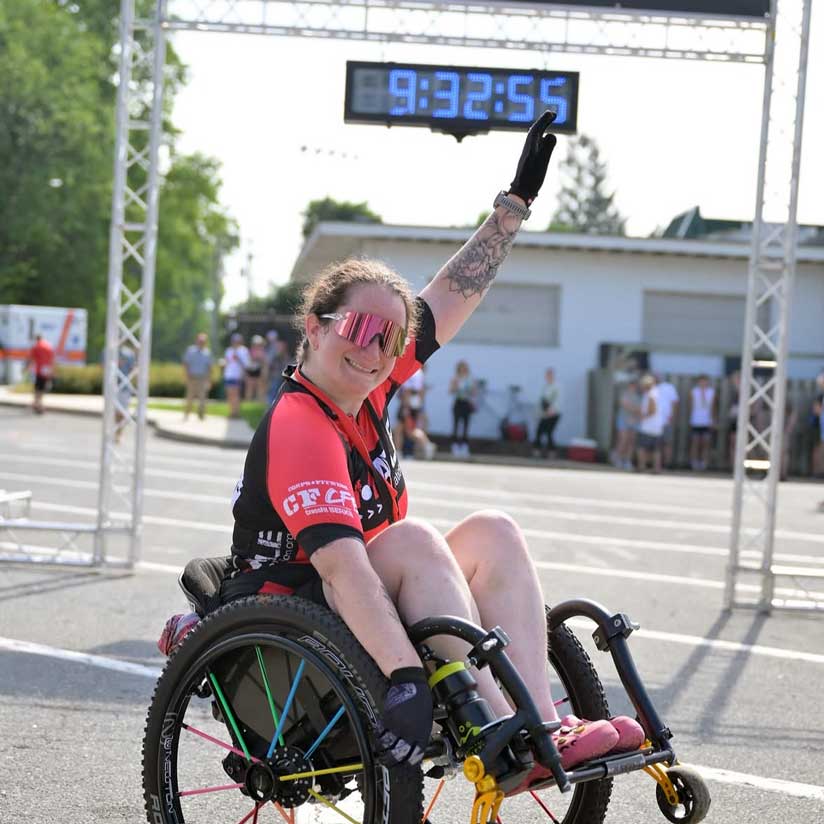
Emily Nappi at the IM ABLE Foundation’s Got the Nerve? Triathlon.
My work is about normalizing disabled health care providers and opening doors for my community.
Please tell me a bit more about your advocacy efforts. What have you done that has the most meaning to you?
My goal isn’t to inspire able-bodied people simply because they see a disabled person existing. My advocacy is about visibility and representation of disabled people in health care. I want to be visible to other people with disabilities so they know this career path is possible for them, that they can be competent clinicians too. When clinicians reflect the populations they serve, it improves care. It’s beneficial for our patients, for our health care system’s outcomes, and for our lives and our possibilities as disabled people, as individuals and as a community. My work is about normalizing disabled health care providers and opening doors for my community.