

Decoding
the Future of Health
Bioinformatics at Ramapo connects computation, biology and next-generation medical research.
By Mark Gregorio | Spring 2026
Biology and computer science once asked different questions about the world. One aimed to understand living systems while the other focused on logic, algorithms and machines. Today, those questions increasingly intersect. Modern science produces vast amounts of data, from genomes and proteins to health and environmental information, and understanding it requires computational tools alongside laboratory work. The discipline that unites these fields is bioinformatics.
At Ramapo College, bioinformatics has been part of that discussion for more than 20 years. The bioinformatics program was developed as biology entered a data-driven era, when advances in sequencing and computing began generating more scientific data than traditional methods could interpret. Today, Ramapo is known for preparing students to work at the intersection of biology, technology and data, an area transforming medicine, biotechnology and scientific research.
Faculty say the program’s strength comes from its interdisciplinary foundation, the cornerstone of Ramapo’s liberal arts curriculum. Students do not approach biology or computer science in isolation. Instead, they learn how the two fields inform each other, developing the flexibility needed in a rapidly changing scientific landscape.
That preparation has equipped Ramapo graduates to pursue their post-graduate academic careers at some of the nation’s top research universities, including Harvard, Columbia and Johns Hopkins, where they continue to explore the intersection of biology, data and advanced research that builds on the strong foundation they received at Ramapo.
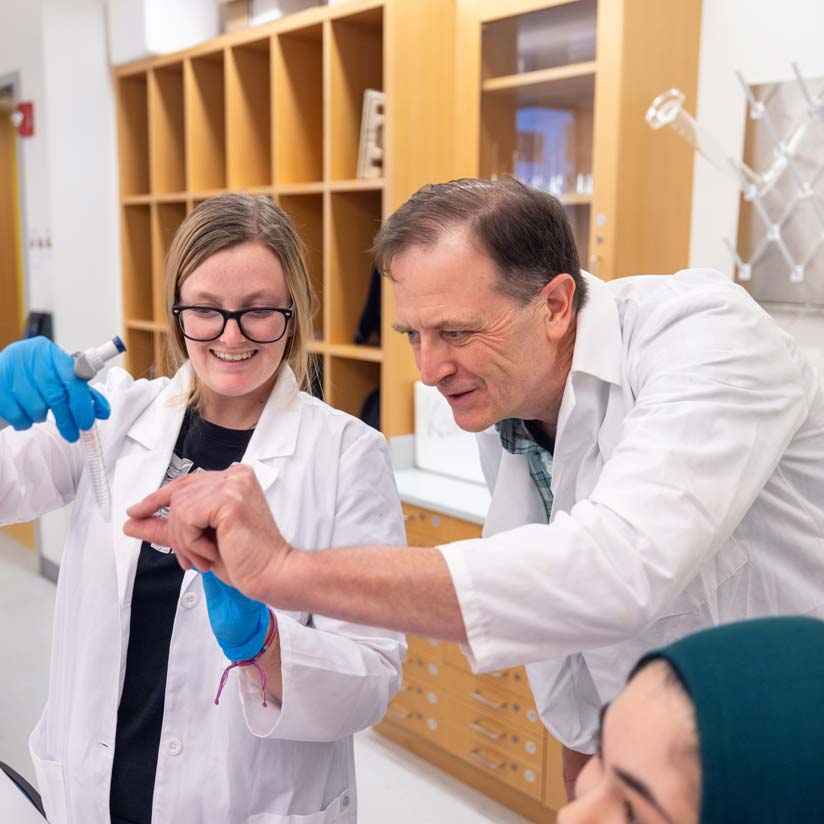
Ashley Stuart, right, associate professor of biochemistry, works with a student collecting laboratory samples.
What is bioinformatics?
Ashley Stuart, an associate professor of biochemistry whose work focuses on structural biology and computational modeling, explains bioinformatics simply: It helps scientists find meaningful patterns in complex biological data. Instead of studying one gene or protein at a time, researchers can analyze entire systems and better understand how biological processes interact.
As biology generates data on an unprecedented scale, this approach has become vital. Bioinformatics enables researchers to organize large data sets, recognize patterns and ask clearer questions about how biological systems work.
Paramjeet Bagga, a biology professor and founding faculty member of Ramapo’s bioinformatics program, says the field has sped up progress in areas such as disease diagnosis, drug development and vaccine research. He emphasizes that the quick development of COVID-19 vaccines showed how computational analysis of genetic data enabled researchers to work faster toward solutions and guide lab efforts more effectively. He explains that computational methods do not replace traditional science. Instead, they help scientists understand complex systems more clearly and allow them to focus their efforts more efficiently. A few years ago, four Ramapo alumni were part of Pfizer Inc.’s development of its mRNA COVID-19 vaccine, with members on the vaccine development and research informatics teams.
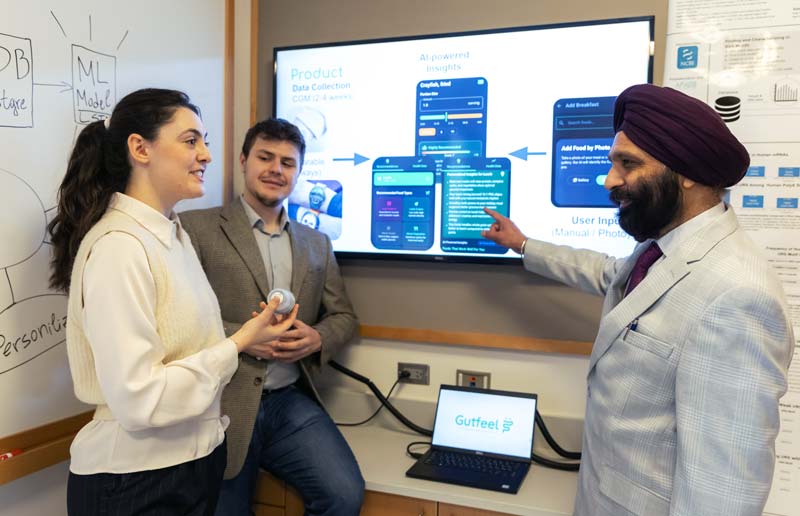
Paramjeet Bagga, right, a biology professor and founding faculty member of Ramapo College’s bioinformatics program, speaks with students Magdalena Nikolova, left, a senior biology and neuroscience major, and Hristo Denev, a senior computer science major, about their GutFeel research project.
Research with real-world impact
At Ramapo, bioinformatics extends beyond theory. Students frequently collaborate with faculty on research projects that use data analysis to solve real scientific problems.
One example is GutFeel, a digital health research project led by Bagga in collaboration with undergraduate student researchers. The project investigates how wearable biosensing data, including glucose monitoring, can help researchers better understand the connections between gut health and broader physiological responses.
Participants record meals and daily activities while faculty and student researchers gather physiological data from biosensors. The aim is to explore potential links between gut-related responses and biological markers, such as glucose changes and cardiovascular signals. Still in the exploratory phase, the research demonstrates a growing interest in personalized and preventive health care approaches.
Equally important is the way the work is conducted. Ramapo students actively engage in research, learning how to analyze real data sets and develop research questions instead of following prescribed experiments. Faculty emphasize critical thinking and adaptability rather than mastering any single tool. Students usually start working with biological data sets after they have built a foundational knowledge of biology and computer programming, often by their sophomore or junior year.
“It’s not about following instructions,” Stuart says. “Students learn to ask questions, analyze data independently and make connections. That’s when real research begins.”
“As I started working in labs, I realized that understanding how to obtain and analyze biological data was essential. Bioinformatics is the natural evolution of biology.”
Magdalena Nikolova
Biolgy and neuroscince student at Ramapo College
Learning at the intersection of science and technology
Many students are not familiar with bioinformatics before college. Magdalena Nikolova, a senior from Varna, Bulgaria, majoring in biology and neuroscience, says she learned about the field while working in research labs and studying how biological data is analyzed.
“As I started working in labs, I realized that understanding how to obtain and analyze biological data was essential,” Nikolova says. “Bioinformatics is the natural evolution of biology.”
Her experience mirrors a typical path in the program. Students move among biology, chemistry, computer science, data science and mathematics, gaining scientific knowledge and computational skills and learning to work across disciplines while engaging in projects with real-world applications.
Students involved in the GutFeel research share a similar experience. Hristo Denev, a senior computer science major, explains that the project demonstrated how computational and biological expertise together are used to explore important health problems. “Seeing how computer science and biology combine to create something with real-world impact made me realize these are the problems I want to work on,” he says.
Faculty say the program’s undergraduate focus enables students to gain hands-on research experience earlier than they might at larger universities. By the time they graduate, students often have both computational skills and laboratory research experience, an increasingly valuable combination in modern scientific careers.
Ramapo alumni have gone on to work at organizations such as Pfizer, Bristol Myers Squibb and Memorial Sloan Kettering Cancer Center, where bioinformatics plays a growing role in drug discovery, clinical research and precision medicine.
The future of bioinformatics
As biological data continues to grow, bioinformatics is expected to become increasingly important in areas such as personalized medicine and early disease detection. Bagga and Stuart emphasize that many of these applications are active research topics, but the trend is clear: Understanding biology increasingly depends on understanding data.
At Ramapo, that future isn’t seen from a distance; it’s being created in classrooms, research labs and student-led projects where biology and computation come together. By combining interdisciplinary teaching with hands-on research and early student involvement, Ramapo is shaping how future scientists approach data-driven discovery. Students graduate not only with technical skills but also with the ability to think across disciplines, ask better questions and turn complex data into meaningful insights. As science and technology continue to merge, Ramapo plays an essential role in preparing and guiding the future of bioinformatics.