

College
A Decade of Innovation
in the Les Paul Studio
By Mark Gregorio | Spring 2026
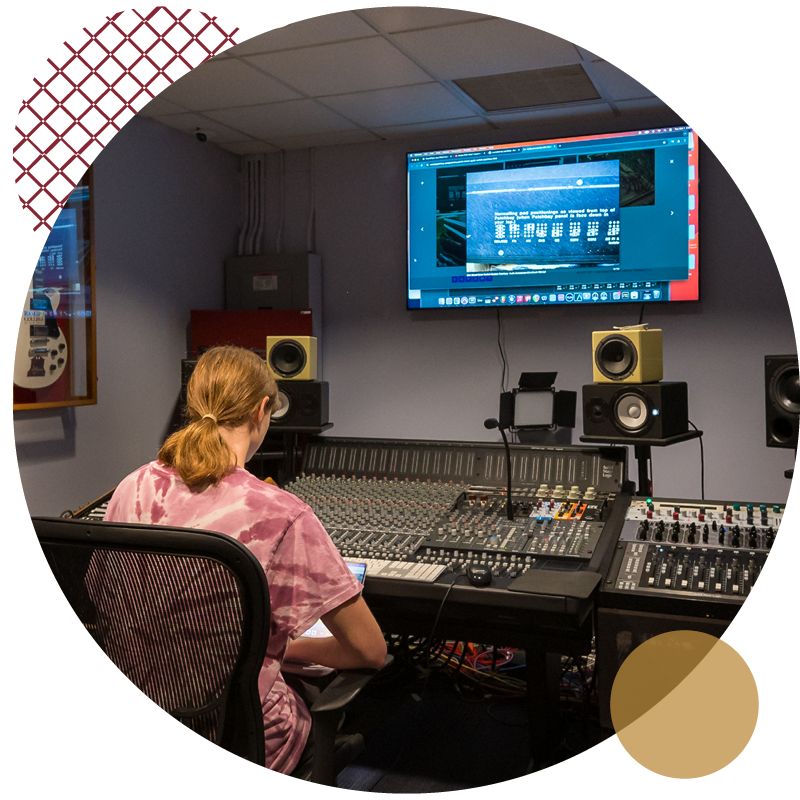
On any given day, the Les Paul Studio at Ramapo College of New Jersey feels less like a classroom and more like a recording session in progress. In a professional studio, musicians, producers and engineers work together to capture performances as they happen, shaping music in real time. That same energy defines the space at Ramapo. Students move between soundproof recording booths and the control room, setting microphones and recording tracks. The steady hum of equipment and glow of studio monitors make it clear that this is a creative workspace, not a traditional lecture setting.
The atmosphere is intentional. The Les Paul Studio is a fully operational recording facility within Ramapo College, equipped with mixing consoles, microphones and recording tools similar to those used in professional studios across the New York area. Students learn by working as professionals, recording bands, producing original music and completing projects in a collaborative environment where coursework reflects hands-on experience.
“What the Les Paul Studio allowed us to do was give students the experience of working in a professional recording environment,” said Ben Neill, professor emeritus and founding director of Ramapo’s Master of Fine Arts (MFA) in Creative Music Technology.
For students studying music production and sound recording, the studio shifts learning from theory to practice. Instead of simulating studio work on laptops, students collaborate in a space designed for real-world production.
A Revolution in Learning
As Ramapo’s music production program continued to grow, so did opportunities for students to engage more deeply with recording, performance and collaborative creative work. The Les Paul Studio marked an important evolution, expanding the program’s ability to support hands-on learning at an even higher level.
“Our students would go into internships and suddenly find themselves surrounded by equipment they hadn’t yet worked with,” Neill said. “Having access to that experience on campus made a real difference.”
The studio brought those experiences directly into the learning environment. Today, capstone projects, ensemble recordings, faculty collaborations and graduate-level work take place in settings that mirror what those students encounter professionally after graduation. The impact is immediate and lasting. Students graduate from Ramapo with confidence in their abilities, experience working collaboratively and portfolios that reflect real creative production, often recording original work while still enrolled.
Where Students Become Artists
For Daniel Fishkin, assistant professor of music production, the studio serves as a teaching space and the program’s creative engine.
“The studio is our lab,” Fishkin said. “It’s where experimentation actually happens.”
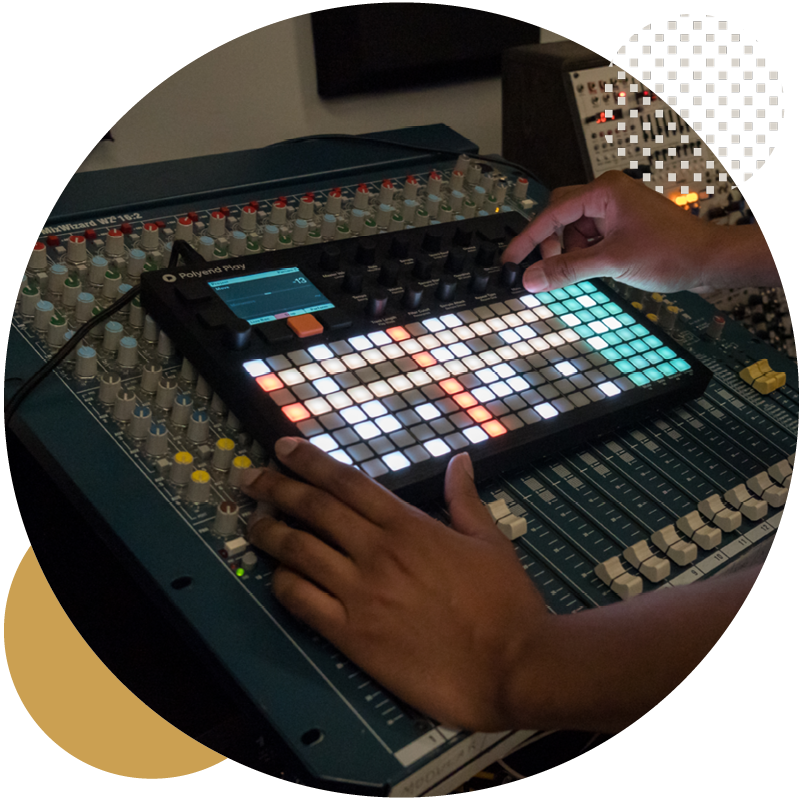
Unlike many college studios that are primarily software-based, the Les Paul Studio emphasizes physical tools, consoles, microphones and analog equipment that encourage intentional decision-making. Students learn by shaping sound through experimentation rather than by relying on presets, reflecting a professional studio culture where there is no single correct approach, only informed creative choices.
That access changes how students see themselves, Fishkin said. “The students who really thrive here aren’t only completing assignments,” he said. “They’re working as artists.”
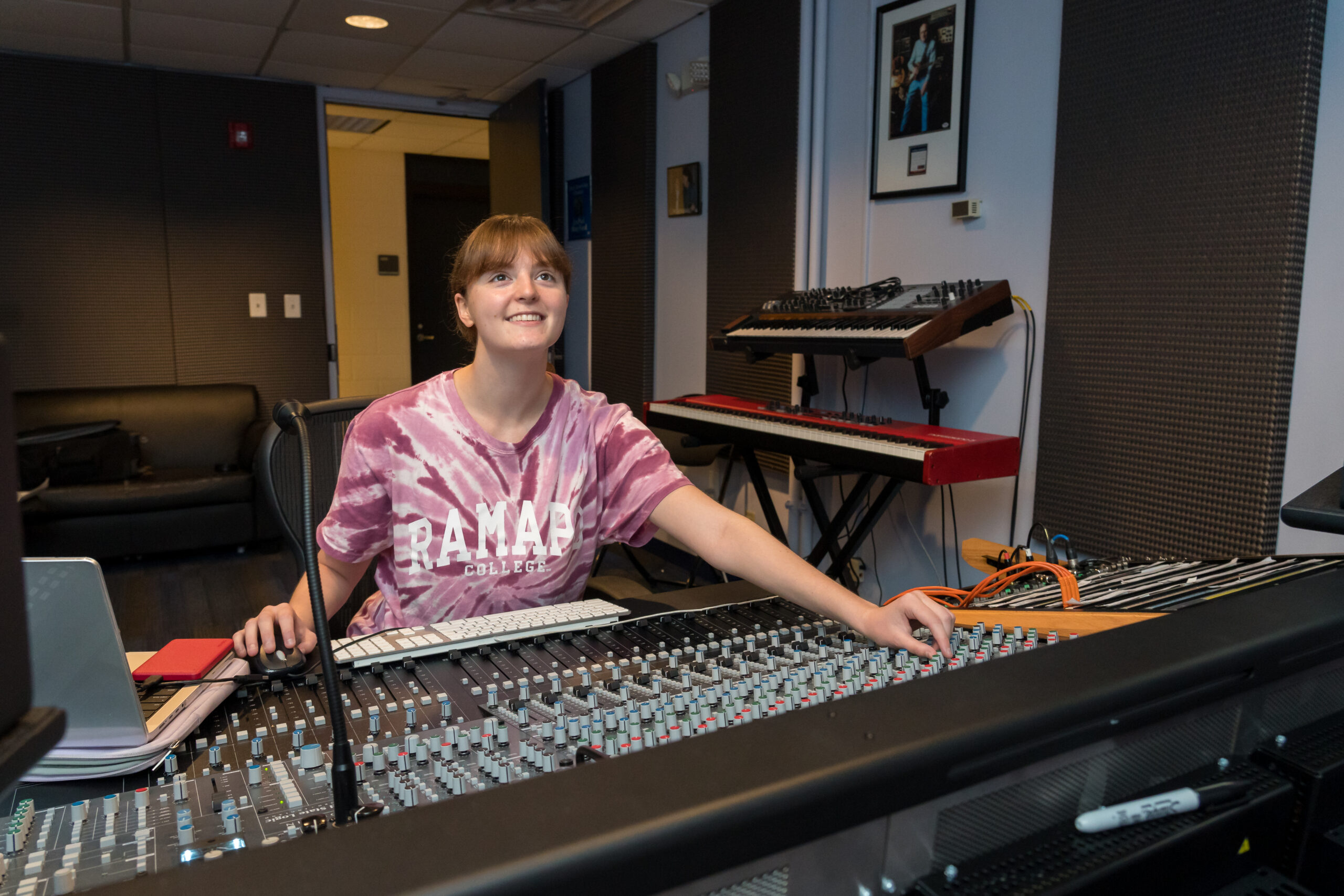
That transformation is reflected in the experience of graduate student Lachlan Strain ’25, a Ramapo undergraduate alumnus whose time in the Les Paul Studio spans both degrees. Introduced to the space as an undergraduate, Strain said the studio’s scale and quality expanded his expectations of what was possible as a student musician. Much of his early work had taken place on a laptop. The studio introduced him to professional workflows and collaborative recording environments that reshaped his creative process.
“The big thing about the studio is that when you walk in, you feel like you’re in a space meant for creation,” Strain said. He added that working alongside classmates changed how he approached collaboration. “You’re not just working on your own music anymore,” he said. “You’re learning how to listen, communicate and build something together.”
While working on his senior capstone project, Strain recorded and mixed original songs with classmates, who became ongoing collaborators. The experience transformed the studio from a classroom into a creative community, ultimately influencing his decision to continue his studies in Ramapo’s MFA program.
That ethos, which promotes experimentation without strict boundaries, influences how students approach music and technology. “The studio teaches students there’s no single method,” Fishkin added. “Only the work itself.”
“You’re not just working on your own music anymore.
You’re learning how to listen, communicate and build something together.”
— Lachlan Strain
Why Les Paul Matters Here
The studio’s name is no coincidence. Les Paul not only was a legendary guitarist but also a relentless innovator who helped redefine how music is created, recorded and experienced. His experiments with multitrack recording and sound layering changed the recording process, influencing generations of musicians and producers.
That spirit of experimentation aligns closely with Ramapo’s philosophy. “We never wanted to be a ‘button-pushing’ program,” said Neill. “We wanted to train musicians who think creatively and technologists who understand music.”
That shared vision drew the attention of the Les Paul Foundation, whose mission is to preserve Paul’s inventive spirit through education. In 2013, the foundation awarded Ramapo a $150,000 grant, matched by the College, to help build a studio that reflects that approach to learning.
Ramapo was also a natural fit because of its local connection to Paul. He lived in Mahwah for more than 50 years, working from his home studio and remaining closely tied to the community until his death in 2009. The studio’s presence on campus continues that connection, linking Paul’s legacy of innovation directly to the next generation of musicians and producers.
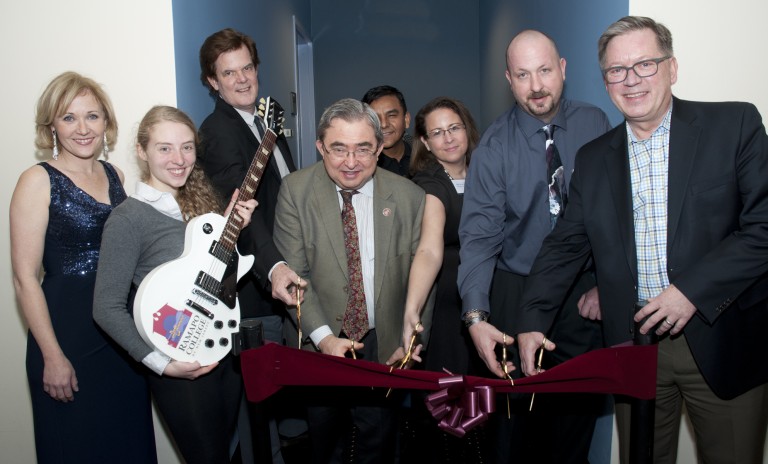
The ribbon cutting at the Les Paul Studio in 2016.
Today, that legacy is most evident in how students use the space, experimenting, collaborating and finding their creative voice.
“Back in the ’70s and ’80s, almost no one was doing this,” Neill said. “Ramapo was.”
As demand for music production education grew, the studio transitioned from a nice addition to an essential facility. After years of planning, building and selecting equipment, the Les Paul Studio officially opened in 2016 and has continually improved through regular upgrades that meet industry standards.
Beyond the Classroom Walls
The studio’s influence extends beyond coursework. Faculty use it for professional recordings and research-based creative projects, blurring the line between academic work and artistic practice. Neill recorded his opera “Fantini Futuro” in the Les Paul Studio, later performing it in Venice while continuing work toward its release – an example of how the space functions not only as a classroom but also as a working creative environment.
That creative momentum increasingly extends beyond campus. In November, students in Ramapo’s Creative Music Technology MFA program transformed Fridman Gallery in New York City into an immersive sound installation inspired by composer and performer David Tudor’s “Rainforest.” The event, Rainforest+, reimagined Tudor’s concept of an “orchestra of loudspeakers,” where everyday objects became instruments vibrating and resonating to create a living soundscape. MFA students designed and performed original responses to Tudor’s work, turning the gallery into an evolving sonic environment shaped by experimentation, collaboration and audience interaction.
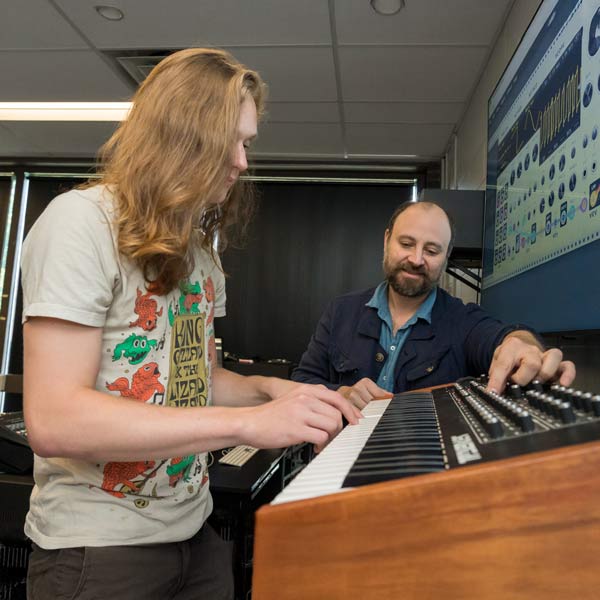
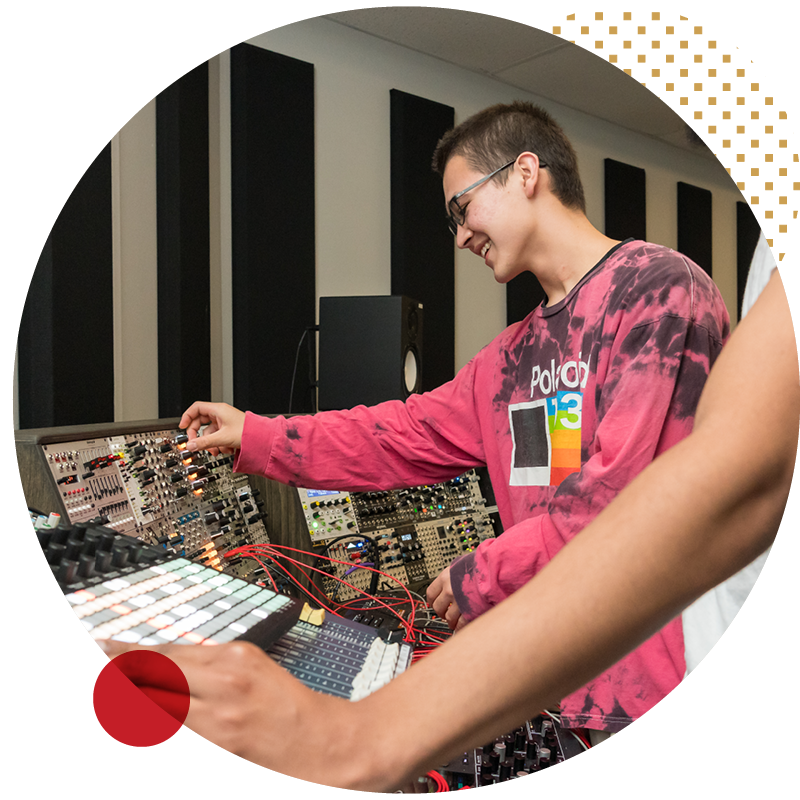
Associate professor of music Zach Layton works with a student, demonstrating sound design and synthesis techniques during a music production session.
For faculty and students alike, projects like this reflect how the Les Paul Studio functions as a starting point rather than an endpoint. Ideas developed in the studio move outward into professional venues, connecting Ramapo’s creative work to broader artistic conversations. The experience mirrors the program’s philosophy: Learning happens not only through instruction but also through making, performing and sharing work in real-world contexts.
Although more institutions are investing in music technology, Neill believes that Ramapo’s early commitment to music technology and its liberal arts environment set it apart. “Technology will keep changing,” he said. “But the ability to think musically, creatively and critically, that’s what lasts.”
Ten years in, the Les Paul Studio remains one of Ramapo’s most distinctive academic spaces, honoring a legendary innovator while preparing students to help shape the future of the music industry. “The studio gives you the chance to take your work seriously,” Strain said. “You’re surrounded by people who want to make something real, and that pushes you to grow. A decade later, it’s still a place where students can walk in with an idea and leave with something they never thought they could make.”